

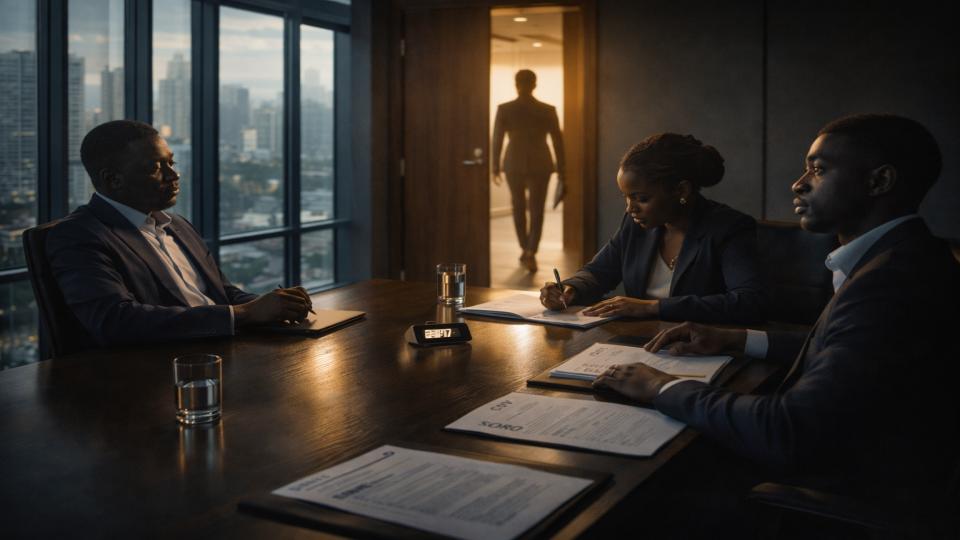
You gather your folio from the table. You thank the panel. You walk to the door with the straightest back you have managed all morning, turn the handle, and step into the corridor. The door closes. You exhale for the first time in forty minutes and reach for your phone. Behind that door, three people are still seated. Nobody has moved yet. The senior manager is clicking his pen. The HR lead is already writing. The line manager is looking at the ceiling. And they are talking about you.
Most career advice stops at the interview itself. It covers how to answer questions, how to dress, how to manage nerves, and how to close strong. Very little of it addresses what happens on the other side of the door after the candidate leaves, even though that ten-minute window is often where the actual hiring decision is made. This article takes you inside that room. It describes the conversations that happen, the criteria that get weighted, the instincts that get trusted, and the moments from your interview that the panel is still replaying and debating while you are standing in the elevator.
Understanding what happens in that room does not just satisfy curiosity. It changes how you prepare, how you answer, how you close, and how you conduct yourself from the moment you enter the building to the moment you walk back out through it. Because everything that happens in those ten minutes traces directly back to what you did and said in the forty minutes before them.
The conversations and panel dynamics described in this article are drawn from observable patterns across Nigerian hiring culture in banking, fintech, oil and gas, and the public sector, informed by the experiences of professionals who have sat on hiring panels across these industries. Individual names and specific companies are not referenced. The goal is to describe truthfully what the post-interview deliberation process looks like in Nigerian corporate settings, not to expose any specific organization.
The First Thirty Seconds: The Reaction Nobody Tells You About
The first thing that happens after you leave is almost always the same, regardless of sector, regardless of company size, regardless of how structured the interview process was supposed to be. Somebody on the panel says something. It might be a word. It might be a sound. It might be a look exchanged across the table. But some immediate, unfiltered reaction to the candidate escapes the room within the first thirty seconds, and that reaction carries enormous weight.
In Nigerian corporate interviews, this first reaction is heavily influenced by what researchers call thin-slicing: the human capacity to draw surprisingly accurate conclusions from very brief exposures. The panel member who says “this one has it” or “I am not sure about this one” in the first thirty seconds after you leave is not usually being arbitrary or unfair. They are surfacing an accumulated impression formed across the entire interview that they have not yet articulated as words. They are articulating it now.
What feeds this impression most strongly? The moments of your interview that felt most natural or most strained. The answer where you lit up versus the answer where you went visibly flat. The way you entered the room and whether that energy sustained itself or collapsed halfway through. The moment a difficult question landed and whether you took it in stride or let it rattle your composure for the next three answers. All of these become the material of the first thirty-second reaction.
● Inside the Room: Nigerian Bank Interview, Mid-Level Operations Role
Senior Manager “Solid on the technical questions. Very solid. But did you notice she never once asked us anything? Not a single question about the team, the role, nothing.”
HR Lead “I noticed. I have her down as strong on knowledge but I am less sure about fit. The questions a candidate asks tell you a lot about how they think about the work.”
Line Manager “She asked one question. At the end. About the salary review timeline. Which, fine, but that was the only thing she wanted to know?”
Senior Manager “Let us see the scores before we decide anything. But that part stays with me.”
This exchange represents a pattern observed across Nigerian banking and financial services interviews. Candidates who ask no questions, or whose only question is about compensation, are frequently flagged for fit concerns regardless of technical performance.
Minutes One to Three: The Score Sheet Conversation
Most structured Nigerian corporate interviews use a scoring framework. The interview panel has been given a set of criteria, weighted by importance, against which each candidate is supposed to be rated numerically or categorically. In theory, the debrief after each candidate should be an objective comparison of scores. In practice, the conversation is much messier and more human than the scoring sheet suggests.
What typically happens in minutes one to three is that panel members compare their scores and immediately surface the disagreements. One panel member rated you a four on “communication skills.” Another gave you a two. That gap does not resolve itself quietly. It generates a conversation, and that conversation is where the real evaluation of your interview performance happens.
The panel member who gave you the higher score will argue for the moments in your interview that justified it. The one who gave the lower score will argue for the moments that justified theirs. The candidate who wins these arguments is almost never the one who gave the most technically correct answers. It is the one who gave answers that were specific, memorable, and emotionally resonant enough to be defended convincingly by at least one panel member who believed in them.
Panel members who were impressed or troubled by a specific answer will quote it directly during the debrief. The answers you think were unremarkable are often the most quoted. The answers you were proudest of are sometimes never mentioned.
In almost every interview debrief, one panel member becomes the informal advocate for a candidate. If nobody on the panel felt strongly enough about you to advocate for you in this moment, the conversation moves quickly to the next candidate.
The Things Panel Members Say That Never Appear on Any Score Sheet
The most consequential parts of the post-interview conversation are almost never captured by any formal scoring framework. They are the observations, impressions, and instincts that panel members share with each other in the informal register of professional conversation. Understanding what kinds of comments are made in this space, and what candidate behaviors generate them, is perhaps the most practically useful thing this article can offer.
● Inside the Room: Nigerian Fintech, Senior Product Role
Product Director “The answers were good. Everything was good. But I kept feeling like he was performing good answers rather than actually thinking. Does that make sense?”
HR Manager “It makes sense. I noticed he paused very little before any answer. Everything came too quickly and too smoothly. Even the hard question about the product failure.”
Panel Member “That product failure answer was rehearsed. You could tell. It had a beginning, a middle, and a lesson at the end that sounded like it came from a book. I am not saying it was wrong. I am saying I do not know if he actually learned it or just knows how to say he did.”
Product Director “That is exactly what I am sitting with.”
Overpreparation that removes the genuine thinking process from your answers is one of the most common concerns raised in Nigerian fintech and tech sector interview debriefs. Structured answers are valued but polish that eliminates authenticity creates doubt.
This kind of observation, one that has nothing to do with what the score sheet measures, is what often determines the outcome for candidates in the middle of the scoring range. The candidates who score clearly at the top and clearly at the bottom are relatively easy decisions. The candidates in the contested middle are decided by these informal impressions, and the impressions are formed by things most candidates have never been told to pay attention to.
● Inside the Room: Nigerian Oil and Gas Company, Graduate Engineer Role
Head of Engineering “She knew her stuff. Genuinely. But the moment we asked about the incident she had mentioned on her CV, she changed. Her voice dropped, she stopped making eye contact. I need someone who can hold composure when things go wrong on a platform, not just when questions are easy.”
HR Lead “That was noticeable. One difficult follow-up and she completely deflated.”
Technical Assessor “I want to give her the benefit of the doubt. That incident clearly affected her. Maybe that sensitivity is actually good for safety culture.”
Head of Engineering “Maybe. But we are not hiring a safety culture poster. We are hiring someone who will be the engineer on call when something real happens. I need to see steadiness under that kind of pressure.”
The ability to maintain composure when a difficult or unexpected question arrives is one of the most discussed qualities in post-interview debriefs across all Nigerian sectors. Candidates who visibly deflate under pressure are consistently noted even when their technical answers were strong.
How the Post-Interview Conversation Differs Across Nigerian Sectors
The ten-minute debrief does not look the same in every Nigerian company. The culture of the organization, the seniority of the role being filled, and the professional norms of the sector all shape what panel members prioritize when they discuss a candidate after the door closes. Understanding these differences helps you think about how to weight different aspects of your preparation depending on where you are interviewing.
Nigerian bank interviewers spend significant time in debriefs discussing whether a candidate seemed trustworthy. Eye contact during sensitive questions, consistency between what the CV claims and what the candidate said in the room, and the quality of the candidate’s response when asked about a past professional difficulty are all weighted heavily. Compliance culture in banking means that red flags around honesty, however small, are taken disproportionately seriously.
In fintech debrief conversations, panel members are less interested in whether answers were technically correct and more interested in the quality of thinking the answers revealed. Did the candidate approach the problem in an interesting way? Did they acknowledge complexity rather than oversimplify? Did their thinking feel original or were they clearly retrieving rehearsed frameworks? Candidates who think visibly and interestingly are favored over those with polished but hollow answers.
Post-interview debriefs in oil and gas companies consistently return to the question of how the candidate handled the moments of unexpected difficulty in the interview. The sector’s safety culture means that the ability to remain clear-headed, organized, and steady when things go sideways is the quality that interviewers are specifically watching for throughout the session. Candidates who maintained composure during difficult follow-up questions are discussed as much as those who gave the best technical answers.
In federal and state government interview debriefs, panel members pay particular attention to whether the candidate demonstrated respect for institutional hierarchy, awareness of how government processes work, and the kind of patient, detail-oriented temperament that public sector work requires. Candidates who came across as eager to disrupt existing processes or who seemed impatient with procedural thoroughness are frequently noted unfavorably regardless of their technical qualifications.
The interview ends when you leave the room. The evaluation of your interview does not end until the panel stops talking. And what the panel talks about is almost never what you thought was most important while you were sitting there.
Minutes Four to Seven: When the Contested Candidates Are Decided
The candidates in the middle of the scoring range, those who did well enough to still be in contention but not so outstandingly that the decision is obvious, are where most of the post-interview deliberation time is spent. This is where the informal observations become decisive. This is where the panel member who noticed something small but significant pushes it into the conversation and finds out whether the others noticed it too.
One of the most consistent patterns in Nigerian interview debrief conversations is what might be called the moment of doubt. Every panel member carries at least one moment from every candidate’s interview where something felt slightly off, slightly inconsistent, or slightly unclear. In the debrief, these moments surface. When multiple panel members share the same moment of doubt about the same candidate, the outcome shifts regardless of how strong the rest of the interview was.
Across Nigerian banking, fintech, oil and gas, and government sector interview debriefs, the single most frequently cited reason for not advancing a contested candidate is this: “I could not tell whether they were being genuine.” Authenticity is not a soft skill in the Nigerian hiring conversation. It is the primary quality that distinguishes a candidate who performed well from one who is trusted enough to be offered a role. Panel members can tolerate a weaker answer from a candidate who seems genuinely thoughtful more easily than they can tolerate a polished answer from someone who seems to be managing an impression rather than having a conversation.
Minutes Seven to Ten: Reference Signals and the Final Working Verdict
In the final minutes of the post-interview debrief, the conversation typically broadens beyond the formal evaluation and into the informal intelligence that panel members bring to the room. Who else knows this candidate? What has been heard about them through professional networks? Does anyone on the panel have a connection to their previous employer or to someone who might know their work?
Nigeria’s professional landscape, particularly in Lagos and Abuja across banking, fintech, and oil and gas, is smaller than it appears. Panel members frequently know people who know the candidates they are interviewing, and this informal reference network operates in parallel with the formal interview process. A panel member who worked previously at the same company as a candidate and has a positive or negative impression of that person’s professional reputation will share it in this part of the conversation.
This is not unfair in the way that it might first appear. In a market where reference checks are inconsistent and formal background verification is variable, the informal professional network functions as a credibility layer that panels rely on. What it means practically is that your professional reputation, how you conduct yourself with colleagues, how you handle difficulty at your current or former employer, and what people say about you when you are not in the room, is a dimension of your interview performance that begins long before you enter any interview room.
A growing number of Nigerian interview panels, particularly in fintech and the private sector, will pull up a finalist candidate’s LinkedIn profile during or immediately after the debrief. Not to verify employment history, which has already been done. To look at the quality of their professional presence, what they post, how they engage with their industry, what their recommendations say, and whether their digital professional identity is consistent with the person who just sat across the table. A LinkedIn profile that has not been updated in two years or that shows no professional engagement with your industry is noticed in this moment. A profile that shows genuine thought leadership and community in your sector works in your favor even after you have left the building.
What You Can Do Differently: Preparing for the Room You Never Enter
Understanding what happens in the post-interview debrief does not change what you can do in the interview itself. But it changes how you think about what matters. The following actions are specifically designed to influence what is said about you after the door closes, not just how you perform while it is open.
The candidate who gets the offer in a contested debrief is almost always the one who gave at least one answer that a panel member found genuinely memorable and was willing to argue for. Generic, technically correct answers give panel members nothing to advocate with. Specific, honest, and unexpectedly candid answers give them material. Think about which two or three answers in an interview you want to be the ones quoted in the debrief, and prepare those answers with that level of specificity and authenticity.
The exchange in the banking interview above ended with the observation that the candidate asked only about salary review timing. Prepare three to four questions that demonstrate you have thought seriously about the work, the team, the challenges of the role, and the direction of the organization. Questions about how success is measured in the first six months, what the biggest challenge the team is navigating right now, and what the panel member finds most interesting about their own work in the organization are all questions that generate positive conversation in the debrief even when the panel has moved on to your scores.
The moment at which most candidates visibly relax is the closing phase of the interview when they sense the formal questioning is ending. This relaxation is readable and it is noted. The composure you carry yourself out of the room with is the composure that the panel replays when they are discussing you two minutes later. Stay present, engaged, and steady until the door actually closes behind you. The debrief starts with the last impression, not the first.
The informal reference network that operates in Nigerian professional circles means that your reputation is already in the room before you arrive. The quality of your LinkedIn profile, what former colleagues say about your work, and how you have conducted yourself at previous employers are all inputs to a conversation that starts before you answer the first question. Building and maintaining a genuine professional reputation in your sector is not a long-term vanity project. It is interview preparation that starts today and compounds over years.
The fintech panel conversation above ended with doubt about whether the candidate actually learned from a failure or just knew how to say he did. The way to avoid this doubt is not to stop preparing your answers. It is to prepare them honestly enough that they contain genuine complexity and genuine uncertainty where that uncertainty actually exists. A failure story that ends with a clean lesson and a bow on top sounds rehearsed because growth rarely works that cleanly. A failure story that ends with “and I am still working out exactly what I should have done differently” sounds like a person who is genuinely thinking about it. Panels know the difference.
Nigerian hiring managers across banking, fintech, oil and gas, and the public sector are all asked the same question when they describe the candidates they most wanted to hire after a debrief: what was different about them? The answer is almost always a variation of the same observation. They felt like a real person having a real conversation rather than a candidate performing an interview. That quality, the sense that someone is genuinely present and genuinely themselves rather than executing a practiced routine, is what generates the kind of post-interview conversation that ends with someone saying “we should move on this one before someone else does.” Everything else, the preparation, the structure, the research, the dress, the composure, is the foundation that makes that quality possible to project. But that quality is what the debrief ultimately decides on.
The Door Closes. The Conversation Begins. Make Sure You Are Worth Talking About.
The ten minutes after you leave a Nigerian job interview are not a mystery to be anxious about. They are a conversation to prepare for. A conversation where your answers are replayed, your composure is remembered, your questions are discussed, and your overall impression on the people in that room is weighed against every other candidate who sat in the same chair before and after you.
The candidate who wins that conversation is not always the one with the best CV or the most technically correct answers. They are the one whose answers were specific enough to be memorable, whose composure was steady enough to be trusted, whose questions were thoughtful enough to signal genuine interest, and whose overall presence in the room felt like a real professional having a real conversation rather than someone auditioning for a role they had been told how to audition for.
That distinction is within reach for every Nigerian job seeker who is willing to prepare for the room they never enter, not just for the one they do. Understand what happens when the door closes and you will prepare differently. Prepare differently and the conversation on the other side of that door will be a different one.
