

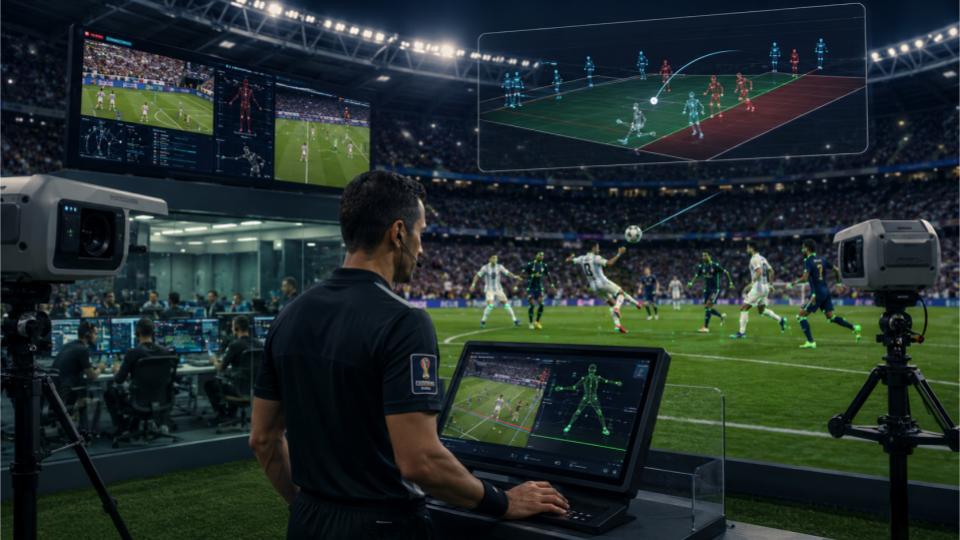
The whistle is no longer the final word. At this year’s World Cup, artificial intelligence is watching every limb, every millimetre, and every millisecond. Here is the full breakdown.
| Semi-Automated Offside Technology (2026) | Performance Metric |
|---|---|
| 📹 Tracking Cameras per Stadium | 29 |
| 🏃 Body Points Tracked per Player | 50 |
| ⚡ Frames Captured per Second | 500 FPS |
| ⏱️ Average Offside Decision Time | Less Than 1 Second |
There is a moment every Nigerian football fan knows well. The referee blows his whistle, raises his flag, and an argument erupts that lasts for days. Was Musa onside? Did that touch happen inside the box or out? The stadium replay is inconclusive, the pundits disagree, and the Super Eagles either celebrate or suffer based on a decision made by a human being standing sixty metres away from where it happened.
That argument is becoming much harder to have in 2026. At this year’s FIFA World Cup hosted across the United States, Canada, and Mexico, a suite of artificial intelligence tools, multi-angle camera networks, and real-time 3D body mapping systems has fundamentally changed what it means to referee a football match at the highest level. The technology that FIFA has deployed is not a patch on what existed before. It is a different system entirely, and it is worth understanding properly because it is already changing how matches are decided and it will eventually change how football is governed and broadcast everywhere, including Nigeria.
What Refereeing Looked Like Before AI Entered the Picture
Historical Context
Football referees have always carried an impossible job description. They are asked to be in the right position at all times, track twenty-two players simultaneously, measure distances with their eyes, and make decisions in fractions of a second that can determine which team advances in a tournament worth billions of dollars. For most of football’s history, the tools available to them were their eyes, a whistle, and an assistant with a flag on the touchline.
VAR, the Video Assistant Referee system, arrived at the 2018 World Cup in Russia and was immediately both celebrated and criticised. It gave referees the ability to review contentious decisions using video footage, which reduced outright errors in clear goal or no-goal situations and in penalty decisions. But it also introduced new problems. Reviews were slow. The offside line-drawing process was manual and therefore open to human error. Lines were drawn over broadcast camera footage that was not always perfectly calibrated. Fans sat in stadiums for three and four minutes while officials stared at screens and drew lines across freeze-frames.
At the 2022 World Cup in Qatar, FIFA introduced the first version of semi-automated offside technology as a pilot programme, and the results were significant enough that for 2026 the system has been expanded, refined, and integrated with additional layers of AI processing. What exists now at the 2026 World Cup is a genuinely new architecture for decision-making in football.
Semi-Automated Offside Technology: What It Actually Does
Core Technology
The term semi-automated offside technology, or SAOT, gets used a lot in football broadcasts without much explanation of what is actually happening inside the system. The name itself is important. It is called semi-automated because a human official still makes the final call, but the data underpinning that call is generated entirely by machine. The technology does not replace the referee. It gives the referee information that no human being could independently gather and verify in real time.
Here is the sequence. During live play, a network of dedicated tracking cameras installed around the stadium continuously captures the positions of all players on the pitch. This is not broadcast camera footage repurposed after the fact. These are purpose-built limb-tracking cameras running at very high frame rates, feeding data to a central AI processing unit. The moment a pass or through-ball is played, the system identifies the exact frame in which the ball leaves the passer’s foot, locks the positions of all relevant players at that moment, and calculates whether any attacking player has any part of their body that can legally score a goal further forward than the second-last defender.
The output arrives within seconds. The VAR team receives a three-dimensional reconstruction of the relevant moment, not a flat two-dimensional image with a manually drawn line, but a spatial model that accounts for camera angle distortion and body lean. The assistant referee in the stadium is no longer trying to hold a mental snapshot of where everyone stood while deciding whether to raise the flag.
How the system decides
Step 1: Tracking cameras identify the moment of pass using ball sensor data and visual detection simultaneously.
Step 2: All 29 body landmarks across every player are recorded at that frame.
Step 3: A 3D spatial model is generated within milliseconds.
Step 4: The system flags any potential offside to the VAR team.
Step 5: A human official reviews and confirms. The animation is then sent to broadcast.
The 3D Body Scan: Tracking 50 Points on Every Player, Every Second
Biomechanics in Real Time
This is the part that genuinely surprised many people when it was first explained publicly. The cameras used in the 2026 World Cup stadiums are not simply tracking where players are on the pitch as a whole. They are tracking up to 50 individual data points on each player’s body, including the tips of shoulders, elbows, hips, knees, ankles, and feet, continuously and simultaneously across all players in frame.
The reason this level of detail matters goes back to a fundamental aspect of the offside law. The rule states that a player is offside if any part of their body that can be used to score a goal is in an offside position. A shoulder counts. An armpit counts. But the arm does not, because you cannot score with your arm. For the previous generation of VAR technology, drawing an accurate line across a video freeze-frame that correctly identified where a player’s shoulder ended was a genuinely difficult problem. Human operators had to make that judgement while looking at a two-dimensional image of a player in motion.
The 3D body scan eliminates that ambiguity. Because the system is tracking skeletal keypoints rather than just the outer edge of a player’s kit, it can calculate the exact three-dimensional position of a shoulder or heel even when the player is twisted away from the camera or partially obscured by another player. The system does not guess. It interpolates from multiple camera angles simultaneously to construct a spatial coordinate for each tracked body point with very high accuracy.
Nigerian Perspective
Nigerian football fans watching the Super Eagles’ qualification journey through the 2026 World Cup campaign will remember several close offside calls that defined crucial matches. The introduction of 3D body tracking means that those millimetre decisions that previously generated weeks of argument now come with spatial data that is far harder to dispute, for better or worse.
The Camera Network: 29 Dedicated Eyes Inside Every Stadium
Infrastructure
A standard broadcast setup for a major football match involves multiple cameras positioned around the stadium, but those cameras are primarily serving the television director rather than the referee. Their angles are chosen for aesthetics and storytelling, not for optimal tracking geometry.
The camera infrastructure installed specifically for refereeing purposes at the 2026 World Cup operates on a completely different logic. Each stadium hosts a dedicated network of tracking cameras positioned at heights and angles calculated to maximise body-point detection coverage across all areas of the pitch. The cameras are synchronised to a shared clock with microsecond precision so that data from different angles can be fused into a single spatial model without timing errors.
These cameras are also not standard commercial broadcast units. They are high-frame-rate machine vision cameras that prioritise capture speed and data output over the colour fidelity and cinematic quality that broadcast cameras chase. They run continuously throughout matches, not just when a decision is being reviewed, generating a live stream of positional data that the AI processing system ingests and analyses in real time.
The volume of data produced by this network during a single ninety-minute match is substantial. Every second, the system is processing the skeletal positions of up to twenty-eight players plus the two goalkeepers, each with 50 tracked body points, at frame rates high enough to capture the moment of any pass. The computing infrastructure required to handle this at stadiums spread across three countries is a logistical achievement in its own right.
| Feature | Traditional VAR (2018-2022) | AI-Assisted System (2026) |
|---|---|---|
| Offside Line Drawing | Manual, operator-drawn | Automated, AI-generated 3D model |
| Body Point Tracking | Not available | 50 points per player, real time |
| Average Offside Review Time | 2 to 4 minutes | Under 30 seconds |
| Ball Position Detection | Visual estimation from video | Inertial sensor inside match ball |
| 3D Spatial Accuracy | Limited by camera angle | Multi-angle fusion, sub-centimetre |
| Broadcast Visualisation | Static freeze-frame with line | Animated 3D reconstruction |
How VAR Itself Has Changed: Faster, Quieter, and More Surgical
System Evolution
The criticism of VAR in its early years was not primarily that it was wrong. It was that it was slow, opaque, and it disrupted the emotional flow of football in ways that felt disproportionate to the accuracy gains it delivered. Stadiums went silent for minutes while players stood around and fans at home argued over what the officials were looking at. When the decision came, there was often no clear explanation of exactly what had been seen.
The 2026 iteration of VAR has been engineered to address both problems. Speed has improved dramatically for offside decisions because the AI system does most of the work before the human official even sits down to review. By the time the VAR team is looking at the incident, they are not starting from raw footage. They are looking at a finished 3D animation of the relevant moment, with all player positions already calculated and flagged. Their job is to confirm the system output and communicate it, not to reconstruct the geometry from scratch.
Transparency has also improved. Broadcasters now receive a standardised animated visualisation for every offside review that shows the three-dimensional model, the relevant body points, and the calculated margins. Nigerian viewers watching on DSTV or streaming platforms can actually see the spatial data that the decision was based on, rather than squinting at a cropped freeze-frame with a hand-drawn line of questionable accuracy.
Nigerian Perspective
DSTV’s SuperSport coverage of the 2026 World Cup has incorporated the FIFA data visualisation feed into its broadcast graphics, meaning Nigerian viewers are seeing the same AI-generated spatial models that the VAR officials use. This is a genuinely new level of transparency that was not available in previous tournaments.
The Ball Has a Brain: Inside the Connected Match Ball
Hardware Innovation
One of the most underreported pieces of the 2026 refereeing technology stack is what is happening inside the match ball itself. The Adidas Fussballliebe Ultra, the official match ball for the tournament, contains a miniaturised inertial measurement unit at its centre. This sensor measures the ball’s acceleration, rotation speed, and position up to 500 times per second and transmits that data wirelessly to the central processing system in real time.
What this means for offside decisions is significant. One of the challenges in the previous system was accurately identifying the exact frame in which a pass was made. The ball and the player’s foot appear to be in contact across multiple frames of high-speed video, and the point at which the ball genuinely leaves the foot can be debated. The inertial sensor inside the ball removes that ambiguity entirely. The system knows the precise moment that acceleration changed, which marks the instant the ball separated from the boot.
This same sensor data is also being used to detect goal-line incidents with greater precision than the previous generation of goal-line technology, and it provides real-time data for tracking ball trajectory, spin, and speed that has direct value for broadcast analytics and post-match analysis.
Inside the match ball
The IMU sensor at the ball’s centre records data at 500Hz. When that reading shows a sudden change in momentum consistent with a boot strike, it sends a timestamp to the central AI. That timestamp is then used to lock the player position data from the tracking cameras at that exact moment. The entire handshake between ball sensor and camera network takes milliseconds.
Has Technology Ended Controversy? Not Quite, and That Is Interesting
Critical Perspective
You might assume that a system this precise would eliminate football controversy entirely. It has not, and the reasons why are worth thinking about carefully because they tell us something important about what technology can and cannot solve.
The offside law is clear about body position but much less clear about some of the situations leading up to it. Was a player actively interfering with play or not? Did a deflection off a defender reset the offside position? These are judgement calls that the current AI system does not make autonomously. A human official still decides whether the situation meets the legal threshold for offside, even when the AI provides the body position data. The technology has made the geometry argument much shorter and much more transparent. It has not made the law argument go away.
There are also philosophical questions emerging from the precision itself. When a player is flagged offside because their armpit was 1.2 centimetres ahead of the last defender at the moment of the pass, some people argue that the technology has exposed a gap between the letter of the law and the spirit of it. The offside rule was conceived to prevent goal-hanging, not to punish players for the curvature of their shoulder. The cameras and AI did not create that tension; they revealed it in sharper detail than was previously possible.
For Nigerian football fans, this is actually a familiar debate. We argue about the spirit and letter of rules all the time, and having better data does not always resolve the argument. It just moves it to a different level.
What All of This Means for Nigerian Football Specifically
Local Impact
Nigeria’s relationship with football officiating has been complicated for decades. Nigerian players and fans have experienced decisions at both club and international level that were reversed, questioned, or simply wrong in ways that affected Nigerian clubs in continental competitions and the Super Eagles in World Cup qualifiers. The emotions attached to refereeing decisions in Nigerian football are not abstract. They are connected to real outcomes and real economic consequences for clubs and players.
The spread of this technology into African football, and specifically into Nigerian domestic and continental competitions, is not going to happen immediately. The infrastructure costs are significant, and the technical requirements, stable power supply, high-speed data connectivity, and specialised camera hardware, represent real barriers in many Nigerian stadiums. But the technology is moving in a direction that will eventually make it more accessible, and the pressure from players, federations, and broadcast partners will accelerate that timeline.
The Confederation of African Football has been in dialogue with FIFA about extending automated decision support systems to Africa Cup of Nations competitions. If CHAN and AFCON adopt even a lighter version of this technology over the next four years, the impact on Nigerian football at the highest continental level will be direct. Decisions that have historically gone against Nigerian clubs in CAF Champions League competitions because of poor officiating would become much more difficult to get wrong in the same ways.
Nigerian Perspective
The Nigeria Football Federation has an opportunity to engage with FIFA’s technology development programmes now, before this becomes an industry standard it is forced to catch up with. NFF membership of FIFA’s broader sports technology working groups could position Nigerian officials and engineers at the table when implementation decisions are being made for Africa.
Career Opportunities in Sports Technology for Nigerians
Professional Development
Here is a dimension of this story that most football coverage does not discuss at all. The AI refereeing system at the 2026 World Cup was not built by people who only knew football. It was built by a multidisciplinary team that included computer vision engineers, data scientists, biomechanics specialists, real-time systems architects, and product managers who understood how to translate technical capabilities into tools that match officials could actually use under pressure in a live environment.
Sports technology is a legitimate and growing industry globally. Companies including Hawk-Eye Innovations, ChyronHego, Stats Perform, and Genius Sports are all active in the football tracking and officiating technology space, and they employ engineers and data specialists from around the world, including Nigeria. If you are a Nigerian developer or data scientist with skills in computer vision, machine learning, or real-time systems, the sports technology sector is an underexplored pathway that combines technical work with an industry that billions of people are emotionally invested in.
Within Nigeria specifically, there is meaningful room to build sports analytics products for the Nigerian Professional Football League, for youth academies that want to use data to identify and develop talent, and for media organisations that want to offer the kind of data-driven football coverage that Nigerian fans have started to see at the World Cup. The infrastructure gap is real, but it is also where the business opportunity lives.
Skills to develop for sports tech
Computer vision: OpenCV, PyTorch, YOLOv8 for player detection and tracking.
Pose estimation: MediaPipe, OpenPose for body keypoint extraction.
Real-time systems: Low-latency data pipelines, WebSocket, message queues.
Data visualisation: Creating spatial animations and broadcast-ready graphics from raw tracking data.
Sports domain knowledge: Understanding football laws and how officiating decisions are made.
Football Did Not Change. Our Ability to See It Did.
The AI, cameras, and 3D body scan system at the 2026 World Cup did not rewrite the rules of football. The game is still played the same way it has always been. What changed is the quality and precision of the information available to the people making decisions about it.
For Nigerian fans, that means clearer explanations for contentious moments and a more transparent window into decisions that have always felt opaque. For Nigerian football institutions, it means a technology wave is coming that will reshape officiating at every level, and the question is whether Nigeria positions itself to be part of building it or simply a recipient of whatever the rest of the world decides to deploy here.
For Nigerian engineers and data professionals, it is a reminder that the digital economy is not confined to fintech and e-commerce. It includes the things that Nigerians love most, and football is at the top of that list.
Frequently Asked Questions
Is the AI refereeing system at the 2026 World Cup making the final decision on offside calls?
No. The system is described as semi-automated for a reason. The AI generates the spatial data, body position measurements, and the animated visualisation of any offside situation, but a human official on the VAR team reviews that information and makes the final call. The technology informs the decision; it does not replace the official who makes it.
How accurate is the 3D body scanning technology at detecting offside positions?
FIFA has stated that the system operates at sub-centimetre accuracy in ideal conditions. Because it fuses data from multiple calibrated cameras simultaneously rather than relying on any single camera angle, it eliminates most of the distortion problems that affected the previous generation of VAR offside lines. It is significantly more accurate than a human assistant referee judging the same moment in real time.
Will Nigerian Premier League matches use this technology soon?
Not immediately. The infrastructure required is expensive and technically demanding. However, CAF has been discussing data-assisted officiating tools for continental competitions, and the cost of the underlying technology is decreasing. A lighter version of player tracking systems could reach NPFL stadiums within five to eight years if the NFF and relevant stakeholders actively pursue adoption.
What is the inertial sensor inside the 2026 World Cup match ball actually measuring?
It measures the ball’s acceleration, rotation, and movement direction up to 500 times per second. The most important output for refereeing purposes is the exact timestamp at which the ball leaves a player’s foot during a pass, which allows the AI system to lock the precise frame for offside calculations. It is also used to assist with goal-line detection and provides broadcast analytics data on ball speed and trajectory.
Can a team protest or appeal a decision made by the AI system?
The formal process for protesting match decisions in FIFA competitions has not changed. Teams can file official protests through their national federation, but the threshold for overturning a match result remains very high and has nothing to do with the technology used to support the decision. The AI visualisation data does, however, provide a documented record of the spatial information the official used, which makes protests based on factual inaccuracy harder to sustain.
Are there Nigerian engineers working on sports technology like this?
Yes. Nigerian engineers are employed at companies across the global sports technology ecosystem, including data analytics firms and broadcast technology suppliers. Inside Nigeria, a small but growing number of startups and individuals are building sports data products for local markets. The 2026 World Cup is raising awareness of this field significantly and is likely to inspire a new cohort of Nigerian technologists to enter it.
