

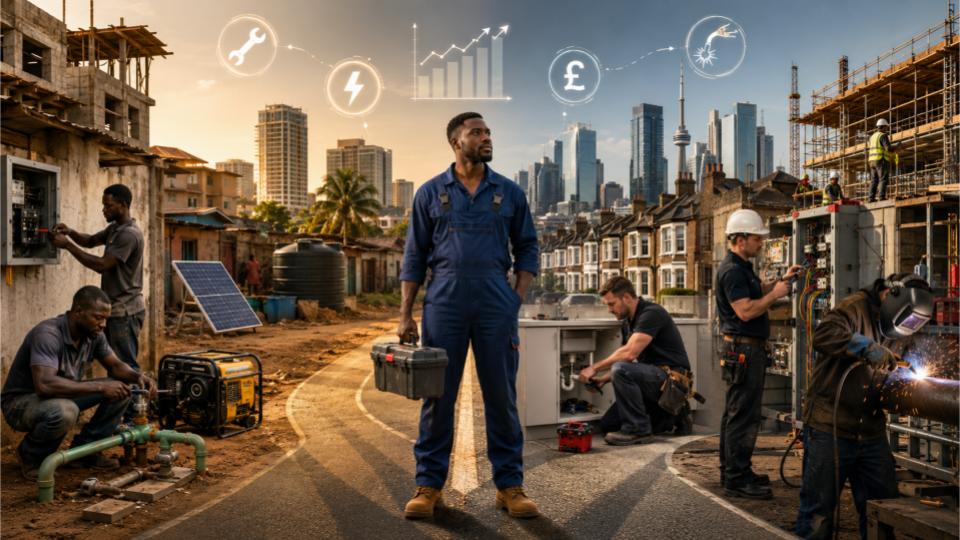
The man who fixed your generator last month may earn five times that income if he were doing the same job in Birmingham. Here is what the honest numbers look like across three labour markets and what it means for Nigerian tradespeople in 2026.
| Country | Income Metric | Plumber | Electrician | Welder | Notes |
|---|---|---|---|---|---|
| 🇳🇬 Nigeria | Monthly Avg • Naira | ₦120K | ₦105K | ₦150K | Naira monthly median estimates • 2026 |
| 🇬🇧 United Kingdom | Annual Avg • GBP | £44K/yr | £41K/yr | £46K/yr | GBP annual median • England and Wales |
| 🇨🇦 Canada | Annual Avg • CAD | C$72K/yr | C$68K/yr | C$77K/yr | CAD annual median • Ontario and BC focus |
Note: Figures shown are illustrative median or average estimates for 2026 and may vary depending on experience, certifications, specialization, region, and employer.
There is a plumber who works across the Lekki axis in Lagos. I have known him for three years. He is meticulous, always on time, always cleans up after himself, and charges rates that some of his clients think are high for Lagos but which, if you converted them to pounds sterling and placed them on a job board in Birmingham, would look like a charity offer. He knows this. He has a brother in Edmonton. The brother is a plumber too. They call each other on weekends and compare notes on the week, which jobs were difficult, which clients paid without argument, which materials were hard to find. The earnings conversation, though, has a complexity they have both quietly accepted: the same hands, the same skill, very different numbers on a very different scale. This article tries to tell that story in honest detail.
Comparing artisan earnings across Nigeria, the United Kingdom, and Canada is not a simple exercise in converting currencies and declaring a winner. The numbers matter, and we will give them to you directly. But the context around the numbers matters just as much, cost of living, certification requirements, tax obligations, and what a skilled artisan actually needs to do to access the higher rates in each market. All of that shapes whether the comparison is practically useful or just mathematically striking.
We will cover four core trades in detail: plumbing, electrical work, welding, and carpentry. These represent some of the most consistently in-demand skilled trades across all three countries and account for a large share of Nigeria’s informal artisan workforce. For each country, we will look at median earnings, the factors that push earnings toward the top of the range, and the specific conditions Nigerian artisans would face if they moved into that market.
🇳🇬
Nigeria
Any honest account of what skilled artisans earn in Nigeria has to begin with the acknowledgement that there is no single Nigerian artisan market. There is Lagos, where a skilled plumber working across Ikoyi, Victoria Island, and Lekki Phase 1 can charge day rates that many salaried professionals would envy. There is Abuja, where the construction boom around the FCT continues to create consistent demand for qualified tradespeople, particularly in the estate development corridors around Lokogoma, Kuje, and Lugbe. And then there are secondary cities like Ibadan, Kano, Enugu, and Port Harcourt, where the same skills command meaningfully different rates, and there is the wider rural and semi-urban market, where artisan incomes are often significantly lower still.
What follows are median estimates for skilled artisans working in major urban centres in Nigeria. These are not the incomes of beginners or the incomes of the most exceptional practitioners. They represent the working reality of an experienced artisan with an established client base in one of Nigeria’s three or four largest cities.
| Trade | Monthly Range (Lagos/Abuja) | Monthly Median Estimate | Notes |
|---|---|---|---|
| Plumber | ₦60,000 to ₦300,000+ | ₦120,000 | Higher for those serving estate developers and maintenance contracts |
| Electrician | ₦55,000 to ₦280,000+ | ₦105,000 | Solar installation skills command a growing premium in 2026 |
| Welder | ₦70,000 to ₦400,000+ | ₦150,000 | Industrial and structural welders earn significantly above median |
| Carpenter | ₦50,000 to ₦250,000+ | ₦95,000 | Cabinet makers and fitted furniture specialists earn highest rates |
| Tiler | ₦60,000 to ₦220,000+ | ₦90,000 | Demand driven by consistent residential construction activity |
| HVAC Technician | ₦90,000 to ₦450,000+ | ₦200,000 | Fastest growing trade income in urban Nigeria due to AC adoption |
A few things are worth noting about these figures. First, the upper end of each range is real but not typical. The plumber earning three hundred thousand naira monthly in Lagos is almost certainly managing a small team, has several estate management contracts, and has spent years building a reputation that generates inbound work without advertising. The median figure is more representative of the experienced but not exceptional practitioner.
Second, income variability is a genuine feature of artisan work in Nigeria in a way that is structurally different from employment. A plumber with a good month in November might have a poor January. Managing this variability requires financial discipline that formal employment does not demand in the same way, and it is one of the underappreciated challenges of artisan income that simple averages do not capture.
Third, HVAC technicians deserve specific mention because the data shows a genuine income premium emerging in this trade that tracks Nigeria’s accelerating adoption of air conditioning in residential and commercial premises, driven partly by worsening heat conditions. Skilled HVAC technicians who can service, install, and maintain inverter AC systems from brands sold in Nigeria are experiencing demand that has outpaced supply, and this is showing up meaningfully in what the best practitioners are earning.
The Solar Electrician Premium in NigeriaOne of the most significant income developments in Nigeria’s artisan economy in 2026 is the emergence of a genuine premium for electricians who understand solar photovoltaic systems. Nigeria’s electricity supply crisis has pushed millions of homes and businesses toward solar investment, and the installation, commissioning, and maintenance of these systems requires electrical skills combined with specific knowledge of inverters, battery management systems, and solar panel wiring. Electricians in Lagos and Abuja who have developed verifiable solar installation competency are reporting income premiums of forty to eighty percent above standard electrical work rates. This is one of the clearest examples of how skill specialisation within a trade can create dramatically different income outcomes in the Nigerian market.
United Kingdom
🇬🇧
United Kingdom
The United Kingdom has a genuine and well-documented shortage of skilled tradespeople that has been building for over a decade. The combination of an aging trades workforce with fewer young people entering apprenticeships, the exit of European workers after Brexit, and an accelerating construction and infrastructure programme driven by government housing targets has created a market in which skilled artisans are consistently in demand and consistently commanding wages that have risen faster than the national average.
This is the market context within which the numbers below sit. UK artisan earnings in 2026 are not simply a reflection of higher general wage levels. They reflect genuine scarcity of skilled labour in specific trades and a regulatory environment that creates meaningful barriers to entry that protect the earning power of those who clear them.
| Trade | Annual Range (England) | Annual Median | Naira Equivalent (approx) |
|---|---|---|---|
| Plumber | £28,000 to £65,000+ | £44,000 | ~₦88M per year / ~₦7.3M per month |
| Electrician | £28,000 to £58,000+ | £41,000 | ~₦82M per year / ~₦6.8M per month |
| Welder | £30,000 to £72,000+ | £46,000 | ~₦92M per year / ~₦7.7M per month |
| Carpenter / Joiner | £26,000 to £52,000+ | £37,000 | ~₦74M per year / ~₦6.2M per month |
| Tiler | £25,000 to ₊£48,000 | £34,000 | ~₦68M per year / ~₦5.7M per month |
| Gas Engineer | £35,000 to £75,000+ | £52,000 | ~₦104M per year / ~₦8.7M per month |
The naira equivalents in that table are striking but require serious qualification. They are calculated at a representative exchange rate and represent gross income before UK income tax, National Insurance contributions, and in the case of self-employed tradespeople, their own business running costs, equipment, insurance, and vehicle expenses. After tax and national insurance, a UK plumber earning £44,000 annually takes home approximately £33,000 to £35,000, equivalent to roughly £2,800 per month net. In London, where rent for a room in a shared house starts around £900 per month and a basic one-bedroom flat costs £1,500 or more per month, the cost of living context matters enormously.
What the UK does offer that Nigeria cannot currently match is structured income predictability, a welfare safety net that includes NHS healthcare, unemployment benefits, and a state pension, and a formal career progression framework in the trades that rewards additional qualifications with genuinely higher earning potential.
The difference between what I earned in Lagos and what I earn in Manchester is real. But the difference between what I spend on living in Lagos and what I spend in Manchester is also very real. The net gap is smaller than people back home imagine, especially in the first two or three years.
Nigerian plumber, six years in Manchester, speaking to Careerdoor in April 2026
Canada
🇨🇦
Canada
Canada is arguably the most actively welcoming of the three countries to skilled tradespeople from countries like Nigeria, and this is reflected in its immigration system. The Express Entry system awards points for skilled trades experience, and numerous Provincial Nominee Programmes have dedicated streams for tradespeople in occupations on Canada’s National Occupational Classification list where domestic supply is insufficient.
The Canadian trades market has its own certification system, with the Red Seal Programme providing nationally recognised certification for trades that complete the required apprenticeship and examination process. For Nigerian artisans, the Red Seal pathway requires provincial apprenticeship registration, a period of supervised work, and a trade examination, but once achieved, it opens access to the full spectrum of Canadian trades wages.
| Trade | Annual Range (Ontario/BC) | Annual Median | Naira Equivalent (approx) |
|---|---|---|---|
| Plumber | C$55,000 to C$105,000+ | C$72,000 | ~₦79M per year / ~₦6.6M per month |
| Electrician | C$52,000 to C$98,000+ | C$68,000 | ~₦74M per year / ~₦6.2M per month |
| Welder | C$58,000 to C$120,000+ | C$77,000 | ~₦84M per year / ~₦7M per month |
| Carpenter | C$48,000 to C$88,000+ | C$62,000 | ~₦68M per year / ~₦5.7M per month |
| HVAC Technician | C$58,000 to C$108,000+ | C$78,000 | ~₦85M per year / ~₦7.1M per month |
| Heavy Equipment Operator | C$62,000 to C$110,000+ | C$82,000 | ~₦90M per year / ~₦7.5M per month |
Alberta, Canada’s oil-producing province, deserves separate mention. Welders, pipefitters, and heavy equipment operators in the Alberta oil sands command some of the highest trades wages in the country, with experienced workers earning well above the Ontario medians shown above. The work is demanding, often in remote locations, and involves long shifts, but the compensation reflects those conditions and represents one of the highest-paying environments for skilled tradespeople anywhere in the English-speaking world.
| 📊 Skilled Trades Income Comparison (2026) | Details |
|---|---|
| 🔄 ~60x | Nominal difference between a Nigerian plumber’s monthly income and a Canadian plumber’s monthly equivalent when converted to naira. |
| 🛒 8 to 12 times | Difference in real purchasing power after cost of living adjustments between Nigeria and UK or Canada. |
| 💷 £55/hr | Self-employed daily rate achievable by a Gas Safe registered plumber in Greater London in 2026. |
ℹ️ Note: The figures above are presented exactly as provided and are intended as broad comparative indicators. Actual earnings and purchasing power vary depending on experience, location, exchange rates, taxes, and living costs.
The Full Picture
All Trades, All Three Countries: The Master Comparison
The table below brings all the data together in one place. Naira equivalents for UK and Canada figures are approximate, based on representative exchange rates, and are gross figures before tax. They are provided for context and illustration, not as a precise financial calculation.
| Trade | 🇳🇬 Nigeria (Monthly ₦) | 🇬🇧 UK (Annual £ / Monthly ₦ equiv.) | 🇨🇦 Canada (Annual C$ / Monthly ₦ equiv.) |
|---|---|---|---|
| Plumber | ₦120,000 | £44,000 / ~₦7.3M | C$72,000 / ~₦6.6M |
| Electrician | ₦105,000 | £41,000 / ~₦6.8M | C$68,000 / ~₦6.2M |
| Welder | ₦150,000 | £46,000 / ~₦7.7M | C$77,000 / ~₦7M |
| Carpenter | ₦95,000 | £37,000 / ~₦6.2M | C$62,000 / ~₦5.7M |
| HVAC Technician | ₦200,000 | £45,000 / ~₦7.5M | C$78,000 / ~₦7.1M |
| Gas Engineer | ₦180,000 | £52,000 / ~₦8.7M | C$74,000 / ~₦6.8M |
What This Means
What Nigerian Artisans Should Actually Do With This Information
A comparison article that only shows numbers without connecting them to action is an interesting document but not a useful one. So here is what the data above should mean in practical terms for Nigerian artisans, their families, and the young people considering whether to enter a trade.
The Industrial Training Fund, the Council for the Regulation of Engineering in Nigeria, and various trade guilds and apprenticeship bodies in Nigeria offer formal certification pathways for artisans. Holding a documented Nigerian qualification, even if it needs supplementary assessment abroad, demonstrates credibility and provides a paper trail of training history that overseas immigration and certification authorities expect to see. Many Nigerian artisans with years of practical experience have no documentation whatsoever, which creates unnecessary obstacles in any formal employment or immigration process.
The income data for Nigeria shows clearly that the gap between median and top earnings within each trade is very wide. HVAC technicians with solar skills, electricians who can specify and install backup power systems, plumbers who understand water treatment and filtration, and carpenters who can produce fitted furniture to international specification all earn significantly above the median in the same city. Specializing within your trade is the fastest income improvement pathway available to a Nigerian artisan who is not yet ready or positioned to relocate.
Canada’s trades certification is provincially managed. An electrician pathway in Ontario differs from the same pathway in British Columbia or Alberta. Before investing in Canadian immigration applications, research the specific apprenticeship authority for your province of interest, understand what assessment of your Nigerian experience will involve, and if possible connect with Nigerian tradespeople already working in that province who can give you a ground-level account of the process. The Canadian government’s Job Bank website and the Red Seal programme website are reliable starting points for official information.
Many of the highest earners in the UK trades market are self-employed rather than employed. A self-employed plumber in London working consistent days can earn significantly above the employed median but also carries the costs of their own tools, insurance, van, and the administrative burden of self-employment tax filing. The UK’s Self Assessment system requires annual tax returns. Understanding these obligations before arriving means you are not surprised by a system that is straightforward once understood but confusing if encountered without preparation.
One of the most consistent patterns in conversations with skilled Nigerian artisans is systematic underpricing of their work, driven by the assumption that clients will push back if rates are raised. In reality, clients who have found a reliable, skilled artisan often accept rate increases that reflect the full value of the service, particularly in the higher-income areas of Lagos, Abuja, and Port Harcourt. Getting to a sustainable rate in Nigeria often requires less than people think and delivers more than people expect in terms of client retention. Start by benchmarking your rates against the data in this article and consider whether your current pricing reflects your actual skill level.
The Honest Question Behind This ComparisonThe article started with a plumber in Lagos and his brother in Edmonton, and it is worth returning to them at the close. The brother in Edmonton earns more in naira terms, significantly more. But he also spends more, lives further from his family, carries the weight of navigating a new society, and operates in a labour market where his years of Nigerian experience had to be re-proven before the financial reward arrived. The comparison between artisan earnings in Nigeria and abroad is ultimately not a simple argument for leaving. It is an argument for knowing what your skills are actually worth, in Nigeria and outside it, and making decisions about your career and your life with accurate information rather than either the romanticized version of abroad or the unnecessarily hopeless version of staying.
The Bigger Picture: What Artisan Earnings Tell Us About Nigeria’s Economy
The gap between Nigerian artisan earnings and those in the UK and Canada reflects a combination of factors: lower general wage levels, weaker formal credentialing systems, fragmented client markets, and an absence of the collective bargaining and regulatory structures that protect trades wages in developed economies. Addressing this gap domestically requires investment in formal trades training infrastructure, stronger apprenticeship regulation, and a cultural shift that treats skilled trades as a genuine professional category rather than a fallback option. The countries with the highest artisan wages are also the countries where artisan training is most formalised and most respected. That connection is not accidental, and Nigeria has the scale of infrastructure need and population to build a trades economy that rewards skill appropriately, if the institutional investment to support it follows.
Artisan Earnings Nigeria, UK and Canada: Questions Answered
How much does a plumber earn in Nigeria vs the UK in 2026?
In Nigeria, a skilled plumber in a major city like Lagos or Abuja typically earns between 80,000 and 250,000 naira per month depending on experience and client base. In the United Kingdom, a qualified plumber with Gas Safe registration earns between £35,000 and £55,000 per year, with self-employed plumbers in London often earning considerably more. Converting the UK figure to naira at current exchange rates produces a dramatic nominal difference, though this must be understood in the context of the significantly higher cost of living in the UK.
Can Nigerian artisans find work in Canada in 2026?
Yes, Canada actively recruits skilled tradespeople under its Express Entry system and various Provincial Nominee Programmes, and several trades including electricians, plumbers, welders, and heavy equipment operators appear on Canada’s in-demand occupations lists. Nigerian tradespeople need to have their qualifications assessed by the relevant provincial apprenticeship authority, pass any required trades examinations, and in many cases complete a period of supervised work before receiving full certification. The process is well-defined but requires careful planning and preparation before applying.
What is the average salary for an electrician in the UK in 2026?
A qualified electrician in the United Kingdom earns an average salary of between £33,000 and £50,000 per year in 2026, depending on location, experience, and whether they are employed or self-employed. Electricians in London and the South East typically earn toward the higher end of this range. Those with additional qualifications such as EV charging installation or smart home systems expertise are increasingly able to command premium rates above this range.
Are skilled trade jobs well paid in Nigeria?
Skilled trade incomes in Nigeria vary enormously depending on the trade, the city, the practitioner’s experience, and their ability to access higher-value clients. The most skilled and well-positioned artisans in Lagos, Abuja, and Port Harcourt can earn incomes that compare favourably with entry-level formal sector employment, particularly in construction, industrial maintenance, and specialist services. However, many artisans still earn at levels that place them in the low-income bracket, and the absence of formal certification and structured pricing means that income improvement depends heavily on individual initiative and network building.
