

The way people find information online has fundamentally changed. If your Nigerian website, blog, or digital business is still optimizing only for Google’s ten blue links, you may already be losing ground you do not yet realize you have lost.
I want to start with something that happened to a content creator I know in Lagos. She built a personal finance blog over three years, published over 200 articles, and watched her traffic grow steadily to around 40,000 monthly visitors. Then, somewhere between late 2024 and early 2025, that number started falling without any obvious explanation. No Google penalty. No technical errors. No dramatic change in her publishing schedule. The traffic just quietly started leaving. When we sat down to look at what was happening, the answer was uncomfortable. Her readers were getting their answers directly from Google’s AI summary box before they ever clicked through to her site. She had not done anything wrong. The rules had simply changed under her feet.
That story is happening to Nigerian website owners across every niche right now. Finance bloggers. Job listing platforms. News aggregators. SME directories. Health information sites. Career guidance platforms. The shift is real, it is already affecting traffic and revenue, and the vast majority of Nigerian digital publishers have not responded to it in any meaningful way.
This article is a plain-language explanation of what is happening, why it matters specifically for Nigerian websites, and what practical changes can make the difference between a site that remains relevant and one that quietly fades into digital invisibility over the next two years.
Understanding the Shift: What SEO Was, What AEO Is, and Why the Difference Matters
Defining the Terms
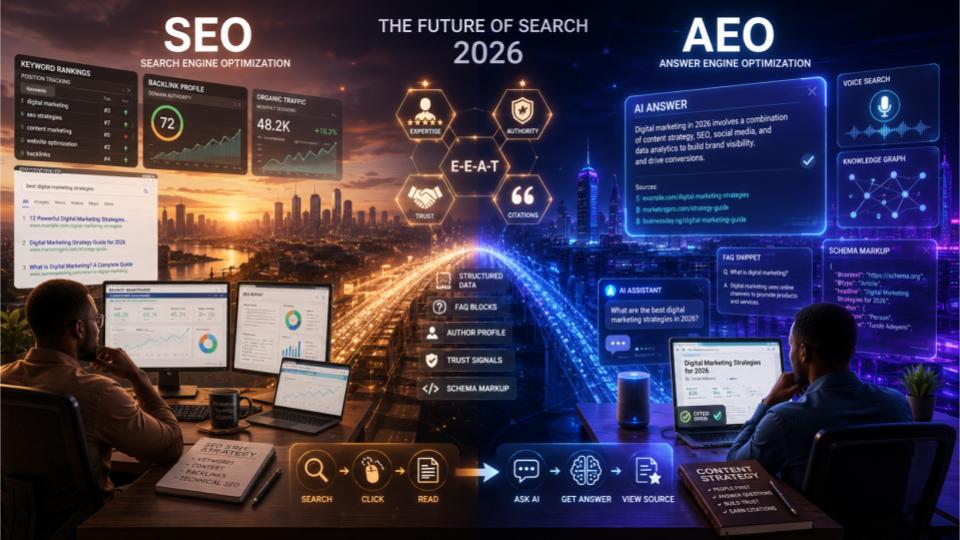
Search Engine Optimisation (SEO) is the practice of making your website rank higher in search engine results pages so that users who type a query find your link and click through to your content. The entire model depends on the user clicking a link. Answer Engine Optimisation (AEO) is the practice of structuring your content so that AI-powered search systems, including Google’s AI Overviews, ChatGPT Search, Microsoft Copilot, and Perplexity AI, extract and present your content directly as a cited answer. The goal is not just to be found. It is to be the source the AI chooses to quote.
The reason this distinction matters so much is economic. Traditional SEO was built on a simple value exchange. You create good content, Google ranks it, users click through, and your website earns impressions, ad revenue, affiliate commissions, or leads. The click was the currency.
AI-powered search breaks that value chain. When Google’s AI Overview reads your content and summarizes it on the results page, the user gets the answer without ever visiting your site. The content is consumed. The creator gets no click, no impression, and no revenue. Unless the creator has structured their content in a way that earns attribution within the AI’s answer, which can bring users back as a named source they trust. That is what AEO is designed to achieve.
For Nigerian website owners who depend on AdSense revenue, affiliate partnerships, or lead generation, this is not an abstract technical concern. It is a direct threat to the income model they built their digital businesses around.
| Old SEO Thinking | AEO Thinking in 2026 |
|---|---|
| Primary Goal: Rank in the top 10 search results for a target keyword | Primary Goal: Become the source AI platforms cite in their answers |
| Success Metric: Click-through rates (CTR) and page visits | Success Metric: Being referenced or cited in AI-generated responses |
| Content Format: Long-form, keyword-dense articles optimized for search engines | Content Format: Direct, concise answers to specific user questions |
| Structure Priority: Headers (H1-H3), internal links, and keyword placement | Structure Priority: Schema markup, FAQ sections, definitions, and structured data |
| Authority Signal: Backlinks from high-authority websites | Authority Signal: Author expertise, credible citations, trust signals, and content accuracy |
| User Journey: Search → Click → Read → Take Action | User Journey: AI Answers → User Sees Source → Visits Website for More Information |
Why This Matters More for Nigerian Sites Than Most People Realise
When discussions about AI search emerge in digital marketing circles, they tend to centre on the American or European experience. The Nigerian context has specific characteristics that make the AEO transition both more urgent and more complex for local publishers.
Nigerian users are adopting AI search tools faster than the industry expected
The assumption in many marketing circles was that AI search would penetrate African markets slowly, held back by connectivity costs, device limitations, and user behaviour. That assumption has proven partially wrong. Data from digital marketing audits conducted across Nigerian content businesses in early 2026 shows that mobile-first Nigerian users have adopted tools like ChatGPT, Gemini, and Perplexity at a rate that surprised even digitally-native practitioners. The reason is partly economic. A single well-phrased question to an AI chatbot saves the data cost of opening five browser tabs to compare answers. In a market where data costs remain significant for many users, the efficiency of AI-powered answers has genuine appeal.
This means Nigerian websites are already experiencing AI-driven traffic displacement, even if their owners have not yet connected the traffic decline to its real cause.
Nigerian content is underrepresented in AI training data and AI citations
Here is a problem that does not get enough attention in discussions about African digital publishing. The large language models powering today’s AI search tools were trained predominantly on English-language content from American, British, and to a lesser extent South African sources. Nigerian-specific content about naira exchange rates, NYSC logistics, Lagos traffic patterns, and the details of WAEC grading is underrepresented in the base training of these models. This means AI tools are more likely to fill gaps in their Nigerian knowledge by reaching for whatever source is best structured and most clearly written, rather than drawing from a deep reservoir of pre-existing Nigerian knowledge.
For Nigerian publishers, this is actually an opportunity wearing the clothes of a problem. A Nigerian website that writes clearly structured, authoritative, locally grounded content about Nigerian topics and formats it properly for AI extraction has a genuine chance of becoming the default cited source when AI tools answer questions about Nigerian life, careers, business, and finance. The field is not yet saturated. The early-mover opportunity is real. But it is closing faster than most people realize.
“The Nigerian publisher who understands AEO right now is where the SEO pioneer was in 2008. The early movers will set a standard that latecomers will spend years trying to match.”
Observation from a Lagos-based digital strategy practitioner, April 2026
What AI Search Engines Actually Look For When Choosing a Source to Cite
To optimize for AI-powered answers, it helps to understand at a practical level what these systems prioritize when deciding which source to quote or summarize. The specifics vary across platforms, but the patterns are consistent enough to act on.
Direct, specific answers delivered early in the content
AI search systems are designed to answer questions. They therefore strongly favour content that answers a question directly and early, rather than content that builds slowly toward an answer buried five paragraphs down. If someone searches for how to register a business in Nigeria, the AI will prefer content that says, within the first two or three sentences, that business registration is handled by the Corporate Affairs Commission and then outlines the core steps immediately, over content that opens with a 300-word introduction about the importance of entrepreneurship before arriving at the practical information.
This has real implications for how Nigerian content creators structure their articles. The instinct to establish extensive context before delivering substance is a legitimate editorial choice in long-form journalism but it works directly against AI extractability. The answer needs to be visible, early, and specific.
Structured content with FAQ sections and clear heading hierarchies
Schema markup, particularly FAQ schema, tells AI crawlers exactly what questions a page addresses and what the corresponding answers are. A Nigerian career website using FAQ schema on an article about NYSC allowances is making it dramatically easier for an AI overview to extract and cite that article when someone asks about NYSC pay. Without schema, the AI has to interpret the content. With schema, it is handed a clear map.
Most Nigerian websites are not using schema markup at all, or are using it incorrectly. This is a technical gap that can be closed relatively quickly and that yields a measurable difference in how often AI systems choose to cite your content.
Demonstrated author expertise and trust signals
Google’s framework for evaluating content quality, which directly influences how AI Overviews select sources, places significant weight on what it calls Experience, Expertise, Authoritativeness, and Trustworthiness, commonly known as EEAT. AI search tools generally follow similar logic when choosing sources to cite. A page written by a named author with clear professional credentials, linked to a real professional profile, and published on a site with clear ownership and editorial standards signals trustworthiness in a way that anonymous or vaguely attributed content simply does not.
Many Nigerian content sites were built with anonymous authorship, generic about pages, and minimal trust infrastructure. That was acceptable when the only audience was human readers making their own judgements. It is a liability when AI systems are making source selection decisions algorithmically based on signals your site either provides or fails to provide.
The EEAT Standard and What It Means for Nigerian PublishersGoogle’s EEAT framework, Experience, Expertise, Authoritativeness, and Trustworthiness, has become the de facto benchmark AI systems use when evaluating source credibility. For a Nigerian website to score well on these signals, every article needs a named author with a verifiable bio, the site needs a clear and genuine about page explaining who runs it and why, content should cite real sources with attribution, and the overall site must have a legitimate professional identity that can be independently verified. Websites built as anonymous content operations, however well-written their articles may be, are increasingly being passed over by AI systems in favour of sites that can demonstrate real human expertise behind their content.
Conversational, natural language that mirrors how people actually ask questions
The way people search has shifted considerably. Typed keyword searches like “Lagos jobs 2026” are giving way to conversational queries like “what are the best industries to find work in Lagos right now” and “how do I apply for a government job in Nigeria without connections.” AI search tools are built to handle these natural language queries, and they cite content that mirrors the conversational register of the question being asked.
This means Nigerian content written in overly formal stiff prose, or stuffed with keywords in ways that disrupt natural reading flow, performs worse in AI extraction than content that reads the way a knowledgeable person would explain something in actual conversation. Ironically, the most AI-friendly writing style is also the most reader-friendly one.
Practical Steps Nigerian Website Owners Can Take Right Now
Understanding the theory is useful. Having a concrete action list is more useful. Here is what Nigerian website owners, bloggers, and digital businesses can do in the next 90 days to begin adapting meaningfully to the AEO era.
Take your ten most visited pages and check whether each one answers its primary question within the first 100 words. If the answer is buried in paragraph four or five, rewrite the opening to surface it immediately. This single change, applied consistently, will improve AI extractability without requiring any technical work and will also likely reduce your bounce rate from human readers at the same time.
At the end of each article, add a section titled Frequently Asked Questions containing between three and six questions a reader might have after engaging with the content, each followed by a concise direct answer. Then implement FAQ schema markup in your site’s code or through a plugin if you use WordPress. This is the single highest-impact technical change for AI citation frequency and it is achievable for any site owner with basic content management skills.
Every article on your site should have a named author. That author should have a dedicated bio page explaining their professional background, relevant experience, and why they are qualified to write on that specific topic. Link that bio to a LinkedIn profile or other verifiable professional presence. If you have been publishing anonymously, now is the time to step forward and put your name and credentials to your work. AI systems cannot assess the expertise of an unnamed author, and they default to passing over unsigned content.
Identify what Nigerian users are asking AI tools in your niche. You can do this by typing partial queries into ChatGPT, Gemini, or Google and noting the auto-complete suggestions. Then create dedicated articles that answer those questions comprehensively with local context, naira pricing, Nigerian regulatory detail, and platform references that a general-purpose AI model may not have reliably in its training data. These articles will face less competition for AI citation than generic English-language content on the same topic.
Review your about page. Does it clearly explain who owns and operates the site, what the editorial purpose is, and how readers can contact you? Does your site have a visible privacy policy? Are your contact details real and reachable? Is the site on HTTPS? These signals matter more to AI source selection than most Nigerian site owners appreciate. A site that appears anonymous, incomplete, or legally informal is progressively less likely to be cited as a trustworthy source by AI systems applying EEAT-style filtering to their source selection.
This is perhaps the most uncomfortable but most important strategic advice in this entire article. Any Nigerian digital business that depends entirely on organic search traffic is now exposed to a structural risk that is not going away. Building a direct audience through email newsletters, a WhatsApp channel, a Telegram community, or a consistent social media presence creates a reader relationship that AI-powered search disruption cannot sever. The publisher with 15,000 email subscribers is significantly less vulnerable to algorithm shifts than the publisher with 100,000 monthly visitors who all arrive exclusively through Google.
AI Overviews and position zero featured snippets operate on the same selection logic. Google’s system looks for content that directly and clearly answers a query and surfaces it above all other results. Structuring articles with a clear question and a concise answer early in the piece, followed by deeper explanation, gives your content the best chance of being selected for these high-visibility placements. Those are precisely the placements that AI systems draw from when generating their summaries.
A specific caution for Nigerian AdSense publishersIf your website’s income model depends primarily on display advertising revenue from high page view volumes, the AEO transition requires an honest strategic review. AI-summarized answers reduce click-through rates, which reduces page views, which reduces ad impressions and therefore AdSense earnings. Publishers in this position should begin experimenting with complementary revenue streams including affiliate marketing, sponsored content, digital products, paid newsletters, or service-based offers that generate income independent of raw traffic volume. The goal is not to abandon display advertising but to reduce existential dependence on it as a single income source.
What the Best Nigerian Digital Publishers Are Already Doing Differently
The shift from SEO to AEO is not only a technical challenge. It is an editorial and philosophical one. The publishers and content creators in Nigeria who are adapting most effectively share a common orientation worth naming clearly.
They are writing for human beings first and algorithms second. This sounds obvious, but it runs contrary to the keyword-stuffing and thin content strategies that dominated Nigerian SEO practice for much of the past decade. AI systems are considerably better than older search algorithms at detecting when content was written to game a ranking rather than to genuinely inform a reader. The writers who spent years building real depth and clarity are better positioned for the AEO era than those who optimized aggressively for search volume without investing in actual quality.
They are being specific about Nigeria. A personal finance article that explains savings rates in naira, references platforms Nigerians actually use like Kuda, Carbon, and Cowrywise, and addresses the practical realities of Lagos living costs and Abuja rent is more useful to a Nigerian user and more distinctive in AI source selection than a generic savings article that could have been written for any English-speaking market. Specificity to the Nigerian context is both a service to readers and a competitive advantage in AI citation.
They are treating their credibility as an asset worth protecting. Named authors. Real editorial policies. Corrections when errors are made. Clear source attribution. These are not just ethical choices. They are AEO infrastructure. The publisher who builds a site that looks, reads, and operates like a trustworthy institution is building something both human readers and AI systems will return to over and over.
The Window Is Open. It Will Not Stay That Way.
There is a timing element to this conversation that deserves to be said plainly. The advantage available to Nigerian digital publishers who adopt AEO practices right now is a genuine first-mover advantage. AI systems that cite sources consistently, once they establish those patterns, tend to keep returning to the same trusted sources. A Nigerian careers site that becomes the go-to cited source for NYSC-related questions in AI search results will benefit from that positioning for a considerable time. A site that arrives two years late to the same realization will find that position already well occupied.
The transition from SEO to AEO does not require abandoning everything that has made Nigerian websites work until now. Good writing still matters. Relevant topics still matter. Publishing consistently still matters. Understanding your audience still matters. What changes is the structural layer around that content: how it is formatted, how it is attributed, how it is technically marked up, and how directly it answers the questions people are actually typing and speaking into AI tools.
The Lagos blogger I mentioned at the beginning of this article has since rebuilt several of her most important pages using AEO principles. She added FAQ sections. She restructured her article openings. She published a proper author page with her credentials. She implemented FAQ schema markup throughout the site. Within three months, two of her articles were being cited in Google’s AI Overviews on personal finance topics. Her organic traffic has not fully recovered. But she is now visible in a new and more durable way, as a named source with authority, rather than just a URL in a list that may or may not get clicked.
That is the real opportunity 2026 is offering Nigerian digital publishers. Not a guarantee of easy traffic. But a real and still-open chance to build the kind of authority that the next phase of search rewards. The question is simply whether you will act before the window closes.
