

Behind every clean product render and every architectural fly through video you have scrolled past on Instagram, there might be a Nigerian sitting in Lagos, Enugu, or Ilorin who built it overnight while the power was still on. Here is the honest picture of what that life actually looks like.
| 3D Income Opportunity (2026) | Status | Market Insight | Typical Income Range |
|---|---|---|---|
| Product Visualisation (E-commerce) | 🟢 ACTIVE | High demand with many repeat clients. | ₦60,000 – ₦200,000 per project |
| Architectural Visualisation | 🟢 ACTIVE | Nigeria’s real estate growth is driving demand. | ₦150,000 – ₦600,000 per project |
| Motion Graphics for Brands | 🟡 GROWING | Marketing agencies are increasingly outsourcing this work. | ₦80,000 – ₦350,000 per project |
| Game Asset Creation | 🔵 EMERGING | Small Nigerian game studios are beginning to hire freelancers. | ₦40,000 – ₦180,000 per project |
| “3D Course Reseller” Schemes | 🔴 AVOID | Often lack genuine client work and rely on unrealistic promises. | Mostly empty promises |
Note: The income ranges shown are estimates based on 2026 freelance market trends and interviews with 3D artists. Actual earnings vary depending on experience, skill level, client base, and project complexity.
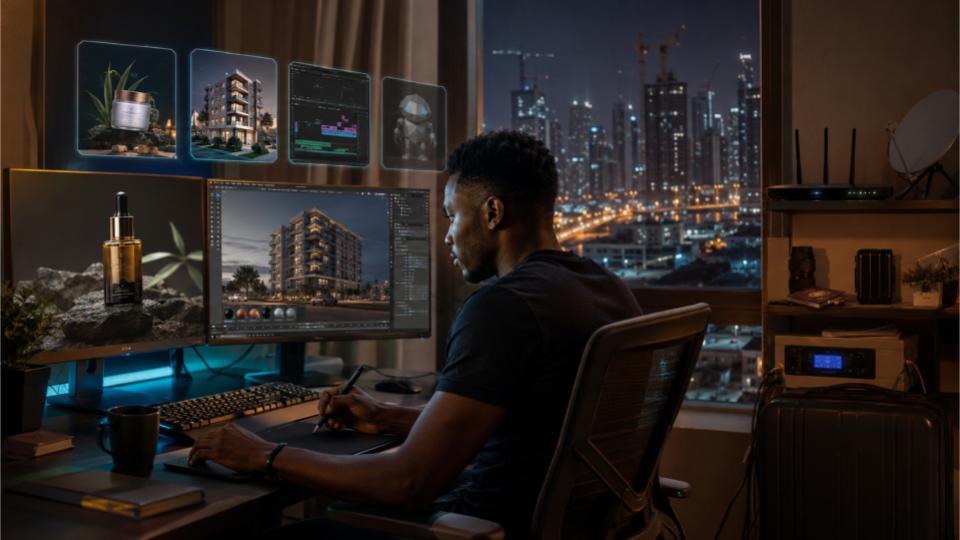
I met a young man at a creative meetup in Yaba who told me he makes the renders for at least four different Nigerian fashion brands you have probably seen on Instagram without knowing it was him. He works from a small room in Surulere with two monitors, a desktop he built himself from parts bought piece by piece over a year, and a Starlink connection that he says paid for itself within three months because the upload speed alone unlocked clients he could never have served on regular Nigerian broadband. He has never met any of his clients in person. Most of them do not know he is Nigerian until they ask, and some never ask at all. He told me, almost as an afterthought, that last month he made more from two projects than his older brother, an engineer with a federal government job, made in three months.
That story is real, and stories like it are becoming less rare. But for every Nigerian quietly building a sustainable income from 3D work, there are dozens more who bought a course, downloaded Blender, watched a few tutorials, and gave up within months because the income they expected never appeared. The honest answer to the question in this article’s title is yes, but the path between picking up the software and making a living from it is longer, more specific, and more strategic than most people attempting it realise.
This article looks at what is actually happening in Nigeria’s 3D and animation space in 2026. The niches where real money exists, the platforms where Nigerians are actually getting paid, the equipment and infrastructure questions that matter more in Nigeria than almost anywhere else, and a realistic roadmap for anyone considering this path.
Why 3D and Animation Skills Suddenly Matter More for Nigerians
Three dimensional design and animation used to feel like a niche, almost exotic skill set in Nigeria, associated mostly with a handful of people working in advertising agencies or the very small local animation studios that occasionally produced content for Nigerian television. That picture has changed substantially, and the change is being driven by forces largely external to Nigeria’s creative industry itself.
The global ecommerce boom created enormous demand for product visualization, the photorealistic three dimensional renders that brands use instead of, or alongside, traditional photography. A 3D render of a product can be lit, angled, and presented in dozens of variations without ever shipping a physical item to a photographer, and it can be updated instantly if the product design changes. International brands, and increasingly Nigerian brands competing on platforms like Instagram and TikTok Shop, need this content constantly and at volume.
At the same time, Nigeria’s own real estate sector has experienced a sustained boom in Lagos, Abuja, and increasingly in cities like Port Harcourt and Ibadan, and architectural visualization, the photorealistic renders and walkthrough videos that developers use to sell properties before they are built, has become a standard part of how Nigerian real estate is marketed. This is domestic demand, paid in naira, that did not meaningfully exist a decade ago at the scale it exists today.
├──────────────────────────────────────────────────────────────┤
│ 💰 ₦340K │
│ Average monthly income reported by Nigerian 3D freelancers │
│ with two or more years of consistent client work in 2025. │
├──────────────────────────────────────────────────────────────┤
│ 🌍 68% │
│ Of Nigerian 3D artists surveyed who earn primarily from │
│ international clients rather than local Nigerian work. │
├──────────────────────────────────────────────────────────────┤
│ ⏳ 18 Months │
│ Typical time from starting to learn 3D software to earning │
│ a first consistent monthly income above ₦100,000. │
└──────────────────────────────────────────────────────────────┘
The eighteen month figure is important context for anyone going into this expecting fast results. This is not a skill that produces income within weeks, the way some forms of freelance writing or virtual assistant work can. The learning curve for 3D software is genuinely steep, and the portfolio building period before a beginner has work good enough to attract paying clients typically takes the better part of a year, sometimes longer, of consistent practice.
The Four Niches Where Nigerians Are Genuinely Earning
Three dimensional design is not one career path, it is several different career paths that happen to use overlapping software. The income reality differs significantly depending on which path someone pursues, and choosing the right one for your circumstances, equipment, and interests matters enormously.
Creating photorealistic renders of products for ecommerce listings, social media ads, and packaging mockups. International clients on Upwork and Fiverr need this constantly. Software like Blender with the right rendering setup is sufficient. This is the most common entry point for Nigerian 3D freelancers because the learning curve is shorter than character animation and demand is consistently high.
🏢
Producing exterior and interior renders, walkthrough animations, and aerial flythroughs for real estate developers. This is the niche with the strongest domestic Nigerian client base, paid in naira, with real estate developers in Lagos and Abuja regularly commissioning visualization packages for property launches. Requires learning software like 3ds Max, Lumion, or Unreal Engine alongside Blender.
🎬
Animated logos, explainer videos, social media motion content, and brand intro sequences for marketing agencies and content creators. This niche overlaps with 2D motion design and is often the easiest transition for designers already working in Adobe tools, since Cinema 4D integrates closely with After Effects, a combination many Nigerian agencies are now actively seeking.
🎮
Modeling characters, environments, and props for game studios, including a small but growing number of Nigerian game development studios working on mobile games for African markets. This niche has the steepest learning curve, often requiring ZBrush for sculpting and a strong understanding of game engine optimisation, but it connects to a global games industry with significant budgets for outsourced asset work.
People think 3D is one skill. It is not. It is more like saying someone is a chef. A pastry chef and a chef who grills suya are both chefs, but you would not hire one for the other’s job. The mistake most Nigerians starting out make is trying to learn everything at once instead of picking one kitchen and getting good enough to get paid in it first.
3D artist and Blender instructor, Lagos, speaking to a group of beginners in early 2026
The Equipment and Power Reality That Nobody Outside Nigeria Talks About
Every general guide to learning 3D modeling, almost all of which are written from the perspective of someone in the United States, Europe, or India, assumes a baseline of infrastructure that simply cannot be assumed in Nigeria, and ignoring this reality sets up Nigerian beginners for frustration that has nothing to do with their actual ability to learn the craft.
The hardware question is real but more flexible than people think
Three dimensional rendering is computationally demanding, and there is a persistent belief among Nigerian beginners that you need an extremely expensive computer to start. This is only partially true. Blender, the free and open source 3D software that has become the standard entry point globally and especially in Nigeria due to its zero cost, runs adequately on mid-range hardware, a computer with sixteen gigabytes of RAM and a graphics card with at least six gigabytes of video memory, something in the NVIDIA RTX 3060 class, is sufficient for learning and for producing client-ready work in most niches.
What changes the equation is final rendering for complex scenes, particularly in architectural visualisation, where a single high quality render can take hours on local hardware. Many Nigerian 3D artists have adapted by using cloud rendering services, where the actual computation happens on remote servers and the artist pays per render rather than owning hardware capable of doing it locally. This has meaningfully lowered the hardware barrier for Nigerians entering architectural visualisation specifically.
Power and internet are the constraints that actually determine who succeeds
The constraint that determines success or failure for many Nigerian 3D artists is not talent, software access, or even hardware. It is consistent electricity and internet access during the hours required to deliver work on deadline. A render that takes six hours can be interrupted by a power outage at hour five, and depending on the software and settings, that can mean starting over. An artist who cannot guarantee power for the eight to twelve hour stretches that serious render jobs sometimes require is operating under a structural disadvantage that an artist in almost any other country simply does not face.
The practical adaptations Nigerian 3D artists have developed around this are worth understanding. Inverter and battery setups sized specifically for a workstation and monitor, rather than an entire household, have become common among serious freelancers, since this is a more achievable and affordable solution than whole-house solar. Working hours are often shifted to align with periods of more reliable national grid power in a given area, and many artists maintain relationships with co-working spaces specifically because those spaces have generator backup that individual home setups often cannot match in reliability. Starlink, despite its cost, has become genuinely transformative for artists who can afford it, both for the more stable connectivity and for upload speeds that make submitting large render files to international clients dramatically faster than was possible on most Nigerian broadband even a few years ago.
A genuinely honest starting budget for someone serious about 3D work in Nigeria in 2026 should account for more than just a laptop and a course. A capable desktop or laptop suitable for learning typically costs between three hundred fifty thousand and seven hundred thousand naira depending on specifications and whether bought new or carefully selected used. Power infrastructure, even a modest inverter setup adequate for a workstation, monitor, and router, typically adds another hundred fifty to three hundred thousand naira. Internet costs, particularly if Starlink becomes part of the setup once income allows, add a recurring monthly cost that needs to be factored into early pricing decisions. Anyone budgeting only for software courses and ignoring infrastructure is budgeting for a fraction of what is actually required to operate reliably.
Platforms, Rates, and What Actually Works for Nigerian 3D Artists
Knowing the niches and having the equipment is only useful if it connects to actual paying clients. The platform landscape for Nigerian 3D artists has specific patterns worth understanding.
| Platform / Channel | How It Works for Nigerians | Typical Income Range |
|---|---|---|
| Upwork | International clients, project-based bidding. Strong portfolio essential. Payment via Payoneer works reliably. | ₦60K to ₦300K/project |
| Fiverr | Package-based selling. Good for product visualisation and motion graphics. Lower entry barrier but more competition on price. | ₦30K to ₦150K/project |
| Direct Real Estate Clients | Nigerian developers in Lagos and Abuja sourced through LinkedIn, referrals, and real estate exhibitions. Paid in naira, often higher value contracts. | ₦150K to ₦800K/contract |
| ArtStation & Sketchfab | Portfolio platforms that also generate inbound client inquiries and asset marketplace sales for game-ready models. | Variable, builds reputation |
| Nigerian Creative Agencies | Contract or retainer work for agencies needing motion graphics and brand animation. Networking through creative communities in Lagos is key. | ₦80K to ₦400K/project |
| Asset Marketplaces (Unreal Marketplace, etc) | Passive income from selling pre-made 3D assets. Slow to build but compounds over time with a growing asset library. | Passive, builds slowly |
The Portfolio Is the Only Currency That Matters HerePerhaps more than in almost any other digital skill discussed in career content for Nigerians, 3D modeling and animation is a field where certificates carry essentially zero weight and portfolios carry essentially all of it. No client, whether on Upwork or a Lagos real estate developer, asks to see a course completion certificate. They ask to see your work, usually through ArtStation, Behance, Instagram, or a personal website. This means the single highest-value activity for a beginner is not accumulating tutorials watched but producing finished pieces, even imperfect ones, consistently, and putting them somewhere a potential client can see them.
A Realistic Path From Zero to First Paid Project
Download Blender, which is completely free, and choose product visualisation as your starting niche regardless of your eventual goal, because it has the shortest path to a portfolio-ready result and the most accessible free tutorials, including content from Nigerian creators on YouTube. Resist the urge to jump between character modeling, architecture, and motion graphics in your first few months. Pick one and get genuinely competent in it before branching out.
Once you understand the basic interface and workflow, stop following tutorials exactly and start recreating real products you could imagine a Nigerian or international brand using. A bottle of palm oil, a pair of sneakers, a phone case, a skincare product. This builds the specific skill of working from reference rather than instructions, which is exactly what client work requires, and produces portfolio pieces that look like real commercial work rather than generic tutorial output.
Quality over quantity matters enormously here. Six genuinely strong, polished renders in a focused niche will get more client attention than thirty mediocre pieces across random subjects. Put this portfolio on ArtStation, which is the platform 3D clients actually browse, and also create an Instagram account dedicated to the work, since many Nigerian agencies and developers source talent through Instagram rather than formal platforms.
Your first few paid projects are not primarily about the money. They are about building a track record of completed client work, learning to manage client communication and revisions, and converting your portfolio pieces into pieces with real-world testimonials attached. Pricing significantly below what you will eventually charge for your first three to five projects, while frustrating, accelerates the transition from portfolio pieces to a credible freelance profile faster than waiting for ideal rates from the start.
Before taking on multiple concurrent clients or committing to tight deadlines, ensure your power and internet setup can reliably support the rendering and upload demands of the work. An artist who takes on a deadline-driven architectural visualisation contract without a power backup plan risks missing deadlines in ways that damage client relationships permanently. Solve this infrastructure question proportional to the scale of work you are taking on, rather than after a missed deadline forces the issue.
After establishing some income through Fiverr or Upwork, begin actively pursuing direct relationships with Nigerian real estate developers, agencies, or businesses that could use 3D visualisation. Attend creative meetups in Lagos, Abuja, or wherever you are based. Reach out directly to property developers with a short portfolio link. These relationships, once established, tend to be more stable, higher value, and free of platform fees, and represent the income tier where Nigerian 3D artists report the highest monthly earnings.
A Word of Caution About the “3D Course” EcosystemAs with several other digital skills discussed across career content for Nigerians, the 3D and animation space has attracted a layer of course sellers, some legitimate and genuinely useful, others charging significant amounts of money for content that is freely available elsewhere, sometimes accompanied by promises of guaranteed income or client pipelines that do not materialise. Before paying for any 3D course in Nigeria, check whether the instructor has a visible portfolio of their own client work, not just teaching content, and be skeptical of any programme that emphasises the income you will earn more than the actual skills you will learn. The free resources available through Blender’s own documentation, YouTube channels run by working 3D artists, and communities like Blender Artists forum are more than sufficient for the foundational stages, and money saved here is better spent on hardware and power infrastructure.
So, Can You Make a Living From This in Nigeria?
Yes, genuinely yes, but with conditions that matter. The Nigerians who are making a sustainable living from 3D modeling and animation in 2026 share a common profile. They chose a specific niche rather than trying to do everything. They built a focused portfolio before seeking paid work rather than applying with weak samples. They solved their power and connectivity constraints proportional to their client commitments rather than discovering the problem mid-deadline. And critically, they treated the first twelve to eighteen months as a building period with modest income, rather than expecting the dramatic income figures that circulate in success stories to apply from month one.
The opportunity itself is real and, if anything, growing. Nigeria’s ecommerce sector needs more product visualisation than the current pool of skilled artists can supply. The real estate boom in Lagos and Abuja shows no signs of slowing, and architectural visualisation remains one of the highest-paying niches available to Nigerian creatives working in naira. International demand for motion graphics and game assets continues to grow as remote work normalises further. The skills gap is real, which means the opportunity for Nigerians willing to put in the unglamorous eighteen months of building is also real.
The young man in Surulere with his self-built desktop and his Starlink connection did not start with either of those things. He started with a free copy of Blender, a YouTube tutorial, and an enormous amount of patience during the months when nothing he made was good enough to show anyone. The render queue in his life today, four fashion brands, consistent monthly income, a setup most Nigerian salaried professionals would envy, was built one finished project at a time, in a small room in Surulere, while the rest of the world had no idea where the work was actually coming from. That is, in the end, the honest answer to whether this can work. It can. It just looks like that, for longer than anyone tells you, before it looks like anything else.
3D Modeling and Animation Income in Nigeria: Common Questions Answered
Can a Nigerian really earn a full income from 3D modeling and animation in 2026?
Yes, a growing number of Nigerians earn a full income from 3D modeling and animation in 2026, primarily through remote freelance work for international clients, product visualisation for ecommerce brands, architectural visualisation for real estate developers, and motion graphics for marketing agencies. However, this income rarely comes from a single source. Most successful Nigerian 3D artists combine freelance platform work, direct client relationships, and asset marketplace sales to build a stable monthly income.
What software should a beginner in Nigeria learn for 3D modeling?
Blender is the recommended starting point for beginners in Nigeria because it is completely free, runs on mid-range computers, and has an enormous library of free tutorials including content created by Nigerian and African instructors. Once foundational skills are established, learning industry-specific tools such as Cinema 4D for motion graphics, Unreal Engine for architectural visualisation, or ZBrush for character sculpting can open additional income streams depending on the chosen specialisation.
How much can a Nigerian 3D artist earn per project on freelance platforms?
Nigerian 3D artists on platforms like Upwork and Fiverr typically earn between thirty thousand naira and two hundred fifty thousand naira per project depending on complexity, with simple product renders at the lower end and full architectural visualisation packages or character animation sequences at the higher end. Established artists with strong portfolios and repeat clients often earn significantly more through direct retainer arrangements that bypass platform fees entirely.
What computer specifications are needed for 3D modeling work in Nigeria?
A computer with at least sixteen gigabytes of RAM, a dedicated graphics card with six gigabytes or more of video memory such as an NVIDIA RTX 3060, and a multi core processor is generally sufficient for most freelance 3D modeling and animation work in 2026. Many Nigerian 3D artists start with more modest hardware and use cloud rendering services to handle the most demanding final render jobs, which reduces the need for an extremely expensive local machine.
