

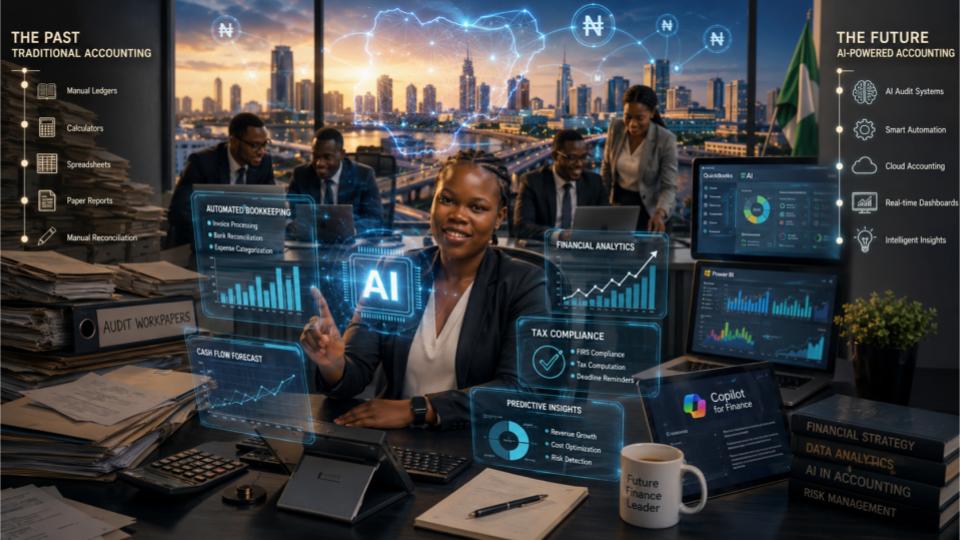
Adewale has been a chartered accountant for eleven years. He qualified with ICAN in 2015 and spent the following decade building a reputation as a thorough, reliable audit professional at a mid-tier Lagos firm. In early 2024 his firm adopted an AI-assisted audit platform. Within three months the reconciliation work that used to take his team of four people ten working days to complete was being done in less than two. The partners were pleased. Adewale was unsettled. Not because his job was at risk. Because he realised he had spent a decade building expertise in the specific tasks that a computer had just made dramatically faster, and he had spent almost no time building expertise in the judgment, interpretation, and advisory work that the same computer could not do. He spent the following year correcting that. In 2026 he is among the highest-billed members of his firm’s advisory practice, not despite AI but because of what it forced him to become.
Adewale’s story is playing out in different forms across every tier of Nigerian accounting practice, from the Big Four offices in Victoria Island to the sole practitioners in Onitsha and Kaduna who handle the books for small and medium-sized businesses. The technology is not the same in every context and the pace of adoption varies significantly. But the underlying shift is consistent: artificial intelligence is taking over the routine, repeatable, data-processing work that has historically occupied the majority of an accountant’s working hours, and it is doing so faster than the profession has fully absorbed.
This is not a crisis for Nigerian accountants who understand what is happening. It is an opportunity of a kind that does not appear in a profession more than once in a generation. The accountants who are positioned ahead of this shift in 2026 are not the ones with the most years of experience in traditional methods. They are the ones who understand which parts of their work AI can do faster and more accurately than they can, and who have invested in building the distinctly human capabilities that the same AI cannot replace: strategic judgment, client relationship management, interpretation of results in local context, ethical oversight, and the ability to translate complex financial data into decisions that business owners can act on.
ⓘ A note about this article before you continueThis article addresses AI’s impact on accounting in Nigeria with honesty about both the opportunities and the challenges. It does not claim that AI will eliminate Nigerian accounting jobs. It does not claim that AI adoption is smooth or fully underway across every segment of the Nigerian market. The reality is more complex: AI adoption in Nigerian accounting is uneven, accelerating, and concentrated currently in larger firms, listed companies, banks, and tech-forward SMEs. The stories and data in this article reflect the leading edge of that adoption and what it means for the direction the wider profession is moving. Income figures are self-reported and represent individual outcomes. Always conduct your own research specific to your sector and organisation.
Four Nigerian Accountants. Four Different Responses. Four Different Outcomes.
Adewale’s story opened this article but the middle section is what matters most for other Nigerian accountants to understand. When his firm adopted the AI audit platform, his first instinct was the same as most of his colleagues: to become more efficient at the tasks the AI was assisting with. That instinct was wrong, and it took him about a month to realize it. Being faster at AI-assisted reconciliation was not a skill that would differentiate him. Everyone on his team was faster at it once the platform was in use. The differentiating skill was being able to do the thing the platform flagged for review: to look at an anomaly identified by the AI and interpret what it actually meant for the client’s financial position, risk profile, and business strategy.
He spent eight months in 2024 deliberately moving toward the advisory side of his practice. He took two short courses in financial analysis and business strategy. He began attending client meetings that had previously been handled entirely by the partners. He started asking questions in those meetings that his technical accounting training had never required him to ask: questions about the business’s competitive position, its management’s decision-making process, and the non-financial factors that the numbers were reflecting. By the end of 2024 the partners had noticed the shift. By mid-2025 he was being billed to clients at the advisory rate rather than the audit rate, an increase in his billing value of approximately sixty percent.
Key lesson: when AI makes technical tasks faster, the value moves upstream to interpretation and judgment. Accountants who move upstream voluntarily get there before they are pushed.
Chiamaka runs a small accounting practice in Abuja serving Nigerian small and medium enterprises. In 2023 she had twelve regular clients and a team of two assistants. She could not take more clients because the manual bookkeeping, reconciliation, and monthly report preparation work was already consuming all available capacity. In early 2024 she began using a combination of QuickBooks with its AI features enabled and an AI-assisted report generation tool. The change to her capacity was dramatic. The work that used to occupy two full days per client per month now took approximately four to six hours, with her time concentrated on reviewing the AI-generated drafts, adjusting for items that required professional judgment, and adding the analysis and recommendations that her clients valued most.
By December 2024 she had grown her client base from twelve to twenty-eight without adding any additional staff. Each new client was taken on at a higher monthly fee than her original twelve because her service had evolved from bookkeeping and compliance to bookkeeping, compliance, and monthly management commentary with specific recommendations for each client’s business situation. The AI tools had not replaced her. They had multiplied the hours she could devote to the high-value work by dramatically reducing the time required for the foundational work that had to happen first.
Key lesson: for sole practitioners and small practices, AI tools are a capacity multiplier that enables revenue growth without proportional cost growth. The economics of a small Nigerian accounting practice change fundamentally with AI adoption.
Kunle is not a traditional accountant. He qualified as an accountant five years ago, worked for two years at a Lagos commercial bank, and then moved to a fintech startup where his role gradually evolved into something that did not have a clear title in any traditional accounting career path. He now leads what his company calls the AI-Assisted Financial Intelligence function, a role that did not exist two years ago and that was created specifically because the company needed someone who could bridge the gap between their AI-powered financial data systems and the business decisions those systems were supposed to inform.
His daily work involves reviewing the outputs of the company’s AI financial models, identifying where the models are producing results that do not account for Nigerian market-specific factors such as informal economy patterns, FIRS regulatory changes, and CBN policy shifts, and translating the gap between what the model says and what the Nigerian reality requires into actionable guidance for the executive team. This combination of accounting qualification, AI literacy, and deep Nigerian market knowledge commands a salary that Kunle describes as more than double what he earned at the bank, and the role is one that he acknowledges most accounting programmes in Nigeria are not currently training people to fill.
Key lesson: the combination of accounting qualification, AI literacy, and Nigerian market-specific knowledge is an extremely rare and therefore extremely valuable combination in the 2026 Nigerian job market.
Fatimah’s path into AI-augmented accounting came from a completely different direction from the previous three stories. She did not adopt AI tools out of curiosity or competitive ambition. She adopted them out of frustration with a specific problem that had been consuming disproportionate amounts of her time for years: Nigerian tax compliance documentation. The volume of documentation required for FIRS submissions, state tax authority filings, and the various certificates and registrations that Nigerian businesses must maintain had always been one of the most time-consuming parts of her practice. It was also the part that generated the most client complaints, not about quality but about speed.
She began using AI tools specifically for document drafting, compliance checklist generation, and preliminary review of client tax positions. The speed improvement was significant. More importantly, the reduction in the mental overhead of managing compliance documentation freed her attention for the higher-value analysis of her clients’ tax positions, the identification of legitimate optimisation opportunities within the Nigerian tax code, and the advisory conversations that resulted from that analysis. Her clients noticed. Several increased their monthly retainer fees voluntarily because they were receiving more strategic guidance than they had previously. Fatimah did not ask for the increases. She received them because the value she was delivering had visibly changed.
Key lesson: AI adoption does not have to start with grand repositioning. Starting with the most painful, time-consuming part of your current practice and using AI to reduce that pain creates immediate value and frees attention for higher-value work.
The AI Tools Reshaping Nigerian Accounting in 2026
Understanding which specific AI tools are in active use in Nigerian accounting practices gives a clearer picture of where adoption is actually happening versus where it is being discussed theoretically. The table below reflects tools that Nigerian accountants and finance professionals are using in practice, not a general list of global accounting technology. Some of these tools have limited free tiers. Some require paid subscriptions. All of them require learning time to use effectively, and the learning investment is significantly smaller than most Nigerian accountants expect it to be.
| Tool | Primary Accounting Use | Cost Model |
|---|---|---|
| QuickBooks AI | Automated bookkeeping, bank reconciliation, cash flow forecasting, anomaly detection | Paid |
| Sage Intacct | AI-powered financial consolidation, multi-entity reporting, regulatory compliance automation | Paid |
| Microsoft Copilot for Finance | Excel-integrated AI analysis, automated variance commentary, financial report drafting | Paid Tier |
| Zoho Books AI | Automated invoicing, expense categorization, tax computation assistance, FIRS compliance support | Free Tier |
| Dext (formerly Receipt Bank) | AI-powered receipt and invoice data extraction, supplier matching, expense report automation | Paid |
| Claude & ChatGPT | Financial report drafting, compliance document preparation, memo writing, client communication, tax position analysis narratives | Free Tier |
| Xero AI Features | Cash flow prediction, automated bank feeds, anomaly flagging, payroll AI assistance | Paid |
| Fiskl | AI-powered accounting and invoicing designed for African markets, including Nigeria | Free Tier |
| Inflow (Nigeria) | AI-assisted inventory management, financial tracking, and SME business management | Free Tier |
| Power BI with AI Visuals | Automated financial dashboards, AI-generated insights, management reporting, KPI visualization | Free Tier |
| KPMG Clara | AI audit platform for large engagements, automated evidence collection, audit analytics, risk assessment | Enterprise |
If you are a Nigerian accountant who has not yet adopted any AI tools and the list above feels daunting, start with two things only. First, enable the AI features in whatever accounting software you already use. If you use QuickBooks, turn on the AI-assisted categorization and the cashflow insights. If you use Excel, access Microsoft Copilot if your organisation has it. Second, begin using Claude or ChatGPT specifically for the written outputs of your work: drafting management commentary, writing client-facing explanations of financial results, and preparing compliance document summaries. These two starting points require no new software purchase and will immediately demonstrate the time savings that make the case for deeper adoption clearer than any article can.
The Skills Shift Every Nigerian Accountant Needs to Understand
The most important thing to understand about AI’s impact on Nigerian accounting is not which specific tasks are being automated. It is which direction value is moving as a result. When AI takes over the data entry, reconciliation, and routine report preparation work, the value that remains for human accountants shifts toward the capabilities that AI cannot replicate: judgment, interpretation, relationship management, ethical oversight, and the application of deeply local knowledge to situations that require context rather than calculation.
The ability to look at AI-generated financial data and explain what it actually means for a Nigerian business in its specific sector, market position, and regulatory environment. AI can produce the numbers. Only a human with genuine business understanding can produce the meaning.
The ability to sit across a table from a Nigerian business owner, understand their situation and goals, and translate financial information into decisions they can take. This is the skill that AI outputs make more valuable, not less, because the AI creates more information that needs translating.
The professional judgment to recognize when AI-generated financial outputs are incorrect, incomplete, or inapplicable to Nigerian regulatory and market context. An AI tool that produces a tax calculation without accounting for FIRS-specific requirements is more dangerous than no AI at all if nobody catches the error.
Understanding of FIRS guidelines, CAMA provisions, CBN regulations, state tax authorities, and the informal practices that govern real Nigerian financial compliance is something AI tools consistently underproduce because it requires current, hyper-local, frequently changing knowledge that training data cannot fully capture.
The foundational skill that most entry-level Nigerian accounting positions have historically required as their primary output. AI handles this faster and more accurately than human entry for structured data. This does not mean the knowledge is worthless, but it is no longer a competitive differentiator.
The production of regular financial reports from existing data, including monthly management accounts, trial balance reports, and standard variance analyses. AI tools produce these reports in a fraction of the previous time, reducing the value of the skill of producing them manually.
Bank reconciliation, supplier statement reconciliation, and intercompany reconciliation are among the first accounting tasks to be substantially automated by AI tools in Nigerian firms that have adopted them. Speed advantage of AI on these tasks ranges from five to twenty times faster than manual completion.
The drafting of standard tax returns, routine statutory filings, and templated compliance letters is increasingly handled by AI-assisted tools. The professional judgment in reviewing and approving these documents retains its value. The time investment in producing them from scratch declines sharply.
AI does not make accounting knowledge less valuable. It makes SHALLOW accounting knowledge less valuable and deep accounting judgment more valuable than it has ever been.
—On what AI adoption means for Nigerian accountants who invest in genuine depth
What the Salary Data Actually Shows in 2026
The most honest thing to say about income data for AI-augmented accounting roles in Nigeria is that the market is moving fast enough that figures published today may be significantly different from the market in eighteen months. What the current data shows clearly is that the gap between traditional accounting roles and AI-augmented equivalents is widening, and that the Nigerian accountants who have made the transition to advisory, analytical, or AI-specialist functions are earning at a level that was previously associated with much more senior positions.
| Role Category | Traditional Salary Range (2024) | AI-Augmented Salary Range (2026) |
|---|---|---|
| Junior Accountant | ₦80,000 – ₦150,000/month | ₦120,000 – ₦250,000/month |
| Management Accountant | ₦200,000 – ₦400,000/month | ₦350,000 – ₦700,000/month |
| Financial Analyst (Fintech) | ₦250,000 – ₦500,000/month | ₦500,000 – ₦1.2 Million/month |
| Tax Advisory Specialist | ₦200,000 – ₦450,000/month | ₦400,000 – ₦900,000/month |
| CFO / Finance Director | ₦600,000 – ₦1.5 Million/month | ₦900,000 – ₦2.5 Million/month |
| AI Finance Specialist (New Role) | Role did not exist in this form | ₦600,000 – ₦1.8 Million/month |
| SME Accounting Consultant | ₦100,000 – ₦300,000/month | ₦250,000 – ₦700,000/month |
ⓘ Important caveat on these figuresThe ranges in the table above reflect the spread from entry-level to experienced practitioners in each category. The AI-augmented ranges assume genuine competence with relevant AI tools and the ability to apply that competence to produce better client or employer outcomes, not simply having completed an online course in AI tools. The income premium is earned by demonstration of value, not by credential. A Nigerian accountant who describes themselves as AI-proficient on their CV but cannot demonstrate meaningful productivity improvement through AI in a practical context will not command the premiums shown above. Those who can demonstrate genuine value through AI adoption consistently report outcomes in the upper ranges.
What This Means for ICAN Members and Nigerian Accounting Students
The Institute of Chartered Accountants of Nigeria has been navigating the AI disruption question carefully and publicly in 2025 and 2026. ICAN’s official position acknowledges that AI is transforming the profession while affirming the continued importance of professional qualification and ethical oversight in an AI-assisted environment. For ICAN members and students, the practical implications are worth understanding clearly.
ICAN qualification remains valuable. The professional judgment, ethical framework, and regulatory knowledge that ICAN training develops are precisely the capabilities that AI tools cannot replicate and that become more important as AI handles more of the routine work. What ICAN qualification does not currently provide, though this is evolving, is sufficient training in the specific AI tools that are now central to Nigerian accounting practice. Members who add AI tool proficiency to their ICAN qualification have a combination that is significantly more marketable than either credential alone.
For ICAN students, the question is whether to study for the qualification with less urgency given AI’s impact on the profession. The answer is no, and the reasoning is important. AI adoption in Nigerian accounting is creating more high-value accounting work, not less. The firms and organisations that are adopting AI tools most aggressively are also the ones hiring the most qualified accountants for the analytical, advisory, and oversight roles that AI has made more prominent. The destination for the best Nigerian accounting careers in 2026 and beyond requires professional qualification and AI literacy together, not one instead of the other.
✔ For ICAN students and recently qualified membersThe most productive investment you can make alongside your ICAN studies or immediately after qualifying is thirty to sixty days of focused learning in the AI tools most relevant to your intended area of practice. For audit and assurance: learn the AI features of the major audit platforms and practice using AI tools for working paper documentation and review note preparation. For tax: learn to use AI tools for compliance documentation drafting and tax position narrative. For management accounting: learn Power BI and Microsoft Copilot for Finance. For practice management: learn Zoho Books, QuickBooks AI features, and Fiskl if you plan to serve SME clients. This investment is smaller than you expect and the return on it in your first three years of practice is larger than any single additional qualification currently available.
How to Start Today, Not Next Quarter
Every Nigerian accountant reading this article exists at a specific point in the adoption curve: either they have already begun integrating AI tools into their practice, they are aware of AI but have not yet made any substantive change, or they are encountering this information seriously for the first time. The checklist below is designed to give each of those positions a concrete, achievable first action rather than an overwhelming programme of transformation.
The Spreadsheet Replaced the Ledger. AI Is Replacing the Spreadsheet. The Accountants Who Adapted Both Times Are the Ones Who Led the Profession.
Adewale is billing at the advisory rate now. Chiamaka has more than doubled her client base without adding staff. Kunle is earning twice what he earned at the bank in a role that did not exist two years ago. Fatimah is receiving voluntary fee increases because the value she delivers has visibly changed. None of them are exceptional people with resources unavailable to other Nigerian accountants. They are people who looked at what was changing in their profession and moved toward it rather than away from it.
The Nigerian accounting profession in 2026 is at an inflection point that does not come around every decade. The accountants who build AI literacy now are not just keeping pace with change. They are positioning themselves at the leading edge of a profession that will be significantly more valuable, more interesting, and more strategically important to Nigerian businesses over the next ten years than it has been in the previous ten. The tools are available. Most of them are free to start. The only thing required is the decision to begin.
Frequently Asked Questions
1. How is AI changing accounting in Nigeria?
AI is automating bookkeeping, reconciliations, report preparation, and compliance tasks, allowing accountants to focus on advisory and strategic roles.
2. Will AI replace accountants in Nigeria?
No. AI is replacing routine tasks, not professional judgment. Accountants who develop AI skills and advisory expertise remain highly valuable.
3. Which AI tools are most useful for Nigerian accountants?
Popular tools include QuickBooks AI, Zoho Books AI, Sage Intacct, Microsoft Copilot, ChatGPT, Claude, Xero AI, and Power BI with AI features.
