

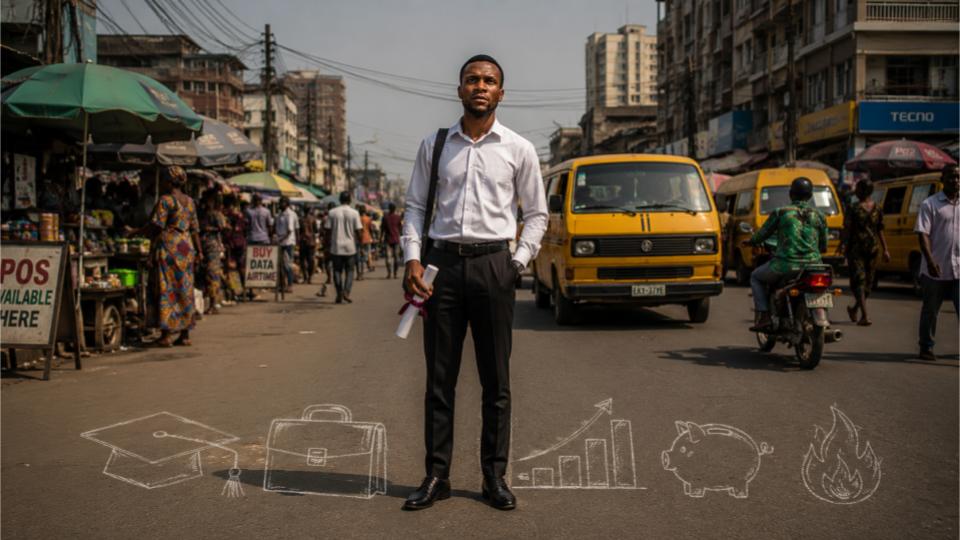
Every year, hundreds of thousands of young Nigerians cross a stage, collect a certificate, and walk into a world that looks nothing like what their parents described. If you are one of them, or if you are still in school counting down the days, this is the conversation nobody sat down to have with you before you left campus.
The Dream They Sold You Before You Graduated
Let us go back to the beginning. You were probably in secondary school when someone, maybe a parent, an uncle, a teacher, or even just the general atmosphere of your household, told you that education was the key. Get into university, study hard, collect your degree, and the good life would follow. A government job, a bank salary, a car within two years, and the respect of the community. That was the promise, spoken or unspoken.
It is not a dishonest promise, at least not in terms of intent. The people who told you that story genuinely believed it. And for a generation that came before, it was largely true. A university graduate in Nigeria in the 1980s or even the early 1990s was entering a market with relatively few degree holders, a more functional civil service, and a banking sector that was actively expanding. The credential was rare. Rare things command premium prices. That era is gone.
Today, Nigeria produces over 500,000 university graduates annually. Add polytechnic and college of education graduates and that number climbs even further. Meanwhile, the formal job market has not grown at anything close to the same rate. What was once a scarce commodity, the Nigerian university degree, has become almost ordinary in many sectors. Yet the expectations that were built around it have barely shifted.
So young people finish school and wait. They wait for the job that matches the sacrifice. They wait for the salary that will justify the WAEC fees, the school fees, the years spent in hostel rooms sharing a room with five other people. They wait, and in the waiting, confusion and sometimes bitterness set in. Because nobody told them the rules had changed.
“The most painful part of graduating in Nigeria is not the poverty. It is realizing that the plan you were given does not actually work anymore and nobody warned you.”
A 2024 graduate of University of Lagos, speaking during a focus group interview
The Realities of Nigeria’s Job Market That Nobody Announced
Here is what the job market in Nigeria actually looks like in 2026. It is not a comfortable picture, but looking at it clearly is the first step toward navigating it intelligently.
The formal employment sector in Nigeria is genuinely small relative to the size of the population. According to figures from the National Bureau of Statistics, the unemployment and underemployment numbers in Nigeria consistently point to a situation where a significant portion of working-age Nigerians are either without work or are working far below their capacity and earning potential. The NBS has reported youth unemployment figures that sit uncomfortably high, and this is not a temporary pandemic hangover. It is a structural reality.
The banking sector, which was once the holy grail for graduates, has been contracting its workforce as technology replaces what used to require large teams of people. The civil service, which absorbed millions of graduates in the post-independence decades, has been frozen or near-frozen in terms of new hires at the federal and many state levels. The oil and gas sector, romantically imagined by many engineering and accounting graduates as a golden destination, hires a very small and highly competitive slice of the graduate population. Telecoms, FMCG companies, consulting firms, they all hire, but nowhere near the volume that the graduating population requires.
There is another layer to this picture that is worth examining honestly. Nigerian employers have become significantly more demanding in what they expect from entry-level candidates. The ability to write a professional email is taken for granted. So is intermediate proficiency in Microsoft Excel, basic data literacy, and communication skills that can hold up in a client-facing environment. Many graduates, through no fault of their own, leave school without these competencies at the level employers expect. And because the pool of applicants is so large, employers can afford to wait for the candidate who is ready on day one.
The NYSC Gap That Nobody Talks AboutThe National Youth Service Corps year is a mandatory delay in your financial life. Twelve months during which most corps members earn a federal allowance that barely covers transport and phone data. Some states and employers add a token on top. But the reality is that at 22 or 23 years old, one full year of your productive earning life is spent in a structured programme that, while valuable in other ways, does not accelerate your financial position. Factor this into your planning before you leave school.
There is also the issue of what economists call credential inflation. When many people in a market have the same qualification, that qualification naturally commands less market power. In the 1980s, an HND in Accounting from a reputable polytechnic opened doors. Today, employers in the same field increasingly filter for a BSc, then for professional certifications on top of the BSc, then for relevant experience on top of the certifications. The bar has moved up, and the cost of clearing it has gone with it.
None of this means the situation is hopeless. Far from it. But hope that is not grounded in reality tends to paralyze rather than propel. So let us look at what actually works.
Why Skills, Networks, and Entrepreneurship Are the New Degree
The young Nigerians who are doing well financially in 2026 tend to share a common trait. They stopped waiting for the job market to validate their degree and started building capability that the market actually needed. They invested in skills, positioned themselves through relationships, or created their own tables when they could not find a seat at an existing one.
Skills are the new currency
Nigeria’s digital economy has created a market for skills that simply did not exist a decade ago. A young person in Ibadan who can build functional websites earns more than many office workers in the same city with three extra years of schooling. A graduate in Enugu who learned video editing on YouTube and built a client base doing commercial content for SMEs has a more predictable income than a colleague waiting for a bank interview callback. A young woman in Kano who learned social media management and built a portfolio of ten small business clients has constructed something that no recruiter can take from her.
These are not edge cases or exceptional stories. They are increasingly normal. What they require is a decision, sometimes an uncomfortable one, to invest time and attention into building marketable capability rather than only waiting for a title and a salary. The specific skills that are commanding the most consistent demand in Nigeria right now include digital marketing, data analysis, software development, UI and UX design, content creation, financial modelling, and social media management. None of these require a second degree. All of them require deliberate practice and the willingness to work for little or nothing at the beginning in exchange for experience and a portfolio.
Your network is operating capital
In Nigeria, perhaps more than in most other economies, it is genuinely true that who you know shapes what opportunities find you. This is sometimes discussed as a negative feature of the system, and in its most corrupt expressions, it certainly is. But there is a version of networking that is not about who will do you a favour. It is about being present in environments where people who are moving are also present, about being known as competent and reliable before a vacancy is ever announced, and about building relationships with people who are one step ahead of you.
The graduates who get first-mover advantage on opportunities are often not the most qualified candidates in the abstract. They are the people who were known before the vacancy was public. Alumni networks, professional associations, LinkedIn connections built and maintained before desperation set in, church networks, and informal business communities all function as pipelines that the wider job market does not advertise. If you are not actively building these networks, you are leaving real opportunity unclaimed.
Entrepreneurship is not a backup plan
There is still a tendency in some Nigerian families to treat entrepreneurship as what you do when you could not get a proper job. That framing is genuinely outdated. Nigeria’s private sector was built almost entirely by people who started something, not by people who waited to be employed into it. The trader who started with a small stall in Alaba market is today running a regional distribution business. The young man who started an event photography side hustle in school is now running a full production company. The young woman who started selling skincare products on Instagram during the COVID lockdowns now has a registered brand with national retail placement.
Entrepreneurship in Nigeria is not guaranteed easy money. It is genuinely hard, full of regulatory friction, infrastructure challenges, and market unpredictability. But it creates an asset, a business, that belongs to you entirely. No company can retrench you from your own business. No economic cycle can make your skills redundant if you are constantly applying them in a market context. And the ceiling on what you can earn is not set by an HR grading system.
The Three Levers Every Nigerian Graduate Needs to PullThe graduates building meaningful financial lives in Nigeria today are not doing one thing well. They are pulling three levers consistently. First, they are building a skill that the market will pay for without requiring a title. Second, they are investing in relationships before they need them. Third, they are generating income from more than one source, whether that means a salary plus a side business, a freelance client base plus an investment, or a product plus a service. The single income stream is one disruption away from crisis. Multiple streams create resilience.
Why Wealth Is Almost Always Built Slowly and Why That Is Actually Good News
Nigerian social media has a lot to answer for in terms of the unrealistic timelines young people are holding themselves to. When you scroll past a 26-year-old flaunting a car, a 28-year-old announcing their second real estate acquisition, or a 25-year-old declaring themselves financially free, it is easy to feel like you are falling behind a race everyone else seems to be winning.
Let me say something plainly. Most of what you see on Nigerian Instagram and Twitter is either exceptional, inherited, funded by debt, or not what it appears. Genuine, sustainable wealth creation in Nigeria takes time. This is not pessimism. It is the pattern visible in virtually every financially successful person you can trace from beginning to where they are now.
Look at the actual trajectory of people who are genuinely wealthy today. The Dangotes and Otedolas of Nigeria did not arrive at their position in their twenties. The businesswoman running a 50-person company in Abuja today started with a personal savings loan and a dining room desk a decade ago. The lawyer billing millions in fees per annum spent years building a reputation, taking cases nobody else wanted, and losing sleep over client problems before the big mandates arrived. Wealth has a compounding structure. Early investments, in skills, in reputation, in relationships, in small consistent savings, pay returns that appear small at first and then dramatically accelerate.
Understanding this changes how you measure progress. The question should not be why am I not rich at 25. The question should be: am I building something real? Are my skills growing? Am I saving anything? Am I adding value in the place I am working right now? These questions measure trajectory, and trajectory is what eventually becomes destination.
It also means resisting the pressure, sometimes intense in Nigerian social settings, to perform prosperity before it arrives. The new car bought on a salary that cannot sustain it, the apartment that takes 80% of your income because the address sounds impressive, the clothes and gadgets purchased to signal success, these are not investments in your financial future. They are withdrawals from it. The people who arrive at real financial security are typically not the same people who looked the most financially comfortable in their mid-twenties.
“In Nigeria, the person who looked broke at 27 because they were investing, learning, and saving is usually the same person who looks unstoppable at 35. Patience is not passivity. It is strategy.”
A Lagos-based financial planner with 12 years of practice
Practical Steps Graduates Can Actually Take to Build a Better Financial Future
Enough of the diagnosis. Here is the practical side of this conversation. These are not abstract suggestions. They are actions with a realistic return in the Nigerian context.
- Pick one high-demand skill and become genuinely good at it within six months — Not five skills at average level. One skill at a level that makes people refer you. Digital marketing, data analysis, web development, copywriting, video editing, or financial modelling are all viable. Use free or affordable resources: YouTube, Coursera, Udemy, Google’s free digital skills programme. Finish something rather than starting everything.
- Build your LinkedIn profile as seriously as you would a CV — Nigerian hiring managers, especially at mid-to-large companies and multinationals, do look at LinkedIn. A well-structured profile with a professional photo, a clear summary, and documented skills or certifications does not cost anything except time. Many graduates in Nigeria still do not have a LinkedIn presence at all, which means having one that is complete immediately puts you ahead of a significant portion of your competition.
- Start saving immediately, even when the amount seems embarrassing — The discipline of saving matters more than the amount in the early years. Five thousand naira a month saved consistently builds the habit and the proof to yourself that you can defer gratification. Platforms like PiggyVest, Cowrywise, or even a dedicated bank account you do not touch are available and functional for this purpose. The amount will grow as your income grows. What will not grow automatically is the habit, and that has to be built consciously.
- Get professional about your current role or side hustle — Whether you are in a job you did not plan for or running a side business you started out of necessity, bring a professional attitude to it. People who are reliable, proactive, and communicate clearly in their current position get referred, promoted, and remembered. Nigeria’s professional market is smaller than it appears. Reputation travels faster than CVs.
- Identify a professional community and show up for it consistently — Industry associations, young professional groups, alumni networks, and even WhatsApp communities structured around a sector are all places where information, opportunities, and mentorship circulate before they reach public channels. You do not need to attend everything. Pick two or three communities that are relevant to your career direction and be consistently present in them. Presence builds visibility. Visibility builds opportunity.
- Create a second income stream within your first two years after graduation — It does not have to be impressive. It just has to exist. Tutoring, freelance writing, social media management for a local business, running errands for a busy professional, buying and reselling goods online. The specific activity matters less than the principle: you should not be entirely financially dependent on one income source. Nigeria’s economy is unpredictable enough that a single income stream is a fragile financial architecture for anyone.
- Invest in a professional certification that complements your degree — In many sectors, a relevant professional certification does more for employability than a second degree. ACCA or ICAN for accounting graduates. CIPM for HR. PMP for project professionals. CISA or CISSP for IT. Google, HubSpot, and Meta all offer free or affordable digital marketing certifications. These credentials signal to employers that you took your development seriously beyond what was required, and in a crowded graduate market, that signal matters more than many people appreciate.
The Broader Conversation We Need to Be Having
This article is largely addressed to individual graduates and what they can do within the reality they face. But it would be incomplete without acknowledging that the challenges described here are not purely individual failures. They are also systemic ones. A government that funds education without a corresponding strategy for job creation is setting young people up for disappointment. An economy that does not attract sufficient investment to create formal employment at scale is a structural problem that individual hustle can only partially offset.
Nigerian graduates are among the most resourceful and hardworking young people on the planet. The energy, creativity, and persistence visible in markets across Lagos, Onitsha, Kano, and Port Harcourt is not the behaviour of a generation that lacks ambition or capability. It is the behaviour of a generation that is finding ways to survive and build in conditions that are genuinely difficult. Acknowledging that difficulty is not an excuse. It is context.
The graduate reading this article deserves both honesty and encouragement. The honesty is that the path to financial security in Nigeria in 2026 requires more than a degree and more patience than social media will ever suggest. The encouragement is that the path exists. People are walking it every day. The combination of a clear skill, a genuine professional network, disciplined savings, and multiple income streams has worked for Nigerians in every generation. It will work for yours too.
Start where you are. Use what you have. And do not let anyone tell you that because the road is harder than it should be, it is not worth walking.
Frequently Asked Questions
Why does a university degree no longer guarantee wealth in Nigeria?
A degree remains valuable, but employers increasingly seek practical skills, digital competence, work experience, and problem-solving abilities alongside academic qualifications.
What skills should Nigerian graduates learn to improve their earning potential?
Graduates should focus on digital skills, data analysis, AI tools, accounting software, digital marketing, software development, communication, and entrepreneurship.
How can graduates create opportunities when jobs are scarce?
They can explore freelancing, remote work, entrepreneurship, internships, professional certifications, and continuous skill development to increase their employability and income.
Which industries offer the best opportunities for graduates in 2026?
Technology, fintech, digital marketing, accounting and finance, renewable energy, healthcare, logistics, and e-commerce continue to offer strong growth opportunities.
Is higher education still worth it in Nigeria?
Yes. A degree provides a strong foundation, but combining it with in-demand skills, certifications, networking, and practical experience significantly improves career and financial outcomes.
