

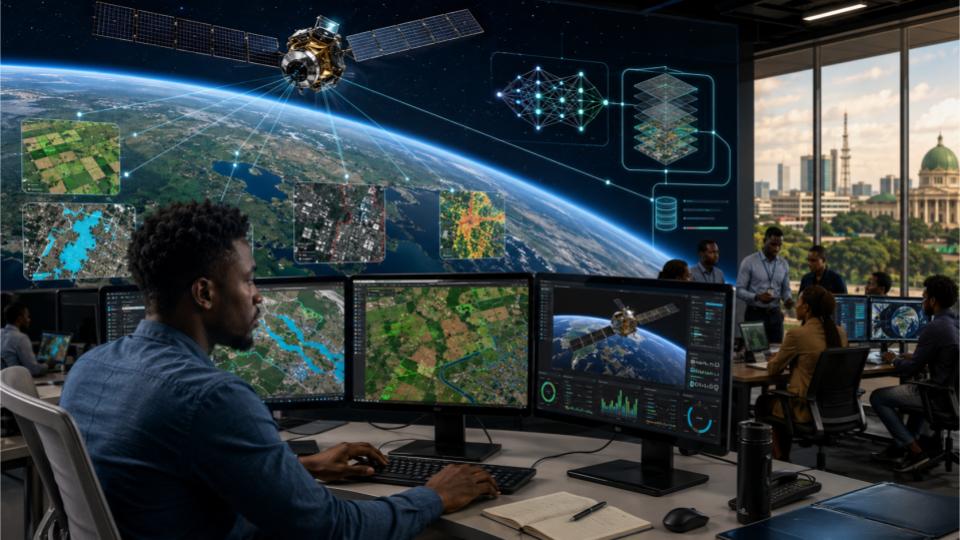
Two hundred kilometres above Nigeria right now, a satellite may be deciding on its own which farmland to photograph, which flood to flag, and which image is worth sending home. Here is what that shift actually means, and why it matters for Nigerian careers, not just Nigerian skies.
I had a conversation last year with a young geospatial analyst working with a Lagos based agritech startup, the kind of person who spends her days looking at satellite imagery so the rest of us never have to think about it. She told me something that stuck with me. She said the satellites she works with now do not just take pictures anymore. They look at the picture themselves, decide whether anything in it matters, and only then tell a human being that something needs attention. Before, the satellite was a camera. Now, increasingly, it is closer to a junior colleague who has learned to triage.
That shift, from satellites as passive cameras to satellites as decision-making systems, is one of the most significant and least discussed transformations happening in technology in 2026. It is happening quietly, mostly in engineering teams and space agencies rather than on the front pages of newspapers, but its consequences reach much further than most people assume, including into Nigeria’s own growing space programme and the career opportunities opening up around it.
This article explains how AI-powered satellites actually work, what onboard artificial intelligence allows them to do that traditional satellites could not, where Nigeria’s own space agency NASRDA fits into this picture, and what it means for Nigerians thinking about careers connected to space technology, agriculture, geospatial analysis, and the broader AI economy in 2026.
THE SHIFT
From Passive Cameras to Thinking Machines: What Changed
For most of the history of Earth observation satellites, the basic workflow was simple and unchanging. A satellite in orbit captures an image or a stream of sensor data. It transmits that raw data down to a ground station whenever it passes within range. Human analysts and software systems on the ground then process the data, looking for whatever it is they are trying to find, a flooded river, a healthy crop field, an unauthorised vessel in restricted waters, a wildfire starting in dry season.
This workflow has a built in bottleneck. Satellites generate enormous volumes of imagery, and the majority of any single image is, for any specific purpose, irrelevant. A satellite monitoring agricultural land across Nigeria’s middle belt captures images of roads, settlements, forest, and cloud cover alongside the farmland that is actually of interest. Transmitting all of that raw data to the ground, and then having a human or a ground based system sort through it, takes time, uses significant communication bandwidth, and delays the moment at which someone actually learns something useful.
What changed with the introduction of onboard artificial intelligence is that satellites can now perform a meaningful portion of that sorting and analysis themselves, in orbit, before the data ever reaches the ground. A satellite equipped with a small but capable AI processor can run an image classification model directly onboard, identify which images contain something relevant, such as flood waters or unusual crop stress patterns, and prioritise transmitting only that subset of data, or in more advanced cases, take a specific automated action, like adjusting its own camera angle to capture a follow-up image of something it has just identified as significant.
| Step | Process | Description |
|---|---|---|
| 1 | Capture | The satellite’s sensors capture raw imagery or data as it passes over a target region, the same first step as traditional satellites. |
| ↓ | ||
| 2 | Onboard Analysis | An AI model running on the satellite’s own processor analyzes the captured data immediately, in orbit, without waiting for a ground connection. |
| ↓ | ||
| 3 | Classification & Decision | The AI identifies what matters in the data, a crop disease pattern, a flood boundary, an object of interest, and decides what action or transmission priority follows. |
| ↓ | ||
| 4 | Selective Transmission | Only the relevant, prioritised data is sent to the ground station, dramatically reducing bandwidth use and the time needed for a human to find what matters. |
| ↓ | ||
| 5 | Human Review & Action | Analysts on the ground, often within agencies like National Space Research and Development Agency or partner organisations, review the AI-prioritised findings and decide on real-world action. |
📡 AI-Powered Satellite Workflow: By processing data directly in orbit, AI-enabled satellites can reduce transmission delays, improve efficiency, and help decision-makers respond more quickly to events such as floods, crop diseases, environmental changes, and security incidents.
| 📡 AI Satellites & Nigeria’s Space Programme (2026) | Details |
|---|---|
| 📉 90%+ | Reduction in irrelevant data transmitted to ground stations by satellites using onboard AI image filtering. |
| ⚡ Minutes (Not Hours) | Typical time for an AI satellite to flag a disaster event versus traditional ground-based analysis pipelines. |
| 👨🚀 6,000+ | Staff currently employed across National Space Research and Development Agency, including over 300 PhD holders working on Nigeria’s space programme. |
WHY IT MATTERS
Why Autonomous Decision Making in Orbit Is a Genuinely Big Deal
It is worth pausing on why this technical shift matters beyond the engineering details. The value of an Earth observation satellite has always been in how quickly and accurately the information it captures can be turned into a decision that helps someone, a farmer, a disaster response team, a security agency, an urban planner. Every minute spent waiting for raw data to be transmitted, downloaded, and manually reviewed is a minute in which a flood spreads further, a crop disease progresses, or a security threat goes unaddressed.
AI-powered satellites compress that delay dramatically. A satellite that can recognise the visual signature of a flooding river as it passes overhead, and immediately prioritise that image for transmission rather than waiting in a queue behind thousands of routine images, can put life-saving information into the hands of disaster response coordinators significantly faster than a traditional system. The same logic applies, with lower stakes but real economic value, to agricultural monitoring, where identifying a crop disease outbreak two weeks earlier than a traditional survey would have can mean the difference between a contained problem and a regional harvest failure.
The satellite used to be the eye. Now it is starting to be the eye and the first part of the brain. The human analyst still makes the final call, but they are making it on information that has already been triaged, which changes how fast a country like Nigeria can respond to things that move quickly, floods, fires, and crop disease among them.
Geospatial data scientist working with a Nigerian agritech firm, speaking in early 2026
There is also a quieter but important economic dimension to this shift. Satellite communication bandwidth, the capacity to transmit data from orbit to the ground, is genuinely expensive and limited. By filtering data onboard before transmission, AI-powered satellites allow a given amount of bandwidth to deliver dramatically more useful information than the same bandwidth could deliver if forced to carry unfiltered raw data. This makes satellite-based monitoring more affordable and more scalable, which matters enormously for a country like Nigeria where investment in space infrastructure has to compete with many other pressing national priorities.
THE NIGERIAN CONTEXT
Where NASRDA and Nigeria’s Space Programme Fit Into This Picture
Nigeria’s relationship with satellite technology is older and more established than many Nigerians realise. The National Space Research and Development Agency, NASRDA, was formed in 1999 and has overseen Nigeria’s satellite programme since the launch of NigeriaSat-1 in 2003, making Nigeria one of the earliest African countries to develop an active satellite capability. NASRDA today employs thousands of staff, including, according to the agency’s own leadership, over three hundred PhD holders, and operates from its headquarters in Lugbe, Abuja.
The integration of artificial intelligence into Nigeria’s satellite and Earth observation work has been advancing steadily rather than arriving as a single dramatic announcement. NASRDA’s CropWatch satellite agricultural monitoring system, launched in 2024, represents an early and concrete example of satellite data being combined with analytical tools to give Nigerian farmers and policymakers a clearer picture of crop conditions across the country. More recently, NASRDA has been running the Irrigated Earth Observation programme, known as IrrEO, in partnership with research institutions and development partners, working specifically to address Nigeria’s heavy dependence on rainfall for agriculture by using satellite-based tools, including AI-assisted analysis, to map irrigated cropland with far greater precision than ground surveys alone could achieve.
Nigeria’s ambitions in this space are expanding rather than slowing down. The Federal Government has approved the launch of four new satellites, three carrying optical payloads and one a Synthetic Aperture Radar satellite intended to replace an existing system, reflecting a deliberate push to strengthen the country’s space technology capability. Separately, NIGCOMSAT, Nigeria’s communications satellite operator, has announced plans for two new communications satellites, NIGCOMSAT-2A and 2B, targeted for 2028 and 2029, intended to strengthen connectivity and security, with NIGCOMSAT’s leadership explicitly describing a vision of using these satellites to support real-time communication, intelligence gathering, and connectivity in remote areas of the country.
What NASRDA’s Agricultural AI Work Actually Looks Like on the Ground
The Innovative Agriculture project, developed by NASRDA in partnership with the European Space Agency and EU agricultural programmes in Nigeria, illustrates how this technology translates into something a Nigerian farmer can actually use. The project establishes demonstration farms across Nigeria’s diverse agroecological zones, equipped with digital mapping, soil analysis, and precision farming tools that draw on satellite imagery analysed using AI methods to give farmers accurate, location-specific guidance on soil quality, suitable crops, and optimal planting schedules. Rather than relying solely on traditional extension services and generalised advice, farmers connected to these systems receive insights derived from how their specific fields actually appear from orbit, processed through models trained to recognise patterns in soil and vegetation health that the human eye alone would struggle to detect consistently across millions of hectares.
BEYOND AGRICULTURE
Security, Disaster Response, and Urban Planning: The Other Frontiers
While agriculture has been the most visible application of AI-enhanced satellite data in Nigeria, the underlying technology has clear relevance across several other domains that matter significantly to the country’s development and security.
Nigeria’s security establishment has signalled growing interest in space-enabled intelligence gathering, with senior military leadership publicly stressing the importance of closer collaboration between government, industry, and international partners to address emerging threats through space-enabled capabilities. AI-powered satellite systems, capable of automatically flagging unusual movement patterns, unauthorised activity in sensitive areas, or changes in infrastructure that warrant attention, represent a meaningfully different intelligence capability than satellites that simply capture imagery for later human review, particularly in a country with porous borders and security challenges spread across a vast and varied terrain.
Disaster response is another area where the speed advantage of onboard AI analysis has direct, practical value for Nigeria. The flooding that affects parts of Nigeria during the rainy season, sometimes displacing hundreds of thousands of people, is exactly the kind of fast-moving event where a satellite capable of automatically recognising and flagging flood extent as it happens, rather than requiring a multi-step ground-based analysis process, can meaningfully accelerate the emergency response timeline that follows.
Urban planning and infrastructure monitoring represent a quieter but steadily growing application area. NASRDA itself has highlighted the production of high resolution satellite imagery for environmental analysis and urban planning as part of its core service offering, and the combination of this imagery with AI based change detection, the ability to automatically identify new construction, deforestation, or land use changes across large areas over time, gives Nigerian urban planning authorities and environmental regulators a monitoring capability that would be prohibitively expensive and slow to replicate through ground surveys alone.
THE CAREER ANGLE
What This Means for Nigerians Building Careers Around Space and AI
For most Nigerians, satellites and space technology can feel like a remote, abstract subject with little connection to their own career planning. That perception is increasingly out of date. The growth of AI-integrated Earth observation, both within NASRDA and across the private agritech, fintech, and geospatial analytics companies that consume satellite data, is creating genuine and growing demand for specific, learnable skills.
| Career Path | Demand Level | Description |
|---|---|---|
| 🛰️ Geospatial Data Analysis | High Demand | Skills in GIS software, remote sensing principles, and satellite imagery interpretation are increasingly sought by agritech firms, environmental NGOs, and government agencies working alongside National Space Research and Development Agency‘s data outputs. |
| 🧠 Machine Learning for Earth Observation | Growing Fast | Building and training computer vision models specifically for satellite imagery, crop classification, flood detection, and change detection is a specialised but learnable niche within Nigeria’s broader AI skills landscape. |
| 🌾 AgriTech Data Translation | Underserved Niche | Professionals who can translate satellite-derived insights into practical, farmer-facing guidance, bridging the gap between raw data and usable advice, are in short supply relative to the rapidly growing data output. |
| 📡 Satellite Data Engineering | Emerging | As Nigeria’s satellite fleet expands with new optical and radar payloads, demand is rising for engineers who can manage data pipelines, ground station operations, and the infrastructure connecting satellites to usable products. |
A Realistic Path Into This Field for a Nigerian GraduateYou do not need an aerospace engineering degree to begin building relevant skills for this growing field. A strong foundation in Python programming, combined with free or low-cost courses in remote sensing and GIS through platforms like Google Earth Engine’s own training resources, the European Space Agency’s free online courses, or NASA’s Applied Remote Sensing Training programme, provides a realistic and achievable entry point. From there, building a small portfolio project, for example analysing publicly available satellite imagery of a specific Nigerian region to map vegetation change or flood risk, gives you something concrete to show prospective employers in Nigeria’s growing agritech, environmental consulting, and geospatial analytics sector, several of which actively recruit professionals with exactly this combination of skills.
LOOKING AHEAD
Practical Steps for Nigerians Who Want to Get Involved in This Space
The European Space Agency, NASA, and Google Earth Engine all offer free online training in remote sensing and satellite imagery analysis that require no prior background beyond basic computer literacy and an interest in learning. Completing one of these structured courses gives you both foundational knowledge and a credential to list on your CV and LinkedIn profile.
Python is the dominant programming language in geospatial and remote sensing work. Focus your learning specifically on libraries relevant to this field, including NumPy, Pandas, and specialised geospatial libraries like Rasterio and GeoPandas, rather than general purpose programming alone, since this targeted skill set is what employers in this niche specifically look for.
Satellite imagery from sources like Sentinel Hub and Landsat is freely accessible to the public. Choose a specific, well-defined Nigerian problem, mapping flood risk along a particular river, tracking vegetation change in a specific state, or monitoring urban expansion in a growing city, and produce a complete, documented analysis. This single project, done well, demonstrates more to a potential employer than a list of completed online courses.
NASRDA periodically runs workshops, training programmes, and stakeholder engagements, including recent initiatives focused on satellite-based irrigation mapping and agricultural monitoring. Following the agency’s announcements, and those of partner organisations like Space in Africa, keeps you informed of opportunities for training, internships, or collaboration as Nigeria’s space and AI integration programmes continue to expand.
While NASRDA is the most visible institution in this space, the practical demand for geospatial and satellite data skills in Nigeria increasingly comes from private sector agritech startups, environmental consultancies, insurance companies assessing agricultural risk, and urban planning firms, all of which consume satellite-derived data and increasingly value staff who can work with it directly rather than outsourcing the analysis entirely.
A Necessary Word on Limits and Human OversightIt is worth being clear that autonomous decision making in satellites, as the technology stands in 2026, remains bounded and human-supervised rather than fully independent. Satellites flag, prioritise, and in some cases take narrow predefined automated actions, but consequential decisions, how a government responds to a flood warning, how a security agency acts on a flagged anomaly, how policy responds to crop disease data, remain firmly in human hands. The AI is a triage and acceleration layer, not a replacement for human judgement, and understanding this distinction matters both for realistic expectations about the technology and for understanding where the genuine career opportunities lie, squarely in the space between raw satellite capability and the human expertise needed to interpret and act on what it reveals.
The geospatial analyst I mentioned at the start of this article put it simply when we spoke. The satellites are getting smarter, she said, but that does not make the people who understand them less necessary. If anything, it makes them more necessary, because someone still has to know what the satellite is actually looking at, why it flagged what it flagged, and what to do next. That, in the end, is the opportunity sitting inside this technological shift for Nigeria, not a future where machines decide everything from orbit, but a future where a new generation of Nigerian analysts, engineers, and agricultural specialists learn to work fluently alongside satellites that have finally learned to do some of the looking for themselves.
FREQUENTLY ASKED QUESTIONS (FAQs)
AI-Powered Satellites in 2026: Common Questions Answered
What does it mean for a satellite to be AI-powered or autonomous?
An AI-powered or autonomous satellite carries onboard computing hardware capable of running machine learning models directly in orbit, allowing it to analyze the imagery or data it captures, identify objects or events of interest, and decide what to transmit back to Earth or how to respond, without waiting for instructions from a human-operated ground station. This is different from traditional satellites, which capture raw data and send everything to Earth for human analysts to process.
Does Nigeria have AI-powered satellites in 2026?
Nigeria’s National Space Research and Development Agency, NASRDA, has been incorporating artificial intelligence and earth observation tools into its agricultural monitoring and irrigation mapping programmes in 2026, including initiatives like the Irrigated Earth Observation project and the CropWatch satellite agricultural monitoring system. Nigeria has also received presidential approval for new satellites including optical and Synthetic Aperture Radar payloads, and the country’s broader satellite programme, including the planned NIGCOMSAT-2A and 2B communications satellites, is expected to incorporate more advanced onboard processing capabilities as the technology matures.
What career opportunities does AI satellite technology create for Nigerians?
AI satellite technology is creating demand in Nigeria for skills including geospatial data analysis, machine learning model development for Earth observation, remote sensing and GIS expertise, satellite data engineering, and agricultural technology specialists who can interpret satellite-derived insights for farmers. NASRDA has stated it employs thousands of staff including hundreds of PhD holders, and growing private sector demand exists for professionals who can work with satellite imagery and AI tools in agriculture, security, and urban planning.
How are AI satellites used in agriculture in Nigeria?
In Nigeria, AI-enhanced satellite systems are being used to map irrigated cropland, monitor crop health, assess soil quality, and help determine optimal planting schedules through programmes such as NASRDA’s CropWatch system and the EU-supported Innovative Agriculture project. These systems combine satellite imagery with machine learning analysis to give farmers and policymakers more accurate, timely information than traditional ground surveys alone could provide.
