

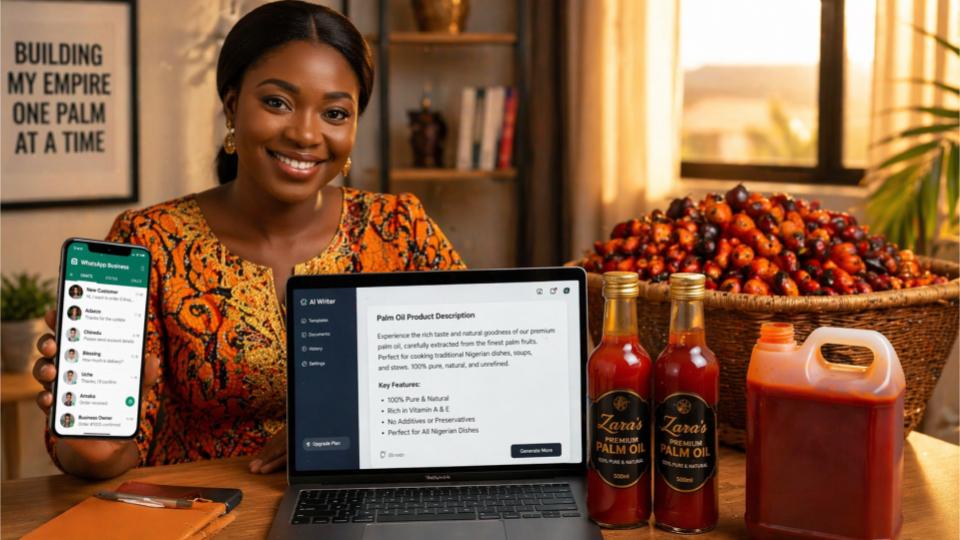
My aunt in Owerri has been selling palm oil for nineteen years. She wakes up before five in the morning, travels to the mill, haggles with processors, loads her jerry cans into a shared bus, and by noon she is selling from a small shop in the market. On a good week she makes N60,000. On a bad week, especially in the months when palm oil is scarce or prices crash, she makes N20,000. She works harder than almost anyone I know and she is perpetually exhausted. When I sat with her last December and showed her how one woman in Abia State had built an N8 million annual palm oil business selling entirely through WhatsApp and Instagram, she stared at me for a long moment and said, “But I do not know how to do those things.”
That conversation is exactly why this guide exists. Palm oil business digital income in Nigeria is not a fantasy or a get-rich scheme. It is a genuine, practical opportunity that is available right now to anyone who sells palm oil, processes it, or even just lives near a community that produces it. And with AI tools that are increasingly affordable and accessible even on a basic Android smartphone, the barrier to entry has dropped dramatically in 2026.
This guide will walk you through everything you need to know, from understanding why palm oil remains one of Nigeria’s most profitable commodities, to how AI specifically applies to your business, to the exact steps for building a digital income stream from palm oil with low starting capital, and how to avoid the mistakes that derail most beginners before they see results.
Why Palm Oil Business Is Still Profitable in Nigeria in 2026
Before we talk about digital tools and AI, it is worth establishing clearly why palm oil remains one of the most consistently profitable commodities available to Nigerian entrepreneurs at virtually any income level. There are three reasons this commodity continues to deliver returns even when other businesses struggle.
The first reason is that palm oil is a staple. It is not optional in the Nigerian kitchen. It goes into soups, stews, pepper soup, egusi, banga, ofe onugbu, and dozens of other dishes that Nigerians eat every single day. Demand does not collapse when the economy tightens. In fact, economic hardship tends to push more Nigerians toward local staple cooking and away from imported alternatives, which only strengthens demand for palm oil. According to the Food and Agriculture Organization, Nigeria is the fourth largest producer of palm oil globally, and yet domestic demand still consistently outstrips local supply, which keeps prices firm.
The second reason is the export opportunity. Red palm oil and palm kernel oil are in extremely high demand among African diaspora communities in the United Kingdom, the United States, Canada, and across Europe. These communities cannot easily source quality Nigerian palm oil locally. A seller who understands how to package, export, and market to this audience is accessing a customer base that will pay premium prices, often in pounds or dollars, for the same product that sells for naira at the local market.
The third reason is pricing power. Palm oil prices in Nigeria have risen significantly alongside general inflation, but unlike many commodities, quality palm oil commands genuine premium pricing when it is correctly packaged, marketed, and positioned. A litre of well-presented, clean, premium palm oil in a sealed branded bottle with clear labeling sells for two to three times the price of the same volume sold from a roadside drum, even though the underlying product is identical. Digital marketing and good packaging close that pricing gap, and the entire gap is profit.
Real ExampleChidinma, a 31-year-old mother of two in Umuahia, started reselling palm oil from her local market via WhatsApp in 2023 with N45,000 in starting capital. By mid-2025 she was processing orders of 50 to 200 litres weekly from customers in Lagos, Abuja, and Port Harcourt, plus three diaspora customers in the UK who she found through Instagram. Her monthly net income crossed N350,000. She has never left Umuahia to do any of this.
What Is AI and How Does It Apply to Your Palm Oil Business in Nigeria
When most Nigerians hear the word “AI,” they imagine something out of a science fiction film: robots, supercomputers, and technology that requires a PhD to use. The reality in 2026 is completely different, and understanding this difference is what unlocks the palm oil business digital income opportunity for ordinary Nigerians.
AI, which stands for Artificial Intelligence, simply refers to computer programs that can understand instructions, generate useful content, analyze data, and make predictions based on information they have been trained on. You are already using AI every day without thinking about it. WhatsApp’s voice-to-text feature is AI. Google Maps predicting your travel time is AI. Instagram deciding which posts to show you is AI. These tools are not exotic. They are practical, and more of them are becoming available specifically for small business owners and agricultural traders every month.
For a palm oil business in Nigeria specifically, AI applies in very practical ways. It can help you write your product descriptions and marketing captions better than most humans can do quickly. It can analyze market price trends to tell you when to buy stock and when prices are likely to rise. It can automate customer responses on WhatsApp so you are not losing sales because you were asleep or at the market. It can help you find export customers by analyzing which markets have the highest demand for Nigerian palm oil right now. And it can help you test different packaging and pricing options by analyzing what similar sellers are doing and what is working for them.
Important ClarificationYou do not need to be a tech person to use AI tools for your palm oil business. Most of the tools covered in this guide work through simple apps on your Android phone or through free websites. If you can type a message on WhatsApp, you can use AI to grow your business. The learning curve is genuinely low for the applications that matter most at the beginner level.
7 Ways AI Can Boost Your Palm Oil Business Digital Income in Nigeria
Here are seven specific, practical applications of AI for palm oil business digital income in Nigeria, ordered from easiest to start with to more advanced tools you can grow into as your business scales.
1. AI-Generated Marketing Content for WhatsApp and Social Media
Writing compelling product descriptions, promotional messages, and sales captions is something that stops many small-scale palm oil sellers from marketing effectively online. AI tools like ChatGPT, Gemini, and Claude can generate professional-quality WhatsApp broadcast messages, Instagram captions, and Facebook posts for your palm oil business in seconds. You simply describe your product, your price, your location, and your target customer, and the AI writes content that sells. This alone can dramatically improve your conversion rate from the same number of customer contacts.
2. Market Price Prediction and Buying Strategy
Palm oil prices in Nigeria fluctuate seasonally and in response to broader economic shifts. AI-powered commodity price tools and even simple AI chatbots you can query with market data can help you understand when prices are likely to rise and fall, allowing you to buy stock at lower prices and sell when demand peaks. This is the same kind of intelligence that large commodity traders use, now accessible to small sellers with a smartphone.
3. Automated WhatsApp Customer Responses
Missing a customer enquiry because you were at the mill or asleep is one of the most common ways small-scale palm oil sellers lose sales. WhatsApp Business allows you to set up automated greeting messages and quick replies. More advanced tools like WATI and Respond.io add AI-powered response capabilities that can answer customer questions, send product catalogues, and even process basic orders automatically while you focus on sourcing and logistics.
4. Quality Control Support Using Image AI
AI image tools can now assist with basic quality assessment. Some agricultural startups are already deploying tools that analyze smartphone photos of palm oil to estimate quality indicators like free fatty acid content, moisture levels, and colour grade. While the technology is still developing for local Nigerian conditions, staying aware of this application positions you ahead of competitors who are not watching this space.
5. Identifying and Reaching Export Markets
AI research tools can help you map out which countries have the highest Nigerian diaspora populations and therefore the strongest demand for Nigerian palm oil. They can help you draft professional export inquiry emails, identify food import regulations for specific countries, find Nigerian food importers operating in the UK and US, and even translate your product information into French for Francophone African diaspora markets. This kind of research previously required expensive consultants. AI makes it accessible for free or near-free.
6. Optimizing Pricing Strategy
AI tools can analyze what competitors are charging for similar palm oil products on Nigerian e-commerce platforms and social media, helping you understand whether your pricing is competitive or leaving money on the table. By feeding AI tools with competitor pricing information that you gather manually, you can get useful analysis about optimal price points for different customer segments, packaging sizes, and markets.
7. Building a Professional Online Presence Without a Web Developer
AI website builders like Wix ADI, Squarespace, and newer tools like Framer AI can create a professional-looking website for your palm oil business in under an hour with no coding knowledge required. Having a website adds enormous credibility when approaching export customers or high-value bulk buyers who need to see a professional operation before committing to a large order. AI can also help you write all your website content, including your product pages, about page, and contact information.
Step-by-Step Guide to Start Your Palm Oil Digital Business with Low Capital
This is the section that matters most if you are starting from scratch or currently selling informally and want to build something more structured. These steps are sequenced in a realistic order based on what actually works for Nigerian sellers operating with limited starting budgets.
1. Start with what you already have access to
You do not need to invest in production equipment or a processing mill to start building palm oil business digital income in Nigeria. The fastest starting point is as a reseller. Identify your nearest palm oil producing community, whether that is in Imo, Rivers, Cross River, Akwa Ibom, Delta, or Edo State, connect with at least two or three direct processors or cooperative groups, and negotiate a bulk buying price. Starting with 20 to 50 litres is completely viable. Your starting capital can be as low as N30,000 to N50,000 for your first stock purchase.
2. Set up WhatsApp Business properly before anything else
Download WhatsApp Business (it is free) and set up your profile completely. Add a clear business name, a professional profile photo of your product, your location, business hours, and a short description that includes what you sell and where you deliver. Create a product catalogue inside WhatsApp Business with photos, descriptions, and prices of your different packaging options. This takes about two hours and costs nothing. It is the single most important setup step for a Nigerian palm oil seller going digital.
3. Use AI to create your first marketing content
Open ChatGPT, Gemini, or Claude in your phone browser (all free at the basic level). Ask the AI to write you a WhatsApp broadcast message advertising your palm oil, specifying your price per litre, your location, your delivery options, and what makes your product good quality. Edit the result slightly to add your own voice and contact number. Send this to your existing contacts. Ask satisfied customers to share your number. This costs nothing and takes less than 30 minutes.
4. Add Instagram and Facebook as secondary selling channels
Create a dedicated Instagram business account and Facebook page for your palm oil business. Post photos of your product regularly, ideally well-lit shots that show the quality and colour of your oil. Use AI to generate your captions. Join palm oil buyer and seller groups on Facebook, of which there are dozens active in Nigeria, and post your product with clear pricing information. Consistency matters more than frequency. Posting three good photos per week consistently for three months will grow your reach more than posting twenty photos in one week and then going silent.
5. Invest in packaging that justifies higher pricing
This is the single biggest pricing lever available to Nigerian palm oil sellers. The same litre of palm oil in a clean, sealed, labelled PET bottle commands significantly more than the same oil sold from a drum or an unlabelled sachet. Branded labels can be designed for free using Canva and printed locally for very low cost. Invest in clean food-grade bottles. Price your packaged product at a premium. Buyers who order through WhatsApp and Instagram are overwhelmingly willing to pay more for a product that looks professionally packaged because they are buying trust alongside the oil itself.
6. Start building toward export with small test shipments
Once your local digital business is stable, begin researching export channels. Connect with Nigerian freight forwarders who specialize in food products. Join Facebook groups and WhatsApp communities for Nigerians in the diaspora and offer to ship directly. Start with small 5 to 10 litre shipments to test the logistics and payment process. FedEx, DHL, and EMS PostaMaste all handle small food product shipments from Nigeria to the UK and US. Your first successful export shipment is the proof of concept that everything larger is built on.
How to Sell Palm Oil Online in Nigeria: WhatsApp, Social Media, and Export
Selling palm oil online in Nigeria works across several channels, and the most successful sellers do not rely on just one of them. Here is how each channel works and what it is best suited for in the context of your palm oil business digital income strategy.
WhatsApp Business
The palm oil seller who combines WhatsApp Business with Instagram, exports to two diaspora customers, and supplies one restaurant account has built four separate income streams from one product. That is what digital channels make possible for Nigerian agribusiness in 2026.
Common Mistakes to Avoid When Building Palm Oil Business Digital Income in Nigeria
Most Nigerian palm oil sellers who try to go digital do not fail because they picked the wrong platform or used the wrong tool. They fail because of one of a small number of predictable mistakes that are completely avoidable once you know what to watch for.
1. Inconsistent quality with no quality guarantee
The biggest trust killer in palm oil digital selling is delivering a product that looks or tastes different from what the customer received last time. Digital buyers, unlike market buyers, cannot inspect the product before paying. Your quality must be consistent every single time, and you need to communicate your quality standards clearly in all your marketing. Offering a straightforward replacement policy for genuinely substandard deliveries costs you almost nothing and builds the kind of trust that generates repeat orders and referrals.
2. No clear pricing and packaging options
Selling only in bulk drums or jerry cans without offering smaller packaged options cuts you off from the largest segment of digital buyers, which is households wanting 1 to 5 litre quantities. Offer at least three packaging sizes with clear pricing for each. This doubles or triples your addressable market without adding any complexity to your sourcing.
3. Starting social media and then going silent after two weeks
This is the single most common failure pattern for Nigerian agribusiness sellers going digital. They post intensely for two weeks, get no immediate sales, lose motivation, and stop. Digital income from palm oil does not work on a two-week timeline. It works on a three to six month timeline of consistent activity. The sellers who succeed are the ones who post three times per week for six consecutive months regardless of whether they feel like it or whether the early results are exciting.
4. Ignoring delivery logistics until after orders arrive
Figure out your delivery logistics before you start marketing heavily. Know your delivery partners, your packaging materials, your delivery cost per location, and your minimum order for free delivery. Nothing damages a digital business faster than taking an order and then failing to deliver it reliably and on time. Bad delivery experiences generate the kind of WhatsApp reviews that spread quickly in Nigerian consumer circles.
5. Pricing too low out of fear of losing customers
Digital buyers, especially those ordering through Instagram and WhatsApp, are not primarily price-driven the way market buyers are. They are paying for convenience, trust, and quality assurance. Price your product to reflect the value you are providing, which includes your professional packaging, your responsive communication, your reliable delivery, and your consistent quality. Sellers who price at market rates for digital sales are leaving their most important competitive advantage completely unused.
6. Not asking satisfied customers for referrals
The most powerful marketing tool for a Nigerian palm oil digital business is a satisfied customer who tells their household group chat about you. After every successful delivery, send a simple follow-up message asking how the customer is enjoying the product and politely requesting that they share your number with anyone who might be interested. This costs nothing and builds a referral network that grows your customer base faster than any paid advertising at the early stage of your business.
What to AvoidDo not present your palm oil business as a passive income or overnight success story to potential customers or on your social media. Nigerian digital buyers are sophisticated and quickly identify overselling. Build trust through consistency, transparency about your sourcing, genuine product quality, and reliable delivery. That reputation, built slowly, is worth more than any paid campaign.
The palm oil sellers building serious digital income in Nigeria in 2026 are not necessarily the ones with the best product, the lowest price, or the biggest following. They are the ones who document their process and share it publicly. Short videos of your sourcing trip to the mill, your packaging process, or even your delivery runs build an audience that trusts you before they ever place an order. You do not need a ring light or a studio. A clean background and decent lighting on your phone is enough. Use AI to generate your video captions and description text. Post consistently. The sellers who share their story sell more palm oil. That is simply what the data shows.
Frequently Asked Questions About Palm Oil Business Digital Income in Nigeria
Can I really start a palm oil business in Nigeria with low capital?
Yes, genuinely and practically. A palm oil reselling business in Nigeria can be started with N30,000 to N50,000 for your first stock purchase if you source directly from processors in producing states like Imo, Rivers, or Cross River. You add a WhatsApp Business account which is free, basic packaging materials, and your phone for marketing. You do not need a shop, a warehouse, or any equipment at the beginning. Several Nigerian sellers who now run six-figure monthly operations started with less than N50,000 in initial stock.
How exactly can AI help my palm oil business in Nigeria?
AI helps your palm oil business in several practical ways. It writes your marketing content including WhatsApp broadcasts, Instagram captions, and product descriptions faster and better than most people can do manually. It helps you analyze market price trends to decide when to buy and when to sell. It can automate WhatsApp customer responses so you never miss an enquiry. It can help you research export market opportunities in the diaspora. And it can help you build a professional website without any coding knowledge. All of these applications are available through free or low-cost tools accessible on a basic Android smartphone in Nigeria today.
Is exporting palm oil from Nigeria to the diaspora really possible for a small seller?
What digital skills do I actually need to run a palm oil business online in Nigeria?
