

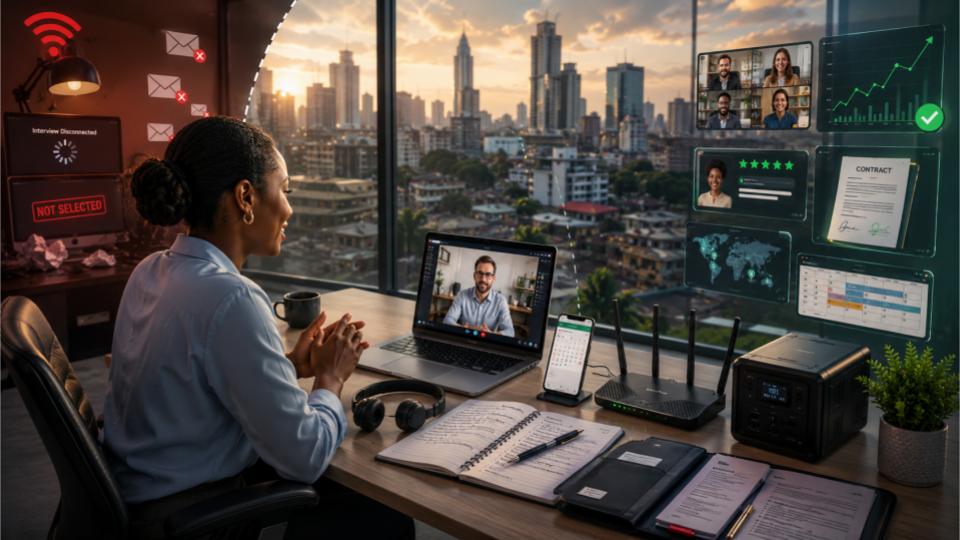
Amaka applied for her first virtual assistant role in March 2025. She had good English, she had learned how to use Google Workspace, she had watched several YouTube tutorials about calendar management and inbox organisation, and she was genuinely excited about working remotely. She got to the interview stage twice and did not get either offer. The feedback was always some version of the same thing: other candidates demonstrated stronger practical readiness.
What Amaka did not know then, and what a lot of Nigerian VA candidates still do not fully grasp, is that a virtual assistant interview is itself a test of your fitness for virtual work. The way you show up to the interview, technically, professionally, and communicatively, is direct evidence of how you will show up for your clients. Interviewers, especially international ones hiring from Nigeria, are watching everything from the moment you join the call to the moment you send your thank-you message. And they are comparing you to candidates from the Philippines, Kenya, India, and Eastern Europe who have been doing this specific kind of preparation for years.
This guide is about giving Nigerian VA candidates the specific, honest preparation they need to go from getting filtered out to getting the offer.
Market Context
The VA Market in Nigeria Right Now: Competitive, Growing, and Tilted Toward the Prepared
The demand for virtual assistants globally has not shrunk. If anything, the post-pandemic normalization of remote work has made the VA role a permanent fixture in how small businesses, entrepreneurs, and busy executives organise their operations. The shift that has happened is on the supply side. Awareness of VA work as a viable remote income path has grown significantly in Nigeria, particularly among recent graduates who cannot find formal employment and among people who have been displaced from declining sectors.
What this means practically is that the pool of Nigerians applying for VA roles on platforms like Upwork, Fiverr, Remote.co, Belay, and Virtual Staff Finder has grown substantially. The clients on the other side of those platforms are more experienced at filtering now. They have hired a few virtual assistants before, they know what questions reveal genuine competence versus surface-level preparation, and they can tell within the first five minutes of an interview whether someone has actually done the work of understanding what a VA role demands.
The VA candidates from Nigeria who are consistently landing international roles in 2026 share a small number of qualities: they treat the interview as a professional performance rather than a casual conversation, they understand the client’s business before the call begins, and they can demonstrate specific skills rather than just claiming to have them. The rest of this guide breaks down exactly how to do each of those things.
Nigerian Context
Nigerian VA rates on international platforms typically range from $5 to $18 per hour for entry-level roles, rising to $25 to $45 per hour for experienced specialists in areas like social media management, executive assistance, or project coordination. The difference between the bottom and top of that range is almost entirely determined by how well a candidate demonstrates competence during the hiring process, not by years of experience alone.
Preparation Phase
What to Do Before the Interview Call: The Work That Wins the Role
Most candidates prepare for a VA interview by reviewing their own skills and thinking about how to present themselves. That is necessary but not sufficient. The candidates who consistently do well go one layer deeper: they prepare on the client side, not just the candidate side.
Before any VA interview, you should spend at least forty-five minutes on the client’s business. Visit their website. Read their about page carefully, paying attention to how they describe what they do and what language they use. Look at their social media presence and note what they post, how often, and what the engagement looks like. If they have a YouTube channel or podcast, listen to a few minutes of it. If they have published any articles or appear in press coverage, read them. By the time you join the interview call, you should be able to say something specific and accurate about what this business does, who its customers are, and what challenges it probably faces.
This level of preparation does two things. First, it allows you to answer questions in a way that references their specific context rather than giving generic answers. Second, and this is often underestimated, it allows you to ask questions that signal genuine interest rather than the generic “what does a typical day look like” question that every interviewer has heard a thousand times.
Pre-Interview Preparation Checklist
- Research the client’s business, products, and target audience thoroughly before the call
- Test your internet connection at the same time of day as the scheduled interview
- Prepare specific examples of past work for every skill listed in the job description
- Write out three to five thoughtful questions to ask the interviewer about the role
- Check your camera framing, lighting, and audio clarity at least 30 minutes early
- Have your portfolio, work samples, or case studies open and ready to share on screen
- Prepare a brief and specific answer to “tell me about yourself” that is under two minutes
- Know the time zone difference and confirm the exact meeting time in your local time
Skills Assessment
Handling the Technical Skills Assessment: Show, Do Not Just Tell
A large proportion of VA interviews in 2026 include some form of practical skills demonstration. It might be a test task sent before the interview. It might be a live exercise during the call where you are asked to do something in Google Docs or Sheets while the interviewer watches. It might be a scenario question where you talk through what you would do in a specific situation. Whichever form it takes, the underlying principle is the same: competent candidates show what they can do, while unsuccessful candidates describe what they know about.
When you are given a test task before the interview, submit it one day early if at all possible, and make it slightly more comprehensive than what was asked for. If the task asked you to draft three email templates, draft three excellent ones and include a brief note at the end explaining the approach you took and why you structured each one the way you did. That additional layer of professional reasoning is what separates candidates who are technically capable from those who are genuinely ready to be trusted with client-facing work.
During live demonstrations on screen, narrate what you are doing as you do it. Interviewers are not just watching whether you arrive at the right outcome. They are watching how you think. Saying out loud “I am going to sort this data by the date column first so that the summary at the bottom reflects the most recent period” while you are doing it gives the interviewer visibility into your reasoning process, which is extremely valuable information for someone deciding whether to trust you with their business operations.
Interview Coach Note
Never say “I can learn that quickly” as your response to a skill gap in an interview. It tells the interviewer nothing except that you do not currently have the skill. Instead, describe the closest thing you have done, acknowledge the gap directly, and then name the specific resource you would use to close it. That is a mature, professional response that experienced hirers respect.
Communication Technique
How to Tell Stories That Get You Hired: The Structure That Works
One of the most consistent weaknesses Nigerian VA candidates demonstrate in interviews is vague, general answers to behavioural questions. “Tell me about a time you handled a difficult client” typically gets answered with something like “I always make sure to listen to clients carefully and resolve their concerns.” That is a statement of intention, not evidence of experience. International clients who have been burned by hires that did not work out are specifically looking for evidence, and stories are the most efficient way to provide it.
The structure that works consistently is this: set up the situation briefly, describe what the specific challenge or task was, walk through what you actually did and why, and then state the concrete outcome. Keep the whole thing under two minutes. It does not need to be dramatic. A genuine, specific story about managing a content calendar for a small Instagram account is more persuasive than a vague claim about social media expertise.
Here is what that looks like in practice for a Nigerian candidate responding to a question about managing competing priorities:
Tell me about a time when you had multiple urgent tasks competing for your attention at the same time. How did you handle it?
Sure. When I was assisting a content creator last year, she had a brand partnership deadline, a weekly newsletter going out that same afternoon, and an inbox that needed clearing because a podcast guest was expecting a response. I listed the three tasks by deadline and consequence, not just time. The partnership submission had a fixed contract deadline so that went first. The newsletter went second because it had a scheduled send time. The inbox last because the guest had not given a same-day response expectation. I finished all three and sent her a brief update at the end of the day noting the order I had prioritised and why. She told me that note was more useful than the tasks themselves because it meant she could trust my judgement on future decisions.
Nigerian Context
If you are newer to VA work and do not yet have many paid client stories to draw from, your examples can come from volunteer work, university project coordination, church or community organisation roles, family business support, or any unpaid work where you exercised the relevant skills. The source of the experience matters less than the specificity and honesty with which you describe it.
What to Expect
Questions Interviewers Actually Ask Nigerian VA Candidates in 2026
The questions that show up most consistently in 2026 VA interviews reflect how the role has evolved. Clients are no longer primarily looking for someone who can manage a calendar. They are looking for someone who can work with minimal supervision, adapt to shifting priorities, communicate proactively when something is unclear, and operate AI-assisted tools intelligently rather than just following rigid instructions.
You should prepare specific, story-backed answers to all of the following before any VA interview: How do you stay organised when managing tasks for more than one client or across multiple platforms? Tell me about a time you caught a mistake before it caused a problem. How do you handle situations where your client gives you instructions that seem unclear or potentially incorrect? What AI or productivity tools have you used, and how have they changed the way you work? Describe how you protect sensitive information when working remotely. What is your process when a task is taking longer than expected?
That last question is more revealing than it sounds. The honest answer for most candidates involves time management challenges, unexpected technical problems, or tasks that were more complex than the initial brief suggested. Interviewers are not looking for perfection in the answer. They are looking for self-awareness, honest communication habits, and a process rather than a panic.
“The biggest green flag in a VA interview is when a candidate describes exactly how they communicate when something goes wrong. That tells me more about what it will be like to work with them than any skill demonstration.”
Remote Hiring Manager, US-based marketing agency
Underestimated Challenge
Asynchronous Interviews: The Nigerian Candidate’s Most Common Blind Spot
A growing number of VA clients in 2026, particularly those with small teams and busy schedules, are conducting initial screening through asynchronous video interview platforms. Tools like Spark Hire, HireVue, and Willo ask you to record your answers to pre-set questions without a live interviewer on the other end. You get a limited number of takes, sometimes just one, and your recorded response is reviewed by the hiring manager in their own time.
Nigerian VA candidates are disproportionately unprepared for this format. The lack of a live conversational partner, the knowledge that you are being recorded for review rather than assessed in real time, and the typical one-take constraint creates a category of pressure that most candidates have never practised handling. The result is that otherwise strong candidates submit nervous, stilted recordings that do not reflect their actual capability.
Preparing for async interviews requires a different kind of practice than live interview preparation. You need to record yourself answering questions and watch the recordings back. This is uncomfortable, and that discomfort is exactly the point. The things that will disqualify you in an async recording are usually things you cannot see or hear in yourself without the footage: looking down at notes, speaking too quietly, starting answers with filler phrases, or delivering responses that tail off at the end rather than closing with a clear point.
Async Interview Success Checklist
- Practice recording yourself answering sample questions and review every recording without skipping
- Set up your camera so it points directly at eye level, not upward from a desk or downward from a shelf
- Use natural light from a window in front of you, not behind you
- Start every answer by restating the question briefly so the reviewer has context
- Close every answer with one clear, confident sentence rather than trailing off
- Dress professionally from head to toe, not just from the waist up
- Record in a quiet room at a time of day when background noise in your area is minimal
Technical Reality
Internet, Power, and Setup: The Practical Issues That Are Still Killing Nigerian Applications
This section exists because the topic still needs to be said plainly. A significant number of Nigerian VA candidates who would otherwise be competitive are being ruled out not because of skill gaps but because of technical issues during the interview itself. Unstable internet that causes the video to freeze. Power cuts that disconnect the call halfway through. Background noise from generators, traffic, or family members in adjacent rooms. These are real constraints, and international clients who have experienced them once are often unwilling to take the risk a second time.
There is no perfect solution to infrastructure constraints in Nigeria, but there is a set of practical steps that the most successful Nigerian remote workers take consistently. Invest in a good backup internet source. If your primary connection is a home fibre or cable service, have a fully charged mobile hotspot as backup. Know your data consumption per hour on a video call so you know how much buffer you have. Schedule interviews for times when your local power supply is most stable, which you will learn through observation if you pay attention over a few weeks.
For the interview environment itself, your background should be clean, neutral, and uncluttered. A plain wall is better than a decorated one in most cases because it removes anything that might distract the interviewer or create an impression you have not intentionally chosen. Your audio matters more than your video quality. If you can only invest in one piece of equipment, invest in a decent headset with a microphone rather than a better camera. Clear audio communicates professionalism more reliably than HD video.
Proactive Framing
If you experience a technical problem during an interview, address it calmly and immediately rather than hoping the interviewer did not notice. “I apologise, my connection dropped for a moment. To continue from where I was…” is a professional response that actually demonstrates the calm, transparent communication style that VA clients value. Pretending it did not happen or becoming visibly flustered is what costs you the offer.
Negotiation
Negotiating Your Rate Without Losing the Offer
Rate negotiation is the part of the VA hiring process where Nigerian candidates most consistently undervalue themselves, and for understandable reasons. The exchange rate creates a situation where even a relatively low dollar rate converts to a meaningful naira income, which creates psychological pressure to accept the first number offered rather than negotiate. Clients who have hired Nigerians before are often aware of this dynamic, and some of them count on it.
Knowing your floor rate before the interview is important, but knowing the market rate for your skill set is even more important. Research what VA specialists with your particular combination of skills charge on the platforms where you are applying. If you have a specific skill like project management, bookkeeping, or social media ads management, your rate should reflect that specialisation rather than the generic VA rate.
When the rate question comes up, give a range rather than a single number if you have flexibility, and anchor the conversation at the higher end of that range rather than the lower end. “I am typically working in the $12 to $16 per hour range depending on the scope of the role” positions you above the floor while leaving room for the client to feel they have won something if they land at $14. Starting at your absolute minimum and hoping they offer more almost never works.
Nigerian Context
If a client explicitly tries to lower your rate based on your location, specifically citing Nigeria as a reason why they expect to pay less, this is worth addressing directly but calmly: “My rate reflects the skills and results I deliver rather than my location, and I am glad to discuss the value of this role in more detail.” Not every client who says this is acting in bad faith, but how they respond to your answer tells you a great deal about what working with them would be like.
After the Call
The Follow-Up That Most Candidates Skip Entirely
Sending a thank-you message after a VA interview is not old-fashioned courtesy. It is a practical competitive advantage, because most candidates simply do not do it. A well-written follow-up message sent within a few hours of the interview does several useful things at once: it keeps you top of mind during a decision period that may last several days, it gives you one more opportunity to reinforce a point from the interview that you feel you did not express as well as you wanted to, and it demonstrates exactly the kind of proactive, professional communication that virtual clients are hiring for.
The message should be short, specific, and not generic. Reference something specific that was said in the conversation. If the client mentioned a particular challenge they are trying to solve, connect it directly to something in your background that you may not have fully explained during the call. Close with a clear statement of your continued interest rather than a hedge. “I am genuinely excited about this opportunity and I look forward to hearing from you” is stronger than “I hope to hear from you soon.”
Chioma, a VA from Abuja who now manages social media and email operations for three international clients, credits her first hire specifically to a follow-up message she sent after an interview she thought she had done poorly in. The client told her in the onboarding call that her note had been the deciding factor because no other candidate had taken the time to send one.
The Interview Is the First Task. Treat It Like One.
Every piece of advice in this guide comes back to the same central idea: a virtual assistant interview is not a formality between your application and your offer. It is a live demonstration of exactly the qualities the client is hiring you to bring to their business. Preparation, clear communication, professional setup, proactive follow-through, and honest, specific answers to specific questions.
Nigerian VA candidates have genuine strengths: strong English, high educational standards, cultural adaptability, and a work ethic shaped by operating in environments where you often have to do more with less. The gap between candidates who get hired and candidates who do not is almost never about those baseline qualities. It is about knowing how to demonstrate them clearly in the compressed, high-stakes window of a remote job interview.
Amaka got her third application right. She researched the client before the call, she had specific stories prepared, she sent a follow-up message the same evening, and she started her first paid VA role two weeks later at $11 per hour. Six months on, she was at $15 and managing two clients. The preparation was the difference. It will be for you too.
Frequently Asked Questions
Do I need formal work experience to get a virtual assistant job in Nigeria?
Formal employment experience helps but is not a hard requirement for entry-level VA roles. What matters more is your ability to demonstrate the relevant skills through any means, including volunteer work, personal projects, academic work, or family business support. Build a portfolio of work samples that show what you can do rather than relying on a list of job titles to make the case for you.
Which platforms are best for finding virtual assistant jobs from Nigeria?
Upwork and Fiverr are the most accessible starting points for Nigerian VA candidates because the application process does not require a pre-existing relationship with a client. Remote.co, We Work Remotely, and LinkedIn also have regular VA postings. For more specialised or higher-paying roles, Belay and Time Etc vet candidates more carefully but also pay more consistently. Networking within Nigerian remote work communities on WhatsApp and Telegram can also surface opportunities that never get publicly posted.
What should I say when an interviewer asks why I want to work as a virtual assistant?
Be honest about the practical appeal of remote income while grounding your answer in something genuine about the work itself. The combination of flexibility and the opportunity to work across different industries and business types is a truthful and professional reason. What to avoid is any answer that makes it sound like being a VA is your fallback while you look for something better. Clients are investing trust in you, and they want to hire someone who actually wants the role.
How do I handle the question “What is your expected salary?” as a Nigerian VA candidate?
Research the market rate for your specific skill set before the interview and come prepared with a range rather than a single number. Position your answer around the value you deliver rather than your cost of living. If you are entry-level, something in the $8 to $12 per hour range is realistic depending on the platform and client. If you have a specialist skill, adjust upward accordingly. Saying you are open to whatever they offer almost always results in a lower rate than you could have achieved by naming your number first.
How important is my internet speed for a VA interview?
It is very important, and the interview itself is your opportunity to prove you can handle it. A stable connection that delivers a clear video and audio experience without dropping or freezing signals to the client that your technical environment is reliable enough for ongoing remote work. Aim for at least 10 Mbps upload speed for a comfortable video call. Test your connection and your backup option before the scheduled interview time, not during it.
Can I work as a virtual assistant while still employed in a Nigerian company?
Yes, many Nigerian VA practitioners begin this way, taking on one or two smaller clients in the evenings or weekends before transitioning fully to remote work. Be transparent with any VA client about your availability and working hours from the beginning of the engagement. Most international clients in different time zones can accommodate a Nigerian VA who works primarily outside of Nigerian business hours, especially if the work does not require real-time availability during their business day.
