

Medical Disclaimer:
This article is written for general health awareness, educational purposes, and career guidance only. It is not a substitute for professional medical advice, diagnosis, or treatment. If you are experiencing infertility or considering IVF treatment, please consult a qualified reproductive endocrinologist or fertility specialist at a licensed Nigerian medical facility.
Ngozi and her husband Emeka had been trying to conceive for six years by the time they walked into a fertility clinic in Victoria Island, Lagos, in September 2024. They had gone through two previous IVF cycles at another facility in the preceding three years, both unsuccessful, at a combined cost that had consumed a significant portion of their savings and extracted a toll on their relationship that Ngozi described as the most difficult thing she had ever lived through.
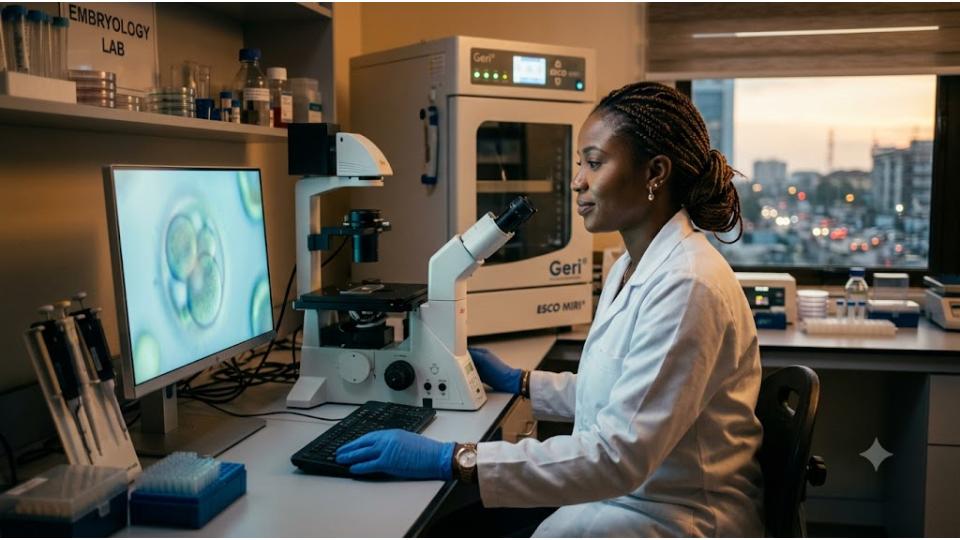
The third cycle, at a clinic that had recently integrated an AI-assisted embryo assessment system, was different from the beginning. The embryologist explained that software would analyse each embryo using thousands of developmental parameters, assigning each one a viability score to inform, though not solely determine, the selection decision. It felt, Ngozi said, both clinical and strangely hopeful. In March 2025, six weeks after the transfer of the embryo the system had rated highest, she saw two lines on a test. Her daughter was born in November 2025.
Whether the AI system made the difference is a question Ngozi is not particularly interested in debating. What she knows is that she has her child, and that the embryo selection process felt more rigorous than anything in her previous two cycles.
Infertility in Nigeria carries a weight that is difficult to fully convey to someone who has not navigated its specific cultural dimensions. Estimates suggest that between 20 and 30 percent of Nigerian couples of reproductive age experience some form of infertility, shaped by untreated sexually transmitted infections, complications from unsafe abortions, undiagnosed PCOS and endometriosis, and stigmatized male factor infertility that is rarely addressed promptly.
Against this backdrop, IVF has emerged as the primary medical intervention for Nigerian couples who have exhausted other options. Licensed fertility clinics in Nigeria have grown from a handful of pioneering centres in Lagos in the early 2000s to over eighty registered facilities by 2026, concentrated mainly in Lagos, Abuja, and Port Harcourt. Into this growing sector, artificial intelligence is arriving as a practical tool already changing how embryologists work.
Key Figures
- 25% — estimated proportion of Nigerian couples of reproductive age experiencing some form of infertility
- 80+ — licensed fertility clinics operating in Nigeria as of 2026, up from fewer than 10 in 2005
- 35% — reported improvement in embryo selection accuracy at clinics using AI assessment versus traditional morphology assessment alone
- ₦3.5 million — average cost per IVF cycle in 2026, down from ₦5 million in real terms five years ago
What AI Is Actually Doing Inside Nigerian IVF Laboratories in 2026
The phrase “AI in IVF” covers a range of applications at very different stages of adoption in Nigerian fertility clinics.
- AI-assisted embryo assessment — machine learning systems analyse time-lapse images of developing embryos, evaluating thousands of morphological and developmental parameters to assign viability scores that inform embryo selection.
- Predictive outcome modelling — algorithms trained on large IVF outcome datasets model the probability of success under different treatment protocols based on age, hormone levels, and cycle history.
- Personalised stimulation protocols — AI-supported analysis of ovarian reserve markers and prior response data helps tailor hormone protocols, reducing hyperstimulation risk while optimizing egg yield.
- Remote monitoring and patient management — automated platforms send medication reminders, collect symptom reports, and flag abnormal results, reducing the burden of in-clinic visits.
- Sperm analysis automation — computer-assisted analysis of motility, morphology, and concentration with greater consistency than manual assessment.
- Clinical documentation automation — reduces the administrative burden on laboratory and clinical staff.
The Embryo Selection Problem AI Is Helping Nigerian Clinics Solve
Traditional embryo selection relies on morphological assessment by an embryologist evaluating an embryo’s appearance at specific developmental time points — a snapshot rather than a full developmental record. Time-lapse incubation systems paired with AI analysis change this: images taken every five to fifteen minutes across the entire culture period let the system identify patterns correlating with successful implantation that no human could track manually.
“We have been using an AI-assisted embryo assessment system since mid-2024 and the change in how our embryology team works has been meaningful… We are seeing something in the range of a 30 to 35 percent improvement in blastocyst selection accuracy compared to our historical morphology-only approach, and that is translating into better outcomes for our patients.”
— Dr. Chinyere Okafor, Senior Embryologist, Lagos Fertility Centre, Victoria Island
Case Study 1
The Abuja Couple Whose Third IVF Cycle Succeeded with AI-Assisted Selection
Adaeze and her husband experienced two failed IVF cycles at Lagos clinics between 2022 and 2024, both producing embryos that appeared high quality under conventional assessment but failed to implant. For their third cycle in 2025, at an Abuja clinic using time-lapse incubation and AI assessment, the embryology team identified an embryo whose conventional grade was moderate but whose AI developmental profile placed it in the highest viability category — not the embryo traditional assessment would have prioritised. It was selected for transfer. Adaeze gave birth to a healthy son in early 2026.
What AI Cannot Change About IVF in Nigeria in 2026
AI cannot overcome the biological fundamentals of reproductive age
A woman’s age remains the strongest predictor of IVF success. A forty-two-year-old undergoing IVF with her own eggs still faces success rates in the range of 10 to 15 percent per cycle even at the most advanced facilities. AI can help identify the best available embryo, but it cannot improve the intrinsic quality of eggs affected by age-related decline.
AI cannot fix the access and affordability gap
The most consequential limitations of IVF care in Nigeria are financial and geographic, not technological. AI-enhanced IVF costs more than standard IVF because time-lapse incubation systems represent significant capital investments passed on to patients.
Approximately 75 percent of Nigerian fertility clinics with any form of advanced reproductive technology are located in Lagos and Abuja. A couple from Maiduguri, Sokoto, Makurdi, or Yola needing IVF must travel to Lagos or Abuja and fund accommodation for a two to three week treatment cycle. The all-in cost for a couple from northern Nigeria routinely exceeds ₦8 to ₦10 million. No AI advancement currently changes that fundamental geographic inequality.
“I am genuinely excited about what AI tools are doing for embryo selection and cycle personalisation… But the biggest gap in Nigerian fertility care in 2026 is not our embryo selection accuracy. It is the fact that a couple in Borno State cannot access any IVF service at all… AI does not solve that problem. Infrastructure, regulation, and financial support mechanisms do.”— Dr. Bello Musa, Consultant Reproductive Endocrinologist, National Hospital Abuja
How AI in Fertility Medicine Is Creating New Career Opportunities for Nigerian Healthcare Professionals
Nigeria’s fertility medicine sector is adopting AI tools faster than it is training professionals to work with them effectively, creating real opportunity for those willing to develop at the intersection of reproductive medicine and digital health tools.
Case Study 2
The Medical Laboratory Scientist Who Became a Fertility Technology Specialist
Tunde graduated from the University of Benin’s Medical Laboratory Science programme in 2021 and spent two years in general diagnostic laboratory work in Edo State before pursuing online training in reproductive biology and data analysis. In early 2025, a Victoria Island fertility clinic hired him as a junior embryology technician, specifically citing his combination of laboratory foundation and technology literacy. His salary more than doubled compared to his previous role.
- Nigerian medical graduates interested in fertility medicine should pursue reproductive endocrinology subspecialty training through the NPMCN pathway, combined with exposure to AI-assisted reproductive technology.
- Clinical embryologists should proactively seek training and certification on AI assessment platforms rather than waiting for employers to mandate it.
- Biomedical engineers should develop expertise in maintaining and calibrating AI reproductive technology equipment — a genuine gap in Nigeria’s current market.
- Health data scientists should explore fertility analytics, given the unusually rich datasets IVF generates.
- Fertility nurses should build competency in technology-enhanced patient monitoring protocols as automated platforms replace manual monitoring.
The IVF Costs Nigerian Couples Will Encounter in 2026
Most Nigerian couples pursuing IVF in 2026 will need one to three cycles before achieving a successful pregnancy, meaning the realistic financial planning figure is ₦4 million to ₦15 million or more over a complete treatment journey. Very few Nigerian health insurance plans cover IVF.
AI in fertility medicine is not a miracle machine and it is not a marketing gimmick. It is a genuinely useful tool that helps trained professionals make better-informed decisions about a process that remains uncertain even in the best hands.
— Dr. Amaka Eze
What the Future of AI-Assisted Fertility Care Could Look Like in Nigeria by 2030
Non-invasive chromosomal screening, where AI analyses secreted metabolites in the culture medium instead of requiring an embryo biopsy, could significantly improve the cost-effectiveness of genetic screening. Currently, preimplantation genetic testing adds ₦500,000 to ₦1 million to cycle costs, placing it beyond most Nigerian couples.
Telemedicine integration with AI monitoring platforms could reduce the burden of in-clinic visits during stimulation cycles. If AI-supported remote monitoring can reduce required visits from eight to twelve down to three or four without compromising safety, the logistical and financial burden on out-of-city patients decreases significantly.
The National Health Act, the Medical and Dental Council of Nigeria, and relevant professional bodies have not yet produced comprehensive regulatory guidance specific to AI in reproductive medicine. Clear standards for clinical validation, liability, and patient consent will become necessary as adoption grows.
Frequently Asked Questions
How is AI improving IVF success rates in Nigeria?
AI is improving outcomes primarily through embryo selection systems that analyse continuous time-lapse images across the entire culture period, identifying patterns associated with successful implantation that single-timepoint assessment cannot reliably detect. AI also supports personalised stimulation protocols and automated patient monitoring.
How much does IVF cost in Nigeria in 2026, and is AI making it cheaper?
An AI-enhanced cycle costs between ₦2.3 million and ₦5 million, versus ₦1.9 million to ₦3.9 million for a standard cycle. AI adds upfront cost through capital equipment, but may reduce overall treatment cost by improving per-cycle success rates and cutting the number of cycles needed.
Which Nigerian cities have IVF clinics using AI technology in 2026?
Primarily Lagos and Abuja, with growing capability in Port Harcourt, Ibadan, and Enugu. Couples in northern Nigeria and rural areas still face significant travel burdens to access these services.
What careers are available for Nigerian medical professionals in AI-assisted fertility care?
Reproductive endocrinologists with digital health training, AI-certified clinical embryologists, medical laboratory scientists moving into fertility technology, biomedical engineers specializing in reproductive equipment, health data scientists, and fertility nurses trained in technology-enhanced monitoring.
Conclusion
Ngozi’s daughter is five months old as of writing. Ngozi does not know for certain that the AI embryo assessment system is the reason she has her daughter — she suspects the honest answer is more complicated, a combination of a better-suited protocol, a different clinic culture, and a cycle where the uncertain variables happened to align. But she knows the system gave her a more rigorous process. For the millions of Nigerian couples navigating infertility in 2026, that combination of better technology and unchanged biological uncertainty is the honest picture of where fertility medicine actually is: not a guarantee, but a genuinely better tool in the hands of genuinely skilled professionals.
Disclaimer —This article is published for general health education and awareness purposes only and does not constitute medical advice. IVF success rates and costs cited reflect available clinic data and professional reports as of 2026 and will vary between facilities and individual patients. Please consult a qualified fertility specialist for personalised medical guidance.
