

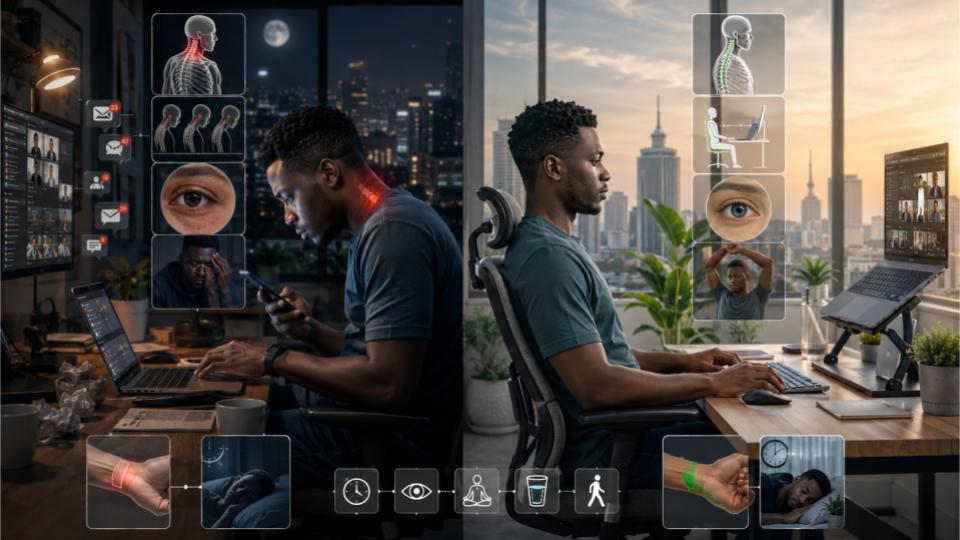
You are earning in dollars, building your career, and living your best remote work life. Your body, however, is keeping a very different kind of score. Here is the honest conversation about smartphone health that Nigeria’s digital workforce needs to have right now.
Medical Disclaimer
This article is written for general health awareness and educational purposes only. It is not a substitute for professional medical advice, diagnosis, or treatment. If you are experiencing persistent pain, vision changes, or any health concern described in this article, please consult a qualified healthcare professional.
Funmi is a thirty-one-year-old UX designer working remotely for a fintech company headquartered in Amsterdam. From her flat in Ikeja, Lagos, she logs on at 8 a.m., spends ten to twelve hours on her laptop and phone combined, and logs off sometime after 9 p.m. when the last Slack notification from a European colleague has quietened down. She earns well, in euros converted to naira at a rate that still makes her feel a little disbelieving when she checks her Wise account. She is living, by most measures, the life that Nigeria’s digital economy promise was supposed to deliver. She is also, she told me in January 2026, almost always in some degree of pain. Her neck, specifically, has bothered her since mid-2024. She initially attributed it to sleeping in a bad position. Then to stress. Then to sitting on a poor-quality chair. It was not until she mentioned it in passing to a physiotherapist friend that she got a more accurate diagnosis. What she has is tech neck, a condition she had never heard of before, and which her physiotherapist told her he is now seeing in roughly four out of every ten patients who come to his clinic in Victoria Island. Nearly all of them are between twenty-five and forty, most of them are doing remote or freelance digital work, and most of them have been trying to attribute their neck pain to anything other than the obvious source: the twelve-plus hours a day their head spends bent forward over a screen.
Funmi’s story is not unusual in 2026. As Nigeria’s digital economy has matured and the population of Nigerians working remotely, freelancing on global platforms, and spending significant portions of their day on smartphones and laptops has grown dramatically, a parallel and less discussed health story has been developing. The bodies of Nigerian digital workers are absorbing the physical and psychological consequences of screen-intensive work in ways that most people either do not recognise as health conditions or do not take seriously enough to address before they become chronic and genuinely limiting problems.
This article is an attempt to put that health story into honest, specific, and practical terms. Not to alarm people out of the digital economy, which is genuinely and consequentially improving lives across Nigeria. But to make sure that the generation building their livelihoods on screens understands what those screens are doing to their bodies and minds, and what can be done about it before the damage compounds.
| Statistic | Value | What It Means |
|---|---|---|
| Average daily screen time (Nigerian remote workers & freelancers, Jan. 2026) | 10.4 hrs | Many Nigerian digital professionals spend over 10 hours daily on computers and smartphones for work and communication. |
| Pressure on the neck at a 60° head tilt | 60 lbs | Looking down at a smartphone can place up to 60 pounds (27 kg) of force on the cervical spine, compared to about 12 lbs in a neutral posture. |
| Digital workers experiencing eye discomfort or headaches | 71% | A large majority report symptoms of digital eye strain, including headaches, dry eyes, blurred vision, and fatigue after prolonged screen use. |
| Higher insomnia rate from late-night smartphone use | 3× | Nigerians using smartphones for more than 2 hours after 9 PM report insomnia at roughly three times the rate of those with lower nighttime screen exposure. |
What Tech Neck Is and Why Nigeria’s Remote Workers Are Its Primary Victims in 2026
The human head weighs between ten and twelve pounds when held in a neutral, upright position. That weight is distributed efficiently across the cervical vertebrae and supported by the muscles of the neck and upper back in a way that allows humans to carry it comfortably for most of the waking day. The problem begins the moment that head tilts forward, as it does every single time you look down at a smartphone. At a fifteen-degree forward tilt, the effective weight the cervical spine must support increases to approximately 27 pounds. At thirty degrees, common when typing on a phone held in your lap, it reaches 40 pounds. At sixty degrees, which is the angle many people adopt when scrolling social media or watching video on a phone flat on a desk, the effective load on the cervical spine reaches 60 pounds. Imagine spending ten hours a day with a 60-pound weight hanging from the back of your neck. That is what tech neck essentially is.
The consequences build gradually and then, for many people, seem to arrive suddenly. The muscles of the posterior neck and upper back, chronically contracted to counteract the forward-tilting head, develop painful trigger points and knots. The soft tissues of the cervical spine experience accelerated degenerative changes in some cases. Headaches that originate in the neck become chronic. Shoulder tension becomes a permanent background condition. And in more serious cases, the nerves that exit the cervical spine and run down the arm begin to be affected, producing tingling, numbness, or weakness in the hands that can become genuinely limiting for digital workers whose livelihood depends on typing.
I began to notice the pattern in my clinic around 2023. Young Nigerians coming in with cervical pain that I would have expected to see in someone twenty years older. When I take a thorough history and ask about their work, the answer is almost always the same. Eight, ten, twelve hours a day on a phone or laptop, rarely in an ergonomically appropriate position, with minimal breaks. The informal sector workers who are sitting on benches or the floor using laptops are often in the worst structural position of all. Tech neck is genuinely a public health issue in Nigeria’s digital workforce and we are only at the beginning of seeing its full consequences.
Dr. Emeka Chukwu
–Consultant Physiotherapist, Victoria Island, Lagos. MSc Musculoskeletal Physiotherapy, University of Lagos
Kolade is a twenty-eight-year-old content strategist in Ibadan who works almost entirely from his phone, having found that his phone-based workflow was faster and more comfortable than using a laptop in the first two years of his freelancing career. He spent the majority of his working day with his phone held in front of him or resting on his thighs while he typed, his head bent at an angle he had never thought twice about.
In mid-2024, he began experiencing persistent headaches at the base of his skull that spread upward over the top of his head. He tried paracetamol, assumed it was related to stress or dehydration, and carried on working. By late 2024, the headaches had become daily, and he had developed significant tension in his right shoulder that made it uncomfortable to raise his arm above shoulder height.
When he eventually saw a physiotherapist in Ibadan, the assessment was straightforward: the muscles at the base of his skull were in near-constant contraction from maintaining the forward-head position while working on his phone. His first-line treatment was a combination of postural correction exercises, targeted stretching for the posterior neck and upper trapezius, and a strict new rule: phone work only when the phone is held at eye level, with a stand purchased at Computer Village for N3,500.
Digital Eye Strain: What It Actually Feels Like and Why Nigerian Digital Workers Ignore It
The second most common physical health consequence of Nigeria’s smartphone-intensive work culture in 2026 is digital eye strain, also called Computer Vision Syndrome by ophthalmologists. Unlike tech neck, which produces pain that is relatively easy to localise and take seriously, digital eye strain tends to produce symptoms that are diffuse, fluctuating, and easy to attribute to other causes like tiredness, dehydration, or simply getting older.
The symptoms of digital eye strain include a burning or stinging sensation in the eyes, blurred vision that comes and goes during the working day, difficulty refocusing when shifting attention from a screen to a distant object, increased sensitivity to light particularly fluorescent office lighting, headaches that typically sit behind or around the eyes, and a persistent dryness and irritation that many people manage with eye-rubbing rather than addressing the underlying cause.
| Health Condition | Primary Cause | Severity if Untreated | Typical Onset |
|---|---|---|---|
| Tech Neck | Forward head posture during screen use | High | 3 to 12 months of heavy screen use |
| Digital Eye Strain | Reduced blink rate and blue light exposure | Moderate | Weeks to months of 6+ hour daily screen use |
| Chronic Sleep Disruption | Blue light suppression of melatonin | High | Develops gradually with late-night phone use |
| Repetitive Strain Injury (Thumb) | Prolonged texting and scrolling motions | Moderate | 6 to 18 months of intensive phone typing |
| Digital Anxiety | Constant notification state, work-life blur | High | Variable, often accelerated by remote work |
| Lower Back Pain | Poor seating posture during laptop use | Moderate | 3 to 6 months without ergonomic intervention |
| Dry Eye Syndrome | Reduced blink frequency during screen use | Lower | Months to years of uncorrected screen exposure |
Why Nigerians blink less than they should in front of screens
Blinking is the eye’s primary self-cleaning and self-lubricating mechanism. The average person blinks fifteen to twenty times per minute in normal activity. When focusing intently on a screen, that rate drops to as low as five to seven blinks per minute. For a Nigerian digital worker spending ten hours in front of screens, this reduced blink rate across the entire working day means the surface of the eye is spending enormous amounts of time less lubricated than it should be, which produces the burning, dryness, and irritation that characterizes digital eye strain. The solution is both simple and genuinely difficult to sustain without deliberate habit change: consciously blink more often, take regular breaks during which you look at distant objects, and use preservative-free artificial tear drops if dryness is already established.
I have been practising ophthalmology in Lagos for fourteen years. The number of young patients presenting with dry eye and significant digital eye strain in 2025 and 2026 is noticeably higher than anything I saw before 2022. Most of them are between twenty-two and thirty-five, most are doing some form of remote digital work, and almost none of them have considered that their eye symptoms might be directly related to their screen habits rather than any underlying eye disease. The good news is that most digital eye strain is fully reversible with appropriate habits and workplace adjustments. The challenge is that Nigerians are not coming to see us until the symptoms are significantly affecting their quality of life.
Dr. Ngozi Obi-Nwachukwu
–Consultant Ophthalmologist, Lagos University Teaching Hospital (LUTH)
The Sleep Disruption That Is Quietly Destroying Nigerian Remote Workers’ Health and Productivity
Of all the health consequences of heavy smartphone use, chronic sleep disruption may be the most pervasive and the most consequential for long-term wellbeing, yet it is the one that most Nigerian digital professionals are least likely to connect to their device habits.
The mechanism is well established in research. Smartphones emit blue wavelength light that, when it reaches the retina in the hours before sleep, suppresses the production of melatonin, the hormone that regulates the body’s transition into sleep. For a Nigerian remote worker who typically wraps up a late-night conversation with a European or American client at 10 or 11 p.m. and then scrolls through WhatsApp, Instagram, or Twitter before attempting to sleep, the melatonin suppression produced by two to three hours of phone use in the evening can delay sleep onset by sixty to ninety minutes and reduce the quality and depth of sleep even when sleep does occur.
Over time, the cumulative effect of this disruption is not just tiredness. Chronic sleep deprivation at the level produced by habitual late-night phone use is associated in research with impaired cognitive function, reduced creativity, increased irritability, weakened immune response, and higher susceptibility to anxiety and depression. For a freelancer whose entire competitive advantage lies in the quality of their thinking and creative output, this is not an abstract health concern. It is a direct business risk.
Emeka is a backend developer in Port Harcourt working for a remote UK startup. For most of 2024, he noticed that his work quality was declining. He was making more errors than usual, his problem-solving felt slower, and he was finding it difficult to concentrate during the focused deep-work sessions that his best code required. He initially attributed this to the workload increasing, to work stress, to the economic anxiety that affected many Nigerians in 2024.
His turning point came during a conversation with a Lagos-based wellness coach he met through a Twitter Space in December 2024. When he described his daily routine including three to four hours of phone use after 10 p.m. catching up on WhatsApp, LinkedIn, and YouTube before bed, the coach asked him a question he had never considered: when did he last feel genuinely rested after a night of sleep? He could not remember.
He implemented a single change with the coach’s guidance: no phone use after 9 p.m. for thirty consecutive days. He replaced the phone time with reading a physical book and listening to music without screens. Within two weeks, he reported falling asleep faster and waking feeling noticeably more rested. Within thirty days, he described his work focus as the best it had been in over a year.
The Mental Health Dimension That Nigerian Digital Workers Are Least Likely to Talk About
Beyond the physical consequences, heavy smartphone use in the context of remote work creates a specific mental health profile that is increasingly documented among Nigerian digital professionals but rarely discussed openly because of the stigma that continues to surround mental health conversations in Nigerian culture.
The constant connectivity of remote work means that the psychological boundary between being at work and being at rest has essentially been eliminated for many Nigerian freelancers and remote employees. When your work communication happens on the same device you use for personal communication, entertainment, and social connection, and when the notifications from all of those purposes arrive on the same screen with the same vibration pattern, the nervous system never fully moves into the restful, non-alert state that it needs to recover from cognitive labour.
The Always-On TrapNigerian remote workers serving international clients face a particular version of this problem. Time zone differences mean that clients in the United States, UK, or Europe are most active during evening hours in Nigeria. A freelancer who feels they must remain available and responsive until midnight to maintain client relationships is not just working long hours. They are keeping their nervous system in a state of alert vigilance during the hours when it most needs to begin unwinding, and the consequences for both sleep quality and mental health accumulate faster than most people realise.
The mental health presentation I am seeing most frequently among Nigerian digital workers is what I would describe as chronic low-grade hyperarousal. They are not in acute crisis. They are functional. But they are operating in a persistent state of mild anxiety, mild irritability, and persistent mental fatigue that they have normalised as simply the cost of doing business in the digital economy. It is not. It is a treatable pattern and it is very directly related to the way they are using their devices. The phone is in the bedroom. The phone is on the bedside table. The phone is the last thing they see before sleep and the first thing they reach for in the morning. That is not neutral.
Dr. Adaeze Umeh
–Clinical Psychologist, Abuja. Specialist in Digital Wellness and Occupational Mental Health
What Nigerian Remote Workers Can Do Right Now: Practical, Low-Cost Interventions
The health consequences described in this article are real and significant. They are also, in most cases, highly responsive to relatively simple behavioural and environmental changes that cost very little and produce measurable improvements within weeks. These are not suggestions that require expensive equipment, gym memberships, or significant time investment. They require primarily attention and consistency.
- Symptom Check: Tech Neck –Persistent pain or stiffness at the base of the skull, upper neck, or between the shoulder blades. Headaches that begin at the back of the head. Shoulder tension that does not resolve with rest. Occasional tingling or numbness in the hands.
- Symptom Check: Digital Eye Strain –Burning, stinging, or dry eyes during or after screen use. Blurred vision that fluctuates throughout the working day. Increased sensitivity to light. Headaches centred around or behind the eyes. Difficulty focusing on objects at different distances.
- Symptom Check: Sleep Disruption –Difficulty falling asleep despite feeling tired. Waking unrefreshed after seven or eight hours. Feeling alert and mentally active when you want to be sleeping. Persistent daytime tiredness that a full night of sleep does not resolve.
- Symptom Check: Digital Anxiety –Feeling compelled to check your phone even during deliberate rest periods. Difficulty concentrating on non-screen activities. Persistent low-level anxiety about work messages or notifications. Irritability when unable to access your phone or internet connection.
- Raise your screen to eye level immediately –For laptop and desktop use, a monitor stand or laptop riser costing N3,000 to N8,000 at Computer Village in Ikeja or any electronics market in your city is the single most effective intervention for tech neck. For phone use, hold the phone at eye level rather than looking down. This one change eliminates the primary mechanism of tech neck immediately, though the muscular recovery from existing damage takes additional time.
- Apply the 20-20-20 rule for every working hour –Every twenty minutes of screen work, look at something at least twenty feet away for twenty seconds. Set a phone timer or use a free desktop reminder app to enforce this. It takes less than thirty seconds per hour and is the most evidence-backed available intervention for digital eye strain. The distant focus gives the eye muscles the opportunity to relax from the sustained near-focus that causes strain.
- Enable night mode and reduce brightness after 6 PM –Every major smartphone operating system now has a night mode or blue light filter setting. Enable it to activate automatically from 6 PM and ensure your screen brightness is set appropriately for your ambient light rather than at maximum. For Nigerian remote workers in poorly lit environments who compensate by increasing screen brightness, this single change can meaningfully reduce both eye strain and sleep disruption.
- Establish a phone curfew between 9 PM and your wake time –Designate your phone to sleep before you do. A consistent curfew at 9 or 9:30 PM creates the melatonin recovery window that restores natural sleep onset. Leave your phone charging outside the bedroom or face down and on silent in the room but at a distance that requires you to deliberately get up to check it. The slight friction this introduces is the entire point.
- Learn and practice the three stretches that directly address tech neck –The chin tuck, the corner stretch for the pectorals, and the levator scapulae stretch address the specific muscles most affected by forward head posture. A physiotherapist can show you the correct technique in a single session. These three exercises done for five minutes twice daily produce measurable relief in neck tension within two to four weeks.
- Take a genuine offline break of at least one hour per day –Not a break where you put the phone down and then pick it up again after three minutes. A deliberate, scheduled one-hour period per day with no screens of any kind. Walk outside. Sit on the balcony. Cook. Read a physical book. The goal is to give the visual system and the nervous system a genuine recovery window every single day, not just the ten-second pauses between scrolling sessions that most people mistake for rest.
The Ergonomic Investment That Pays for ItselfFor Nigerian digital workers generating N300,000 or more monthly from remote or freelance work, a basic ergonomic setup is one of the highest-return investments available. A laptop stand at N5,000, an external keyboard and mouse at N8,000 to N15,000, and a chair with lower back support at N15,000 to N40,000 represent a combined investment of approximately N40,000 to N60,000 that can eliminate the primary physical causes of tech neck and lower back pain. The physiotherapy sessions that chronic tech neck eventually requires typically cost N10,000 to N25,000 per session, and the income days lost to debilitating neck pain or headaches cost significantly more. The ergonomic investment is not a luxury. It is basic occupational health expenditure that the vast majority of Nigerian digital workers are not yet treating as such.
The digital economy is giving a generation of Nigerians something extraordinary: financial independence without a formal employer. The least they owe themselves in return is the discipline to protect the physical and mental health that makes that independence possible for decades rather than burning through it in three to five years of productive but unsustainable habits.
Dr. Tunde Adesina — Careerdoor, May 2026
Frequently Asked Questions About Smartphone Health Effects in Nigeria
What is tech neck and how does it affect Nigerian remote workers?
Tech neck is the chronic muscular and skeletal strain that develops in the neck, upper back, and shoulders when the head is held in a forward and downward position for extended periods during screen use. For every inch the head moves forward from its neutral position, the effective load on the cervical spine increases substantially. Nigerian remote workers and freelancers who spend eight to twelve hours daily looking at phones and laptops without ergonomic support are particularly vulnerable. Symptoms include chronic neck and upper back pain, headaches originating at the base of the skull, shoulder tension, and in more advanced cases, nerve-related symptoms including tingling or numbness in the arms and hands. The condition is treatable but responds much better to early intervention than to prolonged neglect.
How can I reduce eye strain from smartphone and screen use?
The most evidence-based approach to reducing digital eye strain is the 20-20-20 rule: every twenty minutes of screen work, look at something at least twenty feet away for at least twenty seconds. Additionally, hold your phone at eye level rather than looking down, set screen brightness to match your ambient light, enable night mode and blue light filter after 6 PM, consciously increase your blink rate during screen use, use preservative-free artificial tear eye drops if dryness is already present, and ensure your workspace has adequate indirect lighting that does not create screen glare. For persistent symptoms, consulting a Lagos or Abuja-based ophthalmologist is advisable as some cases benefit from specifically prescribed computer glasses.
How many hours of screen time is safe for Nigerian remote workers each day?
There is no universally agreed daily screen limit for adults in occupational contexts, as many Nigerians genuinely cannot reduce their working screen time without affecting their income. What research does support is that how you use screens matters as much as how long. Regular breaks of five to ten minutes every hour, correct ergonomic positioning, adequate lighting, and deliberate eye exercises offset a significant proportion of the harm from extended screen use. Outside of formal working hours, limiting recreational phone use to under two hours and maintaining a consistent phone curfew before sleep is strongly recommended. The combination of occupational hygiene during working hours and genuine offline rest outside them is more achievable than simply trying to reduce work screen time.
Are Nigerian hospitals equipped to treat tech neck and digital eye strain?
Yes. Nigerian hospitals and clinics, particularly in Lagos, Abuja, Port Harcourt, and Ibadan, have physiotherapy departments that are well-equipped to diagnose and treat the musculoskeletal components of tech neck through targeted exercises, manual therapy, and postural correction programmes. Teaching hospitals and many private clinics have ophthalmology departments that can properly assess and manage digital eye strain, dry eye conditions, and related visual symptoms. The primary challenge is not the availability of treatment but the willingness of Nigerian digital workers to seek care early rather than managing symptoms with painkillers or simply tolerating them until they become significantly disabling.
Conclusion
Funmi, the UX designer from Ikeja who opened this article, is doing better. She bought a laptop stand and an external keyboard for less than N20,000 and rearranged her workspace so that her screen is at eye level. She does the chin tuck exercise twice a day during her working hours. She turns her phone face down at 9:30 PM. The neck pain that had been her constant companion since mid-2024 has reduced by, she estimates, about 70 percent over the six months she has maintained these habits. She is still earning in euros, still doing work she is proud of, still building a career that a few years ago she could barely have imagined. She is just doing it now with a little more intelligence about what her body needs in order to keep up with her ambitions. That, she told me, feels like the most grown-up thing she has learned from the digital economy so far.
