

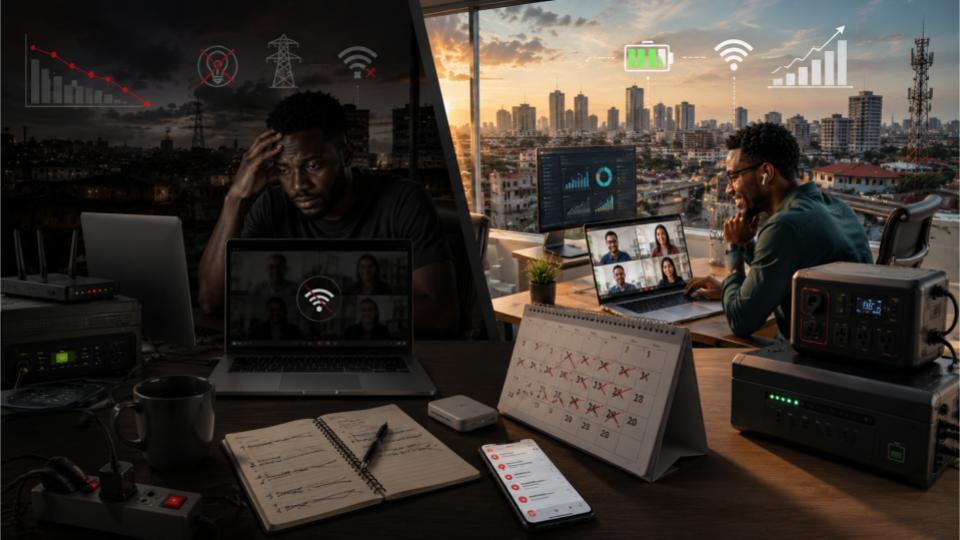
Blackouts are not just annoying. For Nigeria’s growing digital workforce, they are career-ending events that nobody is measuring and almost nobody is talking about honestly.
The Day the Power Went Off and a Client Left
Adaora Eze remembers the exact date. It was a Thursday morning in October 2024, and she was midway through a live UI presentation to a product team in London. She had sent three follow-up emails, gone through two rounds of revision, and waited six weeks for this thirty-minute slot with a decision-maker. The call was running beautifully. Her screen was shared, her portfolio was open, and the feedback from the client’s head of design was warm and specific. Then NEPA did what NEPA does.
The inverter she had been relying on gave out sixteen minutes into the call. Her laptop battery, which had not been replaced in two years, lasted four additional minutes before the screen went black. By the time she borrowed a neighbour’s phone, found a hotspot, restarted her laptop on another extension, and rejoined the meeting, twelve minutes had passed. The client, a small design consultancy with a tight schedule, had moved on. The project went to a designer in Kenya. Adaora, based in Enugu, did not receive a follow-up email.
That contract would have paid her approximately N480,000. It was gone because Nigeria could not keep the lights on for thirty minutes.
Her story is not rare. It is not even particularly dramatic by the standards of what Nigerian digital professionals experience weekly. It is simply one of thousands of moments where the infrastructure failure that defines daily life in this country reaches into careers, bank accounts, and professional reputations and does damage that never shows up in any government statistics.
| Statistic | Value | What It Means |
|---|---|---|
| National Power Generation (2026) | <6,000 MW | Nigeria generates fewer than 6,000 MW of electricity nationwide. |
| Estimated National Power Demand | 30,000+ MW | The country needs over 30,000 MW to meet electricity demand reliably. |
| Average Daily Grid Supply | 4 hrs | Most urban areas receive only about four hours of grid electricity per day on average. |
| Estimated Annual Economic Cost | ₦2.1T | Power failures are estimated to cost the Nigerian economy about ₦2.1 trillion annually. |
How Bad Is It Really? The Numbers
The polite way to discuss Nigerian electricity in 2026 is to say the situation is “challenging” and note that “improvements are ongoing.” The honest way is to say that Nigeria, a country of over 220 million people, generates less electricity than the city of Houston, Texas. The situation in 2026 is not meaningfully better than it was in 2018 for the average household or small business. What has changed is that more Nigerians now depend on reliable electricity for their income than ever before.
The Manufacturers Association of Nigeria estimated in its 2025 annual report that Nigerian businesses collectively spend over N2.1 trillion annually on alternative power generation, primarily diesel and petrol generators. This figure includes manufacturers, but the contribution from digital professionals and micro-businesses working from home has grown sharply since 2022 as remote work expanded.
A 2025 survey conducted by a coalition of Nigerian tech communities including Techpoint Africa, the Lagos State Employment Trust Fund partner organizations, and the Women In Tech Nigeria network found that 78 percent of remote workers in Nigeria had experienced at least one professional incident, a missed deadline, a failed client call, a dropped upload, or a terminated contract in the previous twelve months that was directly attributable to power failure. Of those, 34 percent reported losing a client or project as a direct result.
“We are building digital careers on the most fragile infrastructure foundation imaginable. A developer in Lagos competing for the same contract as a developer in Nairobi is not competing on talent alone. He is competing on uptime.”
Participant, 2025 Nigerian Remote Worker Survey
The irony of Nigeria’s digital economy growth story is that it is happening simultaneously with a power supply situation that structurally disadvantages everyone participating in it. Flutterwave, Andela, Paystack, and every other success story of the Nigerian tech ecosystem was built not because of the infrastructure but despite it.
The Real Financial Cost Nobody Talks About
When people talk about the cost of Nigeria’s power crisis, they usually mean the macro-economic figure. What they rarely calculate is the personal, household-level financial drain that digital professionals absorb every single month just to maintain basic working conditions.
Let us be specific. A remote worker in Lagos who wants to maintain six to eight hours of reliable power for a working day needs a setup that can cover that load consistently. Here is what that typically costs in 2026.
| Power Solution | Monthly Cost (Naira) | Reliability for Work |
|---|---|---|
| Petrol generator (daily use, 4hrs) | N55,000 – N75,000 | Medium (fuel availability varies) |
| Diesel generator (heavier load) | N80,000 – N130,000 | Medium-High (expensive to sustain) |
| Inverter battery maintenance and replacement | N12,000 – N25,000 | Depends on battery age and capacity |
| Solar panel system repayment (monthly, financed) | N45,000 – N90,000 | High (weather dependent) |
| Coworking space subscription (backup) | N30,000 – N65,000 | High (but not always available) |
| Mobile data (backup when router goes off) | N15,000 – N30,000 | Medium (throttling common) |
| Realistic combined monthly spend | N70,000 – N145,000 | Still not fully reliable |
For a remote worker earning N300,000 per month, spending N100,000 on power infrastructure means that 33 percent of gross income is going directly toward solving a problem that simply does not exist for their international clients and competitors. A developer in Ukraine, a designer in Romania, or a writer in the Philippines does not have a line item on their monthly budget called “power survival costs.”
Three Case Studies From Across Nigeria
Tunde Adesanya, 31, Backend Developer
Tunde worked as a contractor for a UK-based SaaS company from January 2024. His contract specified 40 hours per week of availability during UK business hours, which ran from 8am to 5pm GMT, or 9am to 6pm West Africa Time. For the first four months, he managed using a combination of his inverter, occasional generator use, and a coworking space as backup.
In May 2024, a particularly severe power period in his area of Ibadan left him without grid power for eleven consecutive days. His inverter batteries, which needed replacement, could only sustain four hours per charge. He began missing standups. He fell behind on sprint deadlines. He sent explanatory emails to his team lead, who was sympathetic but had no authority over attendance policy.
By June 2024, his contract was reviewed. The client’s HR team cited “availability inconsistency” and reduced his hours from 40 to 20 per week, cutting his monthly income from N640,000 to approximately N320,000. He was never replaced with another Nigerian developer. The reduced arrangement continued for six months before he rebuilt his setup with a financed solar system and returned to full-time work with a different client.
Total estimated income lost during the transition period: N1.92 million over six months, net of the reduced contract payments.
Case Study 02 — Port Harcourt, Rivers State
Blessing Ogbu, 27, Freelance Content Strategist
Blessing built a client roster of four recurring brands across fintech, health, and FMCG between 2023 and 2024, earning a combined N280,000 per month. Her work was entirely digital: research, writing, content calendars, and social copy, all delivered via Google Drive and Notion.
In the second quarter of 2024, Port Harcourt experienced what residents described as the worst power period in recent memory. Blessing’s generator, a 2.5 KVA unit purchased in 2021, developed a fault. The replacement part was unavailable at her local mechanic for three weeks.
She missed four submission deadlines across two clients. One client, a Lagos-based fintech startup, terminated her monthly retainer without severance, citing “repeated late deliverables.” The second docked N40,000 from her invoice. A potential new client she had been pitching, who learned of the delays through a mutual contact, did not proceed.
Total direct loss in terminated income: N85,000 per month recurring. Total loss from pitch failure: estimated N120,000 monthly contract that never materialized. Blessing now works from a cafe near her home on heavy-deadline days and has negotiated deadline windows of 5pm rather than noon with remaining clients as a buffer.
Case Study 03 — Abuja, FCT
Emeka Obi, 35, Digital Marketing Consultant
Emeka’s situation is perhaps the most painful to document because the loss was not a contract but a reputation. He ran paid ads for three small and medium-sized businesses in the education and retail sectors. In September 2024, a campaign for an Abuja-based school running time-sensitive enrollment ads ran into a critical problem: a power outage hit during the peak optimization window of a Meta Ads campaign he had set to adjust manually based on real-time performance.
He could not access the campaign manager for four hours during the window. The campaign overspent by N180,000 on a low-converting audience segment he had planned to pause. The client, who was running a tight marketing budget of N500,000 for the enrollment period, was furious. The school did not renew the engagement. A referral that client had promised, to a sister school, was withdrawn. Emeka believes he lost a combined N360,000 per month in recurring work from those two potential relationships.
He now uses a pre-scheduled automation rule in Meta Ads as a backup and keeps a fully charged power station specifically for campaign management days.
What the Experts Are Saying
The Nigeria power crisis has created what I call an invisible productivity tax. Every digital professional in this country is paying it, but it does not show up on any balance sheet or policy report. When we talk about the competitiveness of Nigeria’s tech ecosystem, we cannot have that conversation seriously without confronting the fact that our best talent is spending 20 to 30 percent of their income just to have access to a working desk.
Dr. Ngozi Adeyemi — Technology and Labour Policy Researcher, University of Lagos
From what I have seen in career counselling sessions, power-related income loss is one of the most underreported sources of professional stress among Nigerian remote workers. People are ashamed to tell a client that NEPA is why they missed a deadline. So they carry the professional consequence alone, and it builds up into real financial anxiety over time. The power problem is also a mental health problem, and nobody is connecting those dots.
Olufunke Adeleke — Career Counsellor and Certified Professional Development Coach, Abuja
The irony is that Nigeria’s tech sector is producing internationally competitive talent at scale for the first time. Andela’s model, the rise of platforms like AltSchool Africa and Decagon, the growth of Techpoint’s community. All of this is building something remarkable. But the infrastructure underneath it is not keeping pace. You cannot build a first-class workforce on a third-class power grid and expect the result to be sustainable at national scale.
Kelechi Nwosu — Founder, Digital Skills Nigeria Initiative; Former Advisor, Federal Ministry of Communications
What It Looks Like: Platform Evidence
The power crisis leaves traceable marks across the digital tools that Nigerian professionals use every day. What follows are reconstructed representations of the types of messages, notifications, and system logs that document the moment when infrastructure failure becomes a professional incident.
The Mental Cost: Stress, Anxiety, and Exhausted Productivity
There is a version of this conversation that stays entirely within the numbers. Lost contracts, wasted fuel costs, reduced invoice amounts. But the number that is hardest to quantify and possibly the most damaging in the long run is what continuous power uncertainty does to the minds of the professionals living with it.
Before any important call or submission deadline, Nigerian remote workers describe a specific anxiety state that has no equivalent in most other parts of the world. It involves checking the inverter charge level, checking the petrol in the generator, charging every device to full, positioning a backup mobile hotspot, and mentally mapping what to do if any one of these failsafe layers collapses mid-task. All of that cognitive load is happening before a single line of code is written or a single word is typed.
Documented Mental Health ImpactA 2024 survey of 340 Nigerian remote workers by a Lagos-based occupational health researcher found that 61 percent reported power-related anxiety as a regular feature of their working day. Of those, 44 percent described checking their power status as a compulsive behavior that interrupted focus multiple times per hour.
Twelve percent reported having declined high-stakes freelance opportunities specifically because they lacked confidence in their power setup to deliver reliably. These are opportunities lost not to skill gaps but to infrastructure fear.
Olufunke Adeleke, the career counsellor quoted earlier in this piece, describes it as “defensive career posture.” Talented professionals who should be pursuing stretch opportunities are instead calibrating their ambitions around what they believe their infrastructure can support. The power crisis is not just deleting income. It is quietly shrinking professional ambition.
What Nigerian Professionals Are Doing About It
The pragmatic and often expensive adaptations that Nigerian digital workers have developed are worth documenting, because they represent real engineering of personal infrastructure in the absence of reliable public infrastructure. These are not hacks. They are survival systems.
Solar System Investment
The most lasting solution being adopted by professionals with capital access or access to financing products like Branch, Carbon, or LAPO Microfinance is the hybrid solar system with lithium battery storage. A well-specified 3.5 kilowatt-hour lithium battery system can sustain a home office with a laptop, monitor, router, and phone charging for a full working day through a single charge cycle. Initial costs range from N800,000 to N2.5 million depending on load requirements and installation quality, but monthly running costs fall to near zero after setup. Several organizations including the Lagos State Government’s Solar Energy Programme have offered subsidized units in 2025, though access has been limited and demand far outstrips supply.
Coworking Space Subscriptions
Coworking spaces in Lagos, Abuja, Port Harcourt, and Ibadan have seen substantial membership growth from remote workers who use them not as their primary workspace but as an emergency backup on high-stakes delivery days. Spaces like The Zone, Co-Creation Hub in Yaba, HubSpace Abuja, and similar facilities across the country have developed flexible daily-pass products specifically because the demand pattern is: reliable power when it matters most, not every day.
Client Communication and Deadline Management
More experienced Nigerian freelancers have developed an approach to client onboarding that includes honest infrastructure disclosures. Rather than hiding the power reality and hoping for the best, they build buffer time into deadlines, avoid scheduling presentations during early morning hours when supply tends to be least stable, and communicate proactively rather than reactively when outages hit. Some have found that international clients, particularly those working with African professionals by design, are more understanding than expected when the situation is explained in advance rather than used as a post-failure excuse.
- Scheduling all critical calls and presentations for the 10am to 12pm window when local grid supply is statistically most stable
- Keeping a fully charged portable power station (like Jackery or a locally sourced equivalent) dedicated only to meeting days
- Negotiating asynchronous working arrangements with international clients that reduce dependence on fixed-time video calls
- Maintaining a second SIM card on a different network as a mobile hotspot backup when the primary router goes down
- Building a three to five day deadline buffer into all deliverables and only deploying it when infrastructure failure actually occurs
- Joining community-level generator cooperatives in some estate communities in Lagos and Abuja where residents pool fuel costs
- Using offline-capable tools like Notion, VS Code, and Figma with local saves to continue working through internet outages even when power holds.
Frequently Asked Questions
HOW MANY HOURS OF ELECTRICITY DOES THE AVERAVE NIGERIAN GET PER DAY IN 2026?
Most urban Nigerians receive between 4 and 8 hours of grid electricity per day in 2026, though this varies significantly by state and local distribution company. Many areas in the south-south and north-east receive fewer than 3 hours daily. Some high-demand periods have seen zero-supply days in multiple states simultaneously. The Electricity Distribution Company network, made up of eleven privatized DisCos across the country, has not improved aggregate supply to the consumer level in any statistically meaningful way since privatization in 2013.
HOW MUCH DO NIGERIAN REMOTE WORKERS SPEND ON ALTERNATIVE POWER MONTHLY?
Estimates from the Manufacturers Association of Nigeria and independent surveys suggest digital professionals spend between N45,000 and N120,000 per month on petrol, diesel, inverter maintenance, and solar equipment to sustain reliable power for work. This figure varies significantly based on location, work intensity, and how established the professional’s backup system is. In the first year of setting up reliable power infrastructure, costs can be higher as capital equipment is purchased.
CAN YOU LOSE A REMOTE JOB IN NIGERIA BECAUSE OF POWER OUTAGES?
Yes, and it happens more than the official conversation around Nigerian tech acknowledges. Multiple documented cases exist of Nigerian remote workers being placed on performance improvement plans or having contracts reduced or terminated after repeated unavailability during working hours caused by power failures. International employers in particular often operate under the assumption that a remote worker has reliable home office infrastructure, since this is the baseline expectation in most countries where remote work is mainstream. Disclosing your power situation proactively, and negotiating asynchronous work where possible, significantly reduces this risk.
WHAT IS THE MOST RELIABLE POWER BACKUP OPTION FOR A NIGERIAN REMOTE WORKER IN 2026?
A hybrid solar system with lithium battery storage is widely considered the most reliable long-term investment for sustained productivity. Initial setup costs range from N800,000 to N2.5 million depending on load capacity, but monthly running costs drop to near zero compared to generator dependence. For professionals who cannot afford the upfront cost, a combination of a quality UPS inverter, regularly maintained batteries, and a small petrol generator as a tertiary backup represents the most practical affordable approach. A dedicated portable power station specifically for laptop and communication equipment on call days is a lower-cost partial solution.
IS NIGERIA’S POWER SITUATION IMPROVING IN 2026?
Marginally. The Electricity Act of 2023 opened the sector to state-level generation and private distribution, and several state governments including Lagos and Ekiti have launched independent grid initiatives. However, total national generation as of early 2026 remains well below 6,000 megawatts, far short of the estimated 30,000 megawatts required to meet demand. The most optimistic indicators are in the decentralized solar space, where private investment is growing rapidly. Systemic grid improvement at a scale that meaningfully changes the daily experience of the average professional is not projected to arrive within the near-term horizon.
SHOULD NIGERIAN FREELANCERS TELL INTERNATIONAL CLIENTS ABOUT THE POWER SITUATION ?
The consensus among experienced Nigerian digital professionals is: yes, but strategically and proactively rather than reactively. Framing it as a managed infrastructure environment with specific mitigation strategies in place, rather than as an unpredictable problem, positions you as a professional who has solved a challenge rather than a victim of it. Some clients working specifically with African talent pools are aware of and already prepared for this reality. Others are not, and a proactive conversation during onboarding will serve you far better than an apologetic explanation after a missed deliverable.
Where Does This Leave Us?
Adaora in Enugu eventually won back a comparable contract eight months later, from a different client in the same sector, after she had installed a proper solar backup system. The N480,000 contract she lost is gone and will not return. The client who moved on will not come back. But Adaora is still working, still building, and, more importantly, still competing.
That is the complicated truth of Nigeria’s power crisis for the digital workforce. It does not stop everyone. The most determined professionals find ways around it, through expensive infrastructure investments, creative scheduling, proactive client communication, and sheer personal resolve. But it raises the cost of participation enormously. It filters out people who cannot afford the workarounds. It penalizes those in regions where the grid is worst. And it extracts a quiet, compounding tax on productivity, mental health, and professional ambition from the people who are building what is supposed to be the future of Nigeria’s economy.
The power problem is not a footnote to the Nigerian digital career story. It is a central chapter that has not been written honestly enough. Until it is, the solutions will remain personal and patchwork, while the structural problem continues to grow alongside the very workforce it is undermining.
Nigerian digital professionals deserve infrastructure that matches their ambition. In 2026, they are still waiting for it. In the meantime, they are doing what Nigerians have always done: finding a way regardless.
