

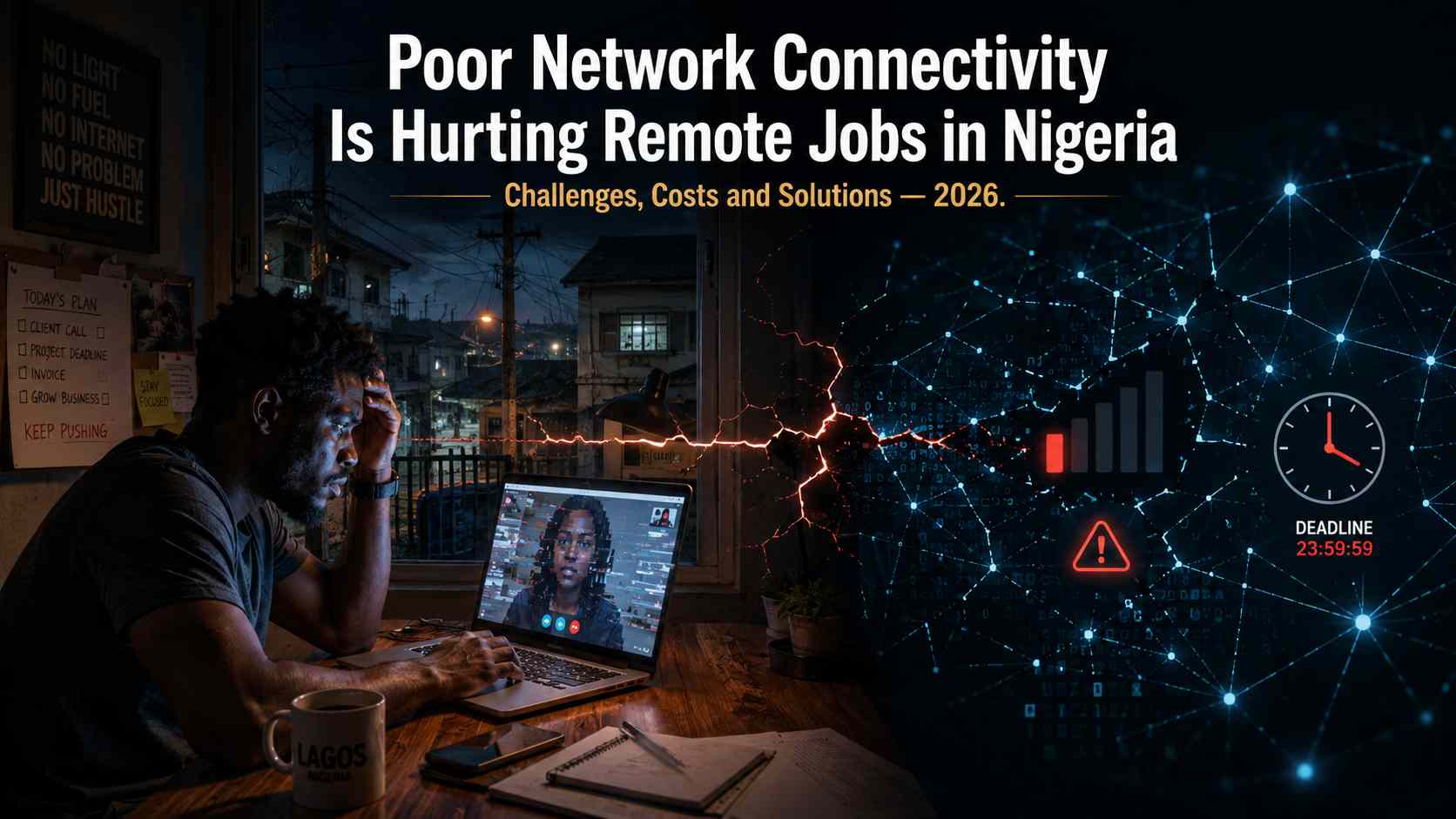
Tunde had prepared for that interview for three weeks. He had researched the company, rehearsed his answers, dressed properly even though nobody would see him below the shoulders, and tested his connection the evening before. Thirty-eight seconds into the most important professional conversation of his year, the screen froze. His face, mid-sentence, locked into a pixelated mask. The interviewer waited. Tunde refreshed the call three times before reconnecting. By the time audio came back, the moment had passed. The warmth that builds in the first minutes of a good interview had cooled. He did not get the role.
He is a software developer in Ibadan. He has eight years of professional experience. His portfolio is solid. His problem was not his competence. His problem was that the infrastructure beneath him failed at the moment it mattered most, and in the world of remote work, that failure is indistinguishable from your own failure from the perspective of a hiring manager sitting in London or Toronto who has ten other candidates whose screens did not freeze.
This is the story of an entire generation of Nigerian professionals whose ambitions are bigger than the bandwidth available to them. In 2026, remote work has become one of the most important channels through which skilled Nigerians access income from the global economy. And in 2026, poor network connectivity remains one of the most persistent, most damaging, and most underreported threats to that access.
The State of Internet Connectivity in Nigeria in 2026
Let us start with the reality of what the numbers actually mean on the ground. Nigeria has made genuine progress in broadband penetration over the last decade. The expansion of fibre optic infrastructure by providers like MainOne, Spectranet, and the state-backed projects tied to the National Broadband Plan have brought better connectivity to parts of Lagos, Abuja, and a handful of other urban centres. Mobile broadband coverage, particularly through 4G LTE networks, has extended to a significantly wider geographic area than existed five years ago.
But coverage on a map is not the same thing as reliable, usable connection in a practical working environment. The gap between what is theoretically available and what a remote worker can actually depend on from hour to hour is where the real story lives.
The average download speed in Nigeria in 2026 sits between 12 and 18 Mbps on mobile broadband under optimal conditions. That number sounds reasonable until you understand that most remote work does not happen under optimal conditions. It happens during peak hours when towers are overloaded, during rainfall when mobile signal degrades, during power outages when the worker has switched from their Wi-Fi router to mobile data, and during the unpredictable periods when a provider’s infrastructure simply fails without explanation or estimated restoration time.
Real-world speeds experienced by remote workers in Lagos, outside the fibre-served neighbourhoods of Lekki, Victoria Island, and parts of Ikoyi, are often significantly below that average. In secondary cities and the peri-urban areas where many working-class remote professionals live, the gap between advertised and actual is wider still.
Who Is Being Hurt Most
The connectivity problem does not distribute its burden equally, and understanding who bears the most weight matters for understanding what the problem is really about.
The professionals most severely impacted are those working in roles that require consistent, real-time connection: software developers in collaborative teams using shared code environments, customer support professionals handling voice and video calls, content creators uploading and downloading large media files, virtual assistants managing multiple client communications, and data analysts working with cloud-based tools that require sustained throughput. These are precisely the roles that the Nigerian remote work economy has been building toward. They are the roles with better compensation, more sustainable career development paths, and the strongest potential for dollar or pound-denominated income in a naira-weakened economy.
Younger workers, those in their mid-twenties and early thirties who moved into remote work specifically because they saw it as the most viable path to income security, are bearing a disproportionate share of the cost. They are working from shared apartments in Ikeja, Yaba, Ojota, or Lugbe, in buildings where the building’s single internet connection is shared by multiple households, from neighbourhoods where fibre infrastructure has not arrived, using mobile data that depletes faster and more expensively than they can afford to replenish it.
The Real Challenges Nigerian Remote Workers Face Daily
Speaking to remote professionals across Lagos, Abuja, Port Harcourt, Enugu, and Ibadan reveals a cluster of recurring problems that go beyond the obvious issue of slow speed. The connectivity challenge in Nigeria is multi-layered, and its layers interact in ways that make the cumulative impact significantly worse than any single problem would be alone.
Power and Internet Are One Problem
The most fundamental issue is that Nigeria’s internet problem and Nigeria’s power problem are, in practice, the same problem. Most internet infrastructure, including the routers, base stations, and servers that deliver connectivity, requires consistent power to function. When power goes out, which happens multiple times per day in many Nigerian neighbourhoods, the Wi-Fi router goes with it. The worker switches to mobile data. Mobile data is more expensive per megabyte, more susceptible to network congestion, and less reliable for sustained high-bandwidth tasks. If the power outage is extended, the worker’s laptop battery eventually depletes too. An eight-hour power cut is not just an inconvenience. It is an eight-hour productive day erased.
Network Congestion During Working Hours
Remote work, almost by definition, happens during the hours when everyone else is also online. Morning to mid-afternoon, which corresponds to the primary working windows for both Nigerian time and the US and European time zones that many Nigerian remote workers serve, is also when mobile networks are at their most congested. The theoretical speed available at midnight on a 4G network is not the speed available at 10am. For workers on calls, in collaborative sessions, or uploading deliverables against a deadline, the speed at 10am is the only speed that matters.
The Multi-SIM Tax
The widely adopted solution to single-provider unreliability is carrying multiple SIM cards from multiple providers and switching between them based on which one is currently performing best. This is a sensible adaptation but it is also an invisible tax on workers who can least afford it. A professional running two or three SIM cards simultaneously, each with active data subscriptions, is spending money that could be going toward professional development, savings, or simply food. The connectivity problem does not just consume time. It consumes income.
“I run three SIMs. MTN for calls, Glo for data when MTN is slow, and Airtel as my backup. I spend about 40,000 naira every month just on data across all three, and I still have days where I apologise to clients because something dropped. My colleague in Ghana pays less than half that and never has to apologise for her connection. It is genuinely demoralising.”UI/UX Designer, Yaba, Lagos. Remote for a UK-based startup.
Video Call Reliability and Professional Perception
Video calling has become the primary medium through which remote work relationships are built and maintained. It is where interviews happen, where team bonding happens, where client confidence is established, and where the subtle signals of professional competence are communicated. When those calls are broken by freezing, by audio dropouts, by the endless “you’re breaking up” exchanges that Nigerian remote workers know too well, the professional impact extends beyond the immediate inconvenience. It shapes how the Nigerian worker is perceived by their international colleagues and clients over time, and those perceptions are sticky even when the connectivity eventually improves.
The Hidden Financial Costs Nobody Talks About
The economic cost of poor connectivity on Nigerian remote workers is significantly larger than the monthly data subscription alone. When you add up all the direct and indirect costs, the picture becomes genuinely alarming.
|
COST CATEGORY |
MONTHLY ESTIMATE | IMPACT ON WORKER |
|---|---|---|
| Multiple data subscriptions (2 to 3 SIMs) | ₦25,000 to ₦55,000 | Direct income drain; often more than 30% of base earnings for entry-level remote workers |
| Generator fuel for power backup | ₦15,000 to ₦35,000 | Necessary to maintain connection during grid outages; compounds data costs |
| Co-working space access | ₦20,000 to ₦60,000 | Increasingly used as a connectivity workaround; adds significant overhead |
| Lost billable hours from outages | ₦30,000 to ₦120,000 | Hardest to calculate but consistently the largest real cost for hourly or deliverable workers |
| Missed opportunities from failed interviews | Uncalculable | Single lost contract can represent months of income; long-term career trajectory impact |
| Reputation costs with clients | Uncalculable | Eroded trust is one of the most difficult things to rebuild in remote working relationships
|
The Opportunities Nigeria Is Losing to Poor Connectivity
Beyond the individual worker, there is a national economic story here that deserves serious attention. Remote work represents one of the most significant opportunities for Nigeria to grow its foreign exchange earnings through the export of professional services rather than raw commodities. A software developer, writer, designer, accountant, or financial analyst earning in dollars from a Nigerian location is injecting hard currency into the domestic economy while building skills and networks that increase their long-term earning potential and the capability of the Nigerian workforce overall.
Countries that have made this transition deliberately and invested in the infrastructure to support it have seen significant economic dividends. The Philippines built a multi-billion-dollar business process outsourcing industry on the back of reliable connectivity, consistent power, and a workforce with the English language and professional skills to serve global clients. India’s technology services sector, which exports hundreds of billions of dollars in professional services annually, required connectivity as a foundational condition. Nigeria has the talent. It does not reliably have the infrastructure.
Nigeria is not losing this race because its people are not capable enough. It is losing it because the ground beneath those capable people keeps giving way. Every engineer who moves to Canada to do the same work they could have done from Lekki is a story about connectivity as much as it is a story about anything else.
The japa phenomenon, the ongoing emigration of skilled young Nigerians to Canada, the United Kingdom, and other countries, is driven by multiple factors. But connectivity and infrastructure are among those factors. When a Nigerian developer knows they can do equivalent work from Lekki or from Toronto, and one of those locations means their client calls do not drop and their power stays on, the comparison does not always end in favour of staying.
How Employers Perceive Nigerian Remote Workers
There is a conversation happening in remote hiring circles that Nigerian professionals rarely get to see or hear, and it is worth describing it honestly even though it is uncomfortable. International employers who hire remote workers globally have developed informal perceptions about reliability by country and region. These perceptions are shaped by aggregate experience and anecdote, not always by rigorous analysis, but they carry real weight in hiring decisions.
Nigeria’s reputation in certain remote hiring communities has been shaped partly by genuine instances of communication failure, missed deadlines caused by connectivity outages, and the difficulty of reaching workers whose phones and internet go down simultaneously during power cuts. These are not personal failures. They are infrastructure failures. But the remote employer experiencing them often cannot distinguish between the two, and the consequence is a generalised caution that affects every Nigerian applicant for remote positions, regardless of their individual connectivity situation.
This is one of the most unjust dimensions of the connectivity problem. The infrastructure failure, which is a government and telco failure, not a worker failure, ends up appearing in the professional record of individual Nigerian workers as a question mark about their reliability and professionalism. The cost of a systemic failure is being borne by the individuals at the bottom of the infrastructure stack.
The Geography of the Problem
The connectivity problem in Nigeria is also a geography problem, and that geography increasingly maps onto existing social and economic inequalities in ways that should alarm anyone concerned about inclusive economic development.
The parts of Nigerian cities that have access to reliable fibre broadband in 2026 are, broadly speaking, the parts of those cities that were already wealthy. Victoria Island, Lekki Phase 1, parts of Ikeja GRA, Maitama and Asokoro in Abuja, GRA areas in Port Harcourt. These are neighbourhoods where the monthly rent for an apartment already exceeds what most remote workers earn. A young professional earning 200,000 naira a month from a remote position cannot afford to live in the neighbourhood where the internet is reliable. They live in Ojuelegba, in Egbeda, in Lugbe, in Rumuola, in Agodi, where the internet is whatever the mobile network is providing on any given day.
The result is a perverse situation where the income-equalising potential of remote work, the idea that someone in Aba can earn what someone in Lekki earns because the work is done online and location should not matter, is undermined by the very infrastructure inequality that remote work was supposed to help transcend. Location still matters. It matters through the quality of the internet it provides.
Why the Infrastructure Is Failing
Understanding why the infrastructure is the way it is requires acknowledging a cluster of overlapping problems that do not have simple or quick solutions, even when there is political will to address them, which is itself not consistently present.
The first layer is the power problem, which has been documented, debated, and deplored for decades without being resolved. Internet infrastructure requires power. Nigeria’s power grid cannot reliably supply the base stations, exchange buildings, and data centres that carry internet traffic. Telecoms companies invest heavily in their own diesel generation and battery backup, but this adds cost to service delivery and creates maintenance challenges that affect uptime. The internet problem in Nigeria is, at a fundamental technical level, a power problem with an internet overlay.
The second layer is the right-of-way problem. Laying fibre optic cable in Nigerian cities requires navigating a complex, slow, and sometimes corrupt process of obtaining permits to dig roads and access buildings. The bureaucratic friction involved in fibre deployment has significantly slowed the expansion of fixed broadband beyond the high-value areas where providers can be confident of commercial return. The regulatory environment has not made fibre rollout as fast or as profitable as it needs to be to attract the investment required for universal coverage.
The third layer is underinvestment in spectrum. Mobile broadband speed and reliability are substantially determined by how much spectrum a provider has licensed and whether that spectrum is being deployed efficiently. The allocation and pricing of spectrum in Nigeria has not always been structured to maximise coverage quality and speed. The introduction of 5G in select areas has been slow, and its benefits have not yet reached the majority of remote workers who need them most.
Nigeria’s fixed broadband penetration rate of approximately 11 percent is significantly below the sub-Saharan African average of 17 percent and drastically below the global target of 40 percent that development organisations consider necessary for meaningful economic participation in the digital economy. Without aggressive infrastructure investment, the gap will continue to widen rather than close.
Practical Solutions That Actually Work in 2026
While systemic change requires policy and investment that individual workers cannot control, there are practical strategies that Nigerian remote workers are successfully using to manage the connectivity challenge in 2026. These are not perfect solutions. They are adaptations that reduce the damage while the larger problems are being addressed at a pace that remains frustratingly slow.
What Government and Telecoms Must Do
Individual adaptation can soften the blow, but it cannot solve the problem. The solutions that matter at scale require action from government, regulators, and the telecoms industry. The following are not wishful thinking. They are the kinds of interventions that other African governments have made, with documented results, when they decided that digital infrastructure was a national priority rather than a peripheral concern.
- The federal government must designate broadband infrastructure investment as a national emergency equivalent to the way road infrastructure is treated. This means prioritising right-of-way reform, reducing the bureaucratic friction that slows fibre deployment, and creating strong incentives for providers to extend coverage beyond commercially attractive areas into the neighbourhoods where remote workers actually live.
- Universal Service Provision Fund resources, which are collected from telecoms operators specifically to fund connectivity in underserved areas, must be deployed aggressively and transparently. This fund has historically been significantly underutilised relative to what has been collected into it. The money exists. The accountability for spending it does not.
- Telecoms operators must be held to meaningful quality-of-service standards with real financial consequences for persistent failures. Advertising 4G speeds while consistently delivering significantly lower performance should not be a commercially consequence-free practice. Consumer protection in the telecoms sector in Nigeria is weaker than it needs to be for the remote work economy to function.
- State governments in major cities should develop public connectivity infrastructure, including well-maintained fibre rings in key commercial and residential areas, on the understanding that connectivity is now as essential to economic participation as roads and water. Several Lagos local governments have gestured at this. None have followed through at the scale the problem requires.
- Import duties and VAT on connectivity equipment, including routers, modems, satellite internet hardware, and backup power systems specifically used for internet access, should be reviewed and reduced. Making the tools of connectivity more affordable directly expands who can access reliable connection, and that expansion has measurable economic returns through increased remote work productivity and foreign exchange earnings.
The Signal Is Weak but the Will Is Strong
Here is what is easy to forget when you are in the middle of the frustration. The fact that hundreds of thousands of young Nigerians are doing remote work at all, that they are building international careers, earning in foreign currency, and competing credibly in the global digital economy despite infrastructure that makes all of it harder than it should be, is itself a remarkable thing. The adaptability, the resilience, and the sheer commercial determination that Nigerian remote workers demonstrate every day are not small things. They are evidence of a talent base that, given the infrastructure it deserves, would be transformative in its economic impact.
Tunde, the developer in Ibadan whose interview froze, found another opportunity two months later. He bought a Starlink kit with money he had been saving for six months. He told me that the first video call he made on it, stable, clear, uninterrupted from his home desk for the first time in his professional life, felt like the country had finally kept a promise to him that it had been making and breaking for years. He got that second job. He is now earning in pounds. He is still in Ibadan.
That story should not require six months of saving and a satellite dish to have a happy ending. It should be available to every Nigerian remote worker by default, through infrastructure that a government serious about its young people’s futures would have built long before it became a personal survival challenge. The connectivity crisis hurting remote jobs in Nigeria in 2026 is not a technology problem. It is a policy problem, an investment problem, and ultimately a question of whether the people making decisions about infrastructure understand what is at stake for the generation sitting behind frozen screens, trying to connect.
Frequently Asked Questions
Why is poor internet connectivity such a big problem for Nigerian remote workers in 2026? A: Because remote work depends entirely on stable internet. In Nigeria, frequent power outages, overloaded mobile towers, and limited fibre coverage mean workers regularly lose connection during client calls, miss deadlines, and appear unreliable to international employers through no fault of their own.
How much do Nigerian remote workers spend monthly dealing with bad internet? A: When you add multiple SIM subscriptions, generator fuel, and co-working space access, many Nigerian remote workers spend between 60,000 and 150,000 naira monthly just managing connectivity. That is before calculating the income lost from outages and missed opportunities.
What is the best internet solution for Nigerian remote workers in 2026? A: Starlink satellite internet is currently the most reliable option for serious remote workers who can afford the upfront cost. For those who cannot, a combination of two mobile SIM cards from different providers plus a UPS battery backup for the router is the most practical middle-ground solution.
Does poor internet affect how international employers perceive Nigerian remote workers? A: Yes, and it is one of the most unfair consequences of the infrastructure problem. When calls freeze or workers go offline unexpectedly, employers often cannot distinguish between personal unreliability and infrastructure failure. This creates a reputational burden that affects hiring decisions for all Nigerian applicants.
