

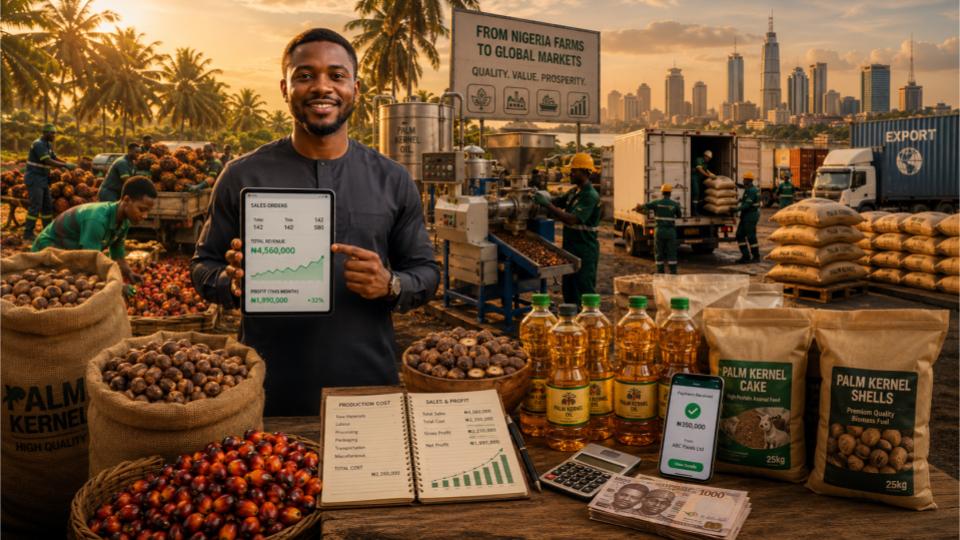
A man I know in Owerri has been buying and processing palm kernels since 2019. He started with N80,000, a second-hand manual press, and a shed behind his house in Nekede. Today he runs a medium-scale palm kernel oil extraction business supplying soap manufacturers in Lagos, cosmetics producers in Onitsha, and three export aggregators who buy his refined oil for customers in China and India. His monthly turnover in early 2026 crossed N4 million. He employs five people and is planning to acquire a second expeller press before the end of the year. When I ask him why he chose palm kernel over other agricultural products, his answer is the same every time: palm kernel produces multiple valuable products from a single raw material, the demand never disappears, and the supply chain in southeastern Nigeria is strong enough that consistent sourcing has never been his problem.
That story is not exceptional for the palm kernel sector. It is representative of a business that rewards people who understand its economics clearly and execute consistently. The palm kernel business in Nigeria in 2026 is not a secret opportunity that only a few people know about. It is a thoroughly established agricultural commodity market with well-understood supply chains, reliable industrial demand, growing export appetite, and room for entrepreneurs at multiple capital levels to build sustainable income.
What most people who are curious about this sector lack is not motivation but specific information. What does it actually cost to start? What can you realistically earn at different scales? What are the products and who buys them? What are the mistakes that kill early-stage businesses in this sector? This guide answers all of those questions with real numbers and honest context.
Why the Palm Kernel Business in Nigeria Remains One of the Most Reliable Agribusiness Opportunities
Palm kernel is what you get after the palm fruit has been processed for its outer pulp oil, the palm oil most Nigerians are familiar with. The hard seed inside that fruit is the palm kernel, and it is the source of palm kernel oil, palm kernel cake, and palm kernel shells, three separate products with three separate markets and three separate income streams from a single raw material.
Nigeria is the fourth largest producer of palm products globally. The oil palm belt stretching through Rivers, Imo, Abia, Cross River, Delta, Edo, and Akwa Ibom states produces enormous volumes of palm fruit year-round, and the palm kernels generated as a by-product of palm oil processing are available consistently and in large quantities. This abundance of raw material is one of the primary reasons the palm kernel business in Nigeria has such a strong supply foundation.
On the demand side, palm kernel oil has applications in food production, soap manufacturing, the cosmetics and personal care industry, and industrial lubricants. Palm kernel cake is a high-protein animal feed ingredient used extensively by poultry and livestock farmers across Nigeria and exported to Asia and Europe. Palm kernel shells are an established biomass fuel source for industrial boilers, particularly in the cement and paper manufacturing sectors, and they are also exported to European countries using biomass energy. The combination of multiple product streams and genuinely diverse buyer markets makes this sector significantly more resilient than single-commodity agricultural businesses.
Palm kernel oil global demand has grown consistently for the past decade driven by its applications in the food industry and increasingly in biofuel and oleochemical manufacturing. Nigeria sits at the centre of a supply region that has not yet reached its production potential, meaning opportunities for processors and traders continue to expand even as more participants enter the market.
The Four Main Products of the Palm Kernel Business and What Each One Earns
Understanding what you can sell before committing to a business model is essential. Palm kernel generates four commercially significant products, each with its own buyer profile, margin structure, and logistical requirements.
The primary product of palm kernel processing. Used in cooking, soap production, cosmetics, and industrial applications. Sold to food manufacturers, soap companies, cosmetics producers, and export buyers. Refined PKO commands a premium over crude. Price per litre ranges from N1,800 to N3,200 depending on quality and refinement level in 2026.
The solid residue after oil extraction. Contains 14 to 17 percent protein, making it valuable as an animal feed ingredient for poultry and ruminant livestock. Sold by the ton to feed manufacturers and large poultry farms. Selling price ranges from N180,000 to N280,000 per tons depending on season and buyer category.
The hard outer shell of the palm kernel. Used as boiler fuel by industrial facilities and exported as biomass energy. Cement factories, paper mills, and food processing plants are active domestic buyers. Export aggregators buy in large volumes for European and Asian markets. Selling price ranges from N25,000 to N65,000 per tons locally.
Palm Kernel Business Nigeria 2026: Real Startup Costs at Three Different Scales
One of the most important things to understand about the palm kernel business is that it is genuinely accessible at multiple capital levels. You do not need to start as a large processor. You can enter as a trader, move into small-scale processing as your capital grows, and scale from there. Here are honest startup cost estimates for each level.
| Business Level | Startup Capital | Key Costs Included | Estimated Monthly Profit |
|---|---|---|---|
| Trader / Aggregator (No Processing) | N50,000 – N200,000 | Initial stock purchase, transport, storage bags, market fees | N30,000 – N100,000 |
| Small-Scale Processor (Manual or Small Motorized Press) | N250,000 – N900,000 | Manual or motorized press (N150,000 to N600,000), initial raw kernel stock, storage drums, labour, transport | N120,000 – N350,000 |
| Medium-Scale Processor (Expeller Press Operation) | N1,500,000 – N5,000,000 | Expeller press machine, cracker and separator, generator, shed construction or rental, working capital for raw material stock | N400,000 – N1,200,000 |
| PKO Cosmetics Producer (Home-Based) | N30,000 – N120,000 | Bulk PKO, containers and moulds, preservatives, packaging materials, labelling | N80,000 – N300,000 |
| Palm Kernel Shell Trader (Supply to Industry) | N80,000 – N300,000 | Shell sourcing from processors, transport arrangement, weighing scale, storage space | N60,000 – N200,000 |
Honest DisclaimerThese profit estimates reflect realistic mid-range outcomes for entrepreneurs who source raw materials at competitive prices, manage their operations consistently, and have established reliable buyers before scaling production. Actual results depend on sourcing costs in your specific location, your product quality, the strength of your buyer relationships, and your operational efficiency. New entrants should expect a three to six month period of learning before reaching these figures consistently.
Step-by-Step: How to Start a Palm Kernel Business in Nigeria from Scratch
The sequence below reflects the actual path that successful palm kernel entrepreneurs in Nigeria have followed. It is deliberately ordered to minimize risk during the early months when you are still learning the market.
- Choose your entry point based on available capital and risk tolerance — If you have less than N200,000, start as a trader or aggregator. Buy palm kernels from small producers and processors, transport them to larger buyers or processing hubs, and earn the margin in between. This requires no equipment, minimal infrastructure, and allows you to learn the market deeply before committing more capital. If you have N300,000 or more, consider starting with a small motorized press and processing your own oil for local and wholesale buyers. If you have access to N1.5 million or above, a medium-scale expeller press operation gives you access to the industrial buyer category.
- Identify your raw material supply source before any other investment — Your supply chain is the foundation of the entire business. Before buying equipment or renting space, spend two to three weeks visiting palm kernel producing communities and small processors in your state. Identify at least three reliable sources who can supply you consistently in the volumes you need. Negotiate a price, agree on quality standards, and if possible arrange a first test purchase to verify both quality and reliability. Never invest in processing equipment until you have confirmed raw material supply.
- Identify your buyers before you start producing — This is the step most beginners skip and it is the one that costs them the most. Before processing your first batch of oil, visit potential buyers including soap manufacturers, cosmetics companies, poultry feed producers, and industrial shell buyers. Understand what specifications they require, what volumes they buy, on what payment terms, and whether they are currently satisfied with their existing suppliers. This market intelligence determines your product quality targets, your packaging decisions, and your pricing strategy before you produce anything.
- Start small, document your numbers meticulously, and optimize before scaling — Whether you start as a trader handling one or two tons per month or a small processor making 200 to 400 litres of oil monthly, track every naira in and every naira out from the beginning. Know your cost per litre of oil produced or your margin per ton of kernels traded. Understand which buyers are most profitable and why. Know your wastage rates and your transport costs per delivery. This financial discipline during your small-scale phase is what allows you to scale intelligently rather than repeating expensive mistakes at higher volume.
- Reinvest aggressively in the first eighteen months — The palm kernel business rewards those who reinvest early profits back into production capacity and working capital rather than consuming them. Target reinvesting at least 40 to 50 percent of net profit during your first eighteen months. This capital builds your raw material buffer, allows you to take advantage of seasonal price dips when kernels are cheaper, and funds the equipment upgrades that unlock access to higher-paying industrial buyer categories. The entrepreneurs in this sector who build real scale almost universally describe aggressive early reinvestment as their most important decision.
- Build toward export as a medium-term income diversification strategy — Once you are producing consistently and have established your domestic buyer relationships, begin exploring the export market. Palm kernel oil, palm kernel shells, and palm kernel cake are all actively traded internationally. Export buyers typically pay in dollars, which at current exchange rates represents a significant income premium over equivalent naira transactions. Connect with the Nigerian Export Promotion Council, attend agricultural trade shows, and join trade associations that facilitate introductions to international buyers. Your first export transaction is the most difficult. Each subsequent one becomes progressively easier.
In the palm kernel business, your supply chain and your buyer relationships are worth more than your equipment. The machines can be acquired when the money is there. The trust of reliable suppliers and consistent buyers is built over time and cannot be bought at any price.
Where to Source Palm Kernels and Who to Sell To in Nigeria
Understanding the geography of this market saves you enormous time and money. Palm kernels are produced abundantly in specific regions and consumed in ways that create clear logistics patterns.
Primary sourcing regions
The main palm kernel producing states in Nigeria are Rivers, Imo, Abia, Cross River, Delta, Edo, Bayelsa, and Akwa Ibom. Within these states, palm processing mills generate large volumes of kernels as a by-product of palm oil extraction. Many of these mills sell their kernels to whoever comes with cash and transport, creating an accessible sourcing market for entrepreneurs willing to establish direct relationships with mill operators. Community markets in towns like Aba, Calabar, Owerri, Asaba, and Uyo also have established palm kernel trading sections where you can buy at competitive prices.
Who buys your products
Palm kernel oil buyers include soap manufacturers concentrated in Lagos and Kano, cosmetics producers primarily in Lagos and Abuja, cooking oil retailers and distributors in urban markets, and export aggregators in Lagos and Port Harcourt collecting on behalf of international buyers. Palm kernel cake buyers are primarily poultry and livestock feed manufacturers in Lagos, Ibadan, Ogun, and Kano. Palm kernel shell buyers include cement factories in Ewekoro, Ibese, and Obajana, industrial facilities with biomass boilers, and export aggregators supplying European and Asian biomass energy markets.
Export OpportunityPalm kernel shells are among the most straightforward Nigerian agricultural commodities to export because they are not a food product and therefore face significantly fewer phytosanitary and certification requirements than food exports. European buyers paying in euros for biomass fuel regularly seek Nigerian palm kernel shell suppliers. The Nigerian Export Promotion Council can facilitate introductions and the export documentation process is manageable for a small operation that has reached consistent production volumes of at least 50 tons per month.
Frequently Asked Questions About the Palm Kernel Business in Nigeria
How much does it cost to start a palm kernel business in Nigeria in 2026?
Starting capital requirements vary significantly based on which part of the palm kernel value chain you enter. A palm kernel trading or aggregation business can be started with N50,000 to N200,000 covering initial stock and transport costs. A small-scale oil extraction operation with a motorized press typically requires N250,000 to N900,000. A medium-scale expeller press processing operation needs N1,500,000 to N5,000,000 depending on machine capacity and facility costs. A palm kernel oil-based cosmetics business can be started with as little as N30,000 to N120,000 from home. Palm kernel shell trading requires N80,000 to N300,000 for initial stock and logistics.
How profitable is the palm kernel business in Nigeria?
The palm kernel business in Nigeria is genuinely profitable at every scale, though the absolute income numbers naturally increase with investment and operational scale. A small-scale trader can expect N30,000 to N100,000 monthly profit with minimal equipment. A small-scale processor can generate N120,000 to N350,000 monthly. A medium-scale expeller press operation can reach N400,000 to N1,200,000 monthly with consistent operation. A PKO cosmetics producer working from home can earn N80,000 to N300,000 monthly depending on their sales channels and product positioning. The most important driver of profitability at any scale is the quality of your supply chain and buyer relationships rather than the sophistication of your equipment.
What products can I make from palm kernel in Nigeria?
A single batch of palm kernels can produce four commercially valuable outputs. Palm kernel oil is the primary product, used in food production, soap manufacturing, cosmetics, and industrial applications. Palm kernel cake is the protein-rich solid residue after oil extraction, sold as an animal feed ingredient to poultry and livestock farmers. Palm kernel shells are the hard casings discarded after cracking, sold as biomass boiler fuel to industries and to export aggregators. Palm kernel oil itself can also be further processed into value-added cosmetic products including body butters, handmade soaps, hair oils, and skin serums, which carry the highest per-unit margins of anything in the palm kernel value chain.
Where can I sell palm kernel products in Nigeria?
The buyer landscape for palm kernel products is genuinely broad. Palm kernel oil sells to soap manufacturers in Lagos and Kano, to cosmetics producers, to export aggregators in Lagos and Port Harcourt, and directly to wholesale and retail oil buyers in major markets. Palm kernel cake sells to poultry feed manufacturers in Lagos, Ibadan, Ogun, and Kano. Palm kernel shells sell to industrial facilities using biomass boilers including cement factories and paper mills, and to export aggregators buying for European biomass energy markets. Palm kernel oil-based cosmetics sell directly to consumers through WhatsApp, Instagram, and physical retail channels. The breadth of this buyer base is one of the key risk management advantages of the palm kernel business over single-market agricultural
🌿 🌿 🌿
The man from Owerri who started with N80,000 and a manual press is not a unique story in the palm kernel sector. Across Rivers, Imo, Delta, and Abia states there are dozens of entrepreneurs who entered this business at a similar scale, understood the market deeply, reinvested consistently, and built operations that now generate incomes they would not have imagined possible when they started. What they have in common is not exceptional talent or special access. It is the decision to begin with accurate information, to start at the scale their capital actually supported rather than the scale they aspired to, and to treat the first twelve to eighteen months as an education paid for by modest but real income.
The palm kernel business in Nigeria in 2026 rewards that kind of patient, informed, and disciplined entry more
than almost any other agricultural sector available at low starting capital. The raw material is abundant, the demand is multi-directional and deep, the export opportunity is real and accessible, and the path from small-scale trader to medium-scale processor is a well-worn one that many Nigerians have already walked successfully. The question is whether you are ready to take the first step.
