

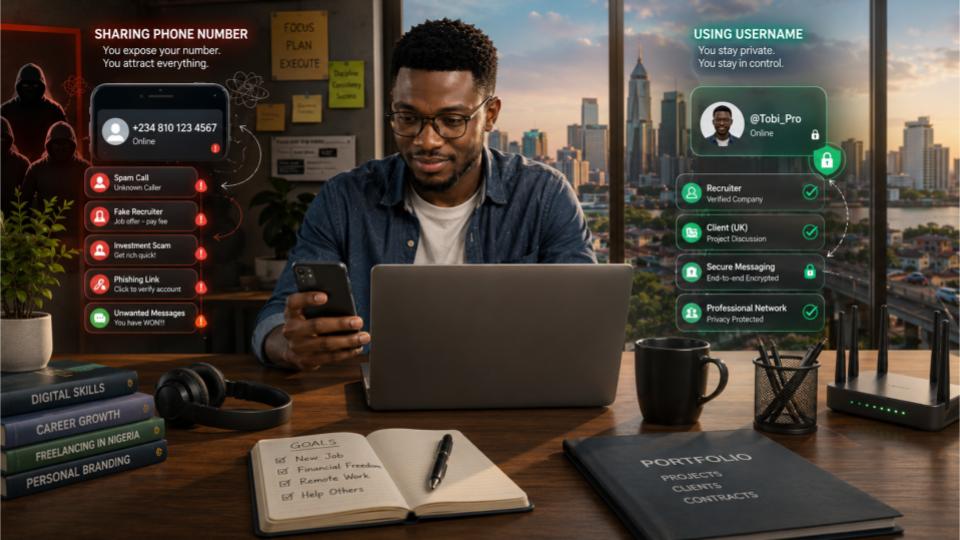
Imagine you are applying for five remote jobs in one week. Every recruiter asks for your WhatsApp number. You share it because you do not want to lose the opportunity.
A week later, your phone will not stop ringing. Unknown callers. Investment schemes. Fake recruiters. Loan offers. Crypto promoters. Even people claiming they found your CV online and have a “fantastic opportunity” for you.
Sound familiar? This has become a common experience for thousands of Nigerian job seekers and freelancers. As WhatsApp increasingly becomes the preferred communication platform for recruitment, customer service, freelancing, and networking, protecting your phone number has become more important than ever.
That is why WhatsApp’s new username feature may be one of its biggest privacy updates in years, and certainly one of the most relevant for anyone trying to build a career or business in Nigeria’s fast moving digital economy.
In this article, we will look closely at what usernames are, why WhatsApp introduced them now, how they actually work behind the scenes, and what they mean for job seekers, freelancers, small businesses, and professionals across the country. We will also cover the limitations of this feature, practical safety tips, a quick checklist, a comparison table, and answers to common questions readers tend to have.
Why WhatsApp Added Usernames Now
Many readers will naturally wonder why this update is happening now, after more than a decade of WhatsApp being tied strictly to phone numbers. The answer lies in how dramatically online communication has changed in recent years.
Online scams targeting job seekers, freelancers, and small business owners have grown significantly, particularly across platforms where phone numbers are shared publicly or semi publicly. Fraudsters scrape numbers from CVs, job boards, and public posts, then use those numbers for spam calls, phishing attempts, and fake recruitment schemes. Privacy concerns have also grown globally, with users across every platform demanding more control over what personal information they expose simply to participate in everyday digital life.
There is also a competitive angle worth mentioning. Other messaging platforms have offered username based identities for a while. Telegram has long allowed users to be reached through a public handle without revealing their phone number. Signal introduced a similar system focused heavily on privacy. Even Discord, though built primarily around communities rather than one on one messaging, has always relied on usernames rather than phone numbers as the core identity layer.
WhatsApp, by comparison, was somewhat behind in this regard. With this update, the platform is clearly positioning itself not just as a family and friends messaging app, but as a serious tool for professional communication, customer support, and business operations, areas where Telegram and other apps had been quietly gaining ground.
Statistics That Put WhatsApp Usernames Into Perspective
The introduction of WhatsApp usernames is not happening in isolation. It reflects broader trends in digital communication, online privacy, and remote work around the world.
| Statistic | What It Means |
|---|---|
| 3+ billion monthly WhatsApp users worldwide | WhatsApp is now one of the world’s largest communication platforms. |
| 51+ million estimated WhatsApp users in Nigeria | Nigeria is among Africa’s largest WhatsApp markets, making privacy features especially relevant. |
| Millions of phishing attacks occur globally each year | Cybercriminals increasingly target messaging apps, fake login pages, and online recruitment platforms. |
| Remote work continues to grow globally | More professionals now use WhatsApp for client communication, interviews, and business networking than ever before. |
How Usernames Actually Work
A common misunderstanding is that usernames completely replace phone numbers on WhatsApp. They do not. It is important to clear this up early, because understanding how the feature actually works helps you use it safely and effectively.
Your phone number still exists in the background. Your WhatsApp account remains tied to your SIM card or registered number, just as it always has. What changes is how people discover and start conversations with you. A username is simply an additional, optional discovery method that sits alongside your number rather than replacing it.
This means someone can search for your username, send you a message, and begin a conversation entirely without ever seeing your actual phone digits. You decide, through your privacy settings, whether your number becomes visible to that person later in the conversation or remains hidden indefinitely. End to end encryption, the security feature that has always protected the content of your WhatsApp messages from outside access, remains fully intact regardless of whether someone reaches you by number or by username.
In short, think of your username as a public facing door to your WhatsApp account, while your number remains the private foundation behind that door.
What This Means for Nigerian Job Seekers
Nigeria’s job market has changed dramatically over the past several years. A huge number of opportunities, especially for young professionals and remote workers, now flow through informal channels such as WhatsApp groups, LinkedIn direct messages, Jobberman and MyJobMag listings, Facebook hiring groups, and Telegram job channels, rather than traditional job boards alone.
The CV Exposure Problem
Many Nigerians upload CVs to job platforms, WhatsApp groups, and even public social media posts. These CVs typically contain a phone number, an email address, and sometimes a separate WhatsApp number listed for convenience. Once that document is online, there is very little control over who downloads it, screenshots it, or forwards it to people far outside the original intended audience.
Usernames offer a practical way to reduce this exposure. Instead of listing a personal number directly on a CV that may circulate widely and indefinitely, a job seeker can list a professional WhatsApp username alongside an email address, keeping the actual phone number private unless and until they choose to share it with a verified, legitimate employer.
Different Recruitment Channels, Different Benefits
Not every recruitment channel carries the same level of risk, and usernames benefit each one slightly differently.
A LinkedIn recruiter reaching out through a verified company profile is generally lower risk, but even here, a username allows the conversation to move to WhatsApp without immediately surrendering personal contact information. An Upwork client discussing a freelance project benefits similarly, since the relationship can begin with a clear, professional handle rather than a personal number. Facebook hiring groups, which are often loosely moderated and attract a wide mix of genuine recruiters and opportunistic spammers, benefit enormously from usernames, since job seekers can interact publicly without exposing their number to an entire group of strangers. Telegram job channels and large WhatsApp job communities, often containing hundreds or even thousands of members, present some of the highest risk environments for number exposure, making usernames particularly valuable there.
Usernames Do Not Stop Fake Recruiters
It is important to be honest about what this feature can and cannot do. Usernames reduce unnecessary exposure of your personal number, but they do not stop scammers from creating fake recruiter accounts or fake usernames designed to look legitimate.
Job seekers should still learn to recognize the common warning signs of fake recruitment, regardless of whether contact happens through a number or a username. These include requests for payment before an interview or job offer, unusually vague job descriptions that avoid specifics about the company or role, pressure to respond immediately or risk “losing the opportunity,” and requests for sensitive personal information such as bank details very early in the conversation. A professional looking username does not automatically mean the person behind it is trustworthy.
What This Means for Nigerian Freelancers
Nigeria has one of the fastest growing freelance and remote work populations in Africa, and WhatsApp plays a central role in how that work gets done. This is not limited to graphic designers and photographers. It applies broadly across virtual assistants, writers, software developers, video editors, digital marketers, business consultants, accountants, online tutors, and even voice over artists, all of whom regularly rely on WhatsApp to communicate with clients, share files, and manage ongoing projects.
Before usernames existed, freelancers across these fields had to publish their phone numbers on portfolio websites, business cards, Fiverr and Toptal profiles, or social media bios simply so potential clients could reach them. This often meant fielding calls from people who were not serious clients at all, or becoming a target for phishing attempts disguised as business inquiries.
Now, freelancers can present a clean, professional handle instead of a raw phone number. Compare the difference between sharing a string of digits like a personal phone number, and sharing something like a memorable handle tied directly to your name or brand. A username such as a recognizable handle built around your name or service immediately looks more polished and intentional than a phone number copied and pasted into a bio. It mirrors the same logic behind using a dedicated business email address instead of a personal Gmail account when dealing with clients, and it signals a level of professionalism that can genuinely influence whether a potential client decides to trust you with their project.
Real Life Case Study
Real-Life Case Study 1: The Nigerian Software Developer
Chinedu, a software engineer in Lagos, regularly applied for remote jobs through LinkedIn and international job boards. Like many applicants, his CV contained both his email address and WhatsApp number.
Within weeks he began receiving: fake recruiter messages, cryptocurrency investment offers, random international calls, WhatsApp spam.
After switching to a professional WhatsApp username, he continued receiving legitimate recruiter messages while significantly reducing unnecessary exposure of his personal phone number. The username did not eliminate scams completely, but it created an extra layer of privacy between his public professional identity and his private contact information.
Real-Life Case Study 2: The Nigerian Virtual Assistant
Aisha works with clients from the UK, Canada and Australia. Previously every new client received her personal phone number before even signing a contract. Today she shares only her WhatsApp username during the first stages of communication. Once a client relationship is established, she can decide whether sharing her phone number is necessary. For freelancers managing dozens of international clients, this creates a more professional first impression while offering greater control over personal privacy.
Real-Life Case Study 3: The Small Business Owner
Emeka runs an online electronics business in Lagos. Previously every Facebook advertisement displayed his personal WhatsApp number. Over time that number became flooded with spam messages, promotional broadcasts and scam attempts. Using a dedicated WhatsApp username allows interested customers to reach him without publicly displaying his phone number across multiple social media platforms.
Business Use Cases Beyond Individual Job Seekers
This update is not only useful for individuals. Small and medium businesses across Nigeria stand to benefit significantly as well.
Fashion brands that rely on WhatsApp for order inquiries and customer support can present a single, consistent username across their Instagram bio, website, and packaging, rather than juggling multiple numbers as staff or lines change over time. Restaurants and food vendors taking orders through WhatsApp can do the same, making it easier for repeat customers to find them again without saving a new number every time a line changes. Logistics companies, POS agents, estate agents, and photographers, all of whom depend heavily on quick, informal communication with customers, gain a similar benefit. A consistent, professional username builds brand recognition and trust in a way that a frequently changing or unfamiliar phone number simply cannot.
This also solves a very real operational headache for many small Nigerian businesses, where a change in staff, SIM card, or device historically meant losing continuity with customers who only had the old number saved.
Five Ways WhatsApp Usernames Improve Privacy
To summarize the privacy benefits in a clear way, here are five concrete improvements this feature brings to everyday users.
Less spam reaches your personal line, since your number is no longer the only way strangers can initiate contact with you. Fewer scam calls find their way to you, because scrapers and bulk spammers that rely on harvested phone numbers have one less easy source to pull from. Better networking becomes possible, since you can confidently share a public handle in group settings without hesitation. Cleaner business branding emerges naturally, since a consistent username looks far more professional than a number that may change over time. Finally, you gain more control over your personal identity online, deciding precisely when and to whom your actual number becomes visible, rather than that decision being made for you the moment you post a CV or join a group.
Practical Examples of When Usernames Can Help
For Job Seekers
Instead of posting:
+234 XXX XXX XXXX
on your CV or LinkedIn profile,
you may soon be able to share:
@DavidTech
This reduces unnecessary exposure while keeping you accessible to recruiters.
For Freelancers
Instead of sending:
“My WhatsApp number is…”
your proposal can simply include your professional username.
It appears cleaner and separates business communication from personal contacts.
For Entrepreneurs
Small business owners can advertise a memorable username instead of publishing a personal mobile number on every social platform.
For Students
Students collaborating on university projects can communicate with classmates without automatically revealing personal phone numbers to everyone in large group chats.
For Content Creators
Creators managing communities across YouTube, Instagram, Facebook and TikTok can invite followers to contact them professionally without exposing private contact details.
The Limitations You Should Understand
A genuinely useful article on this topic has to be balanced, and that means being upfront about what usernames do not do.
Usernames do not hide the actual content of your chats from the person you are messaging, since the conversation itself still happens normally once contact is established. They do not stop phishing attempts, since a scammer can still send malicious links or fraudulent messages through a username based conversation just as easily as through a number based one. They do not replace two factor authentication, which remains a separate and essential layer of account security. They do not stop scammers from creating their own fake usernames designed to impersonate real companies or recruiters. And they do not make your account fully anonymous, since enough information shared over time, combined with profile photos, status updates, or shared groups, can still reveal a great deal about who you are.
Understanding these limitations is not meant to discourage you from using the feature. It simply means usernames should be treated as one part of a broader approach to staying safe online, not a complete solution on their own.
Five Ways to Stay Safe Even With Usernames
Given those limitations, here are practical habits worth building into your routine.
Enable two step verification on your WhatsApp account, which adds a PIN requirement that protects you even if someone attempts to register your number on a new device. Never pay recruiters for interviews, registration, training materials, or any step in a hiring process, since legitimate Nigerian employers do not require job seekers to pay money to be considered for a role. Take time to verify companies independently, checking official websites, LinkedIn pages, and reviews before sharing further personal details with anyone claiming to represent them. Avoid clicking suspicious links sent during conversations, even if they appear to come from someone using a seemingly legitimate username. And report fake accounts directly within WhatsApp whenever you encounter one, which helps protect not just yourself but other users who might otherwise fall victim to the same scheme.
Quick Checklist Before Sharing Your WhatsApp Username
Before you start sharing your new username on your CV, social media bio, or with new contacts, run through this short checklist.
Choose a professional username that reflects your name or brand clearly, rather than an old nickname from years ago. Enable two step verification so your account remains protected even if your number is ever compromised. Review your privacy settings carefully, deciding who can find you through search and who can see further details about your profile. Avoid using usernames built around jokes or casual nicknames if you intend to use the handle professionally. Never share verification codes with anyone, regardless of how convincing their story sounds, since legitimate companies and platforms never need this code from you. And report suspicious accounts promptly rather than simply ignoring or blocking them, since reporting helps WhatsApp take broader action against repeat offenders.
Sharing Phone Number Versus Sharing Username
Sharing your phone number directly exposes that number to everyone who receives it, with very little ability to take that exposure back later. Sharing a username instead means your actual number stays private throughout the interaction. Phone number sharing tends to invite more spam over time, since numbers are easily collected, stored, and resold across various lists. Username sharing significantly reduces this risk. Changing a phone number that has already been widely shared is difficult and often means losing touch with legitimate contacts in the process, whereas managing or adjusting a username is considerably easier and does not disrupt your underlying account. A phone number simply looks personal, almost private by nature, while a thoughtfully chosen username looks intentional and professional. Taken together, phone number sharing carries greater overall scam exposure, while username sharing offers meaningfully better privacy protection by design.
WhatsApp Phone Number vs WhatsApp Username
| Feature | Phone Number | WhatsApp Username |
|---|---|---|
| Privacy | Your personal phone number is visible to anyone you share it with. | Your phone number remains hidden unless you choose to reveal it. |
| Professional Appearance | Looks more personal than business-focused. | Creates a cleaner and more professional identity for networking. |
| Spam Risk | Higher risk of spam calls, messages, and unsolicited contacts. | Reduces unnecessary exposure of your personal phone number. |
| Job Applications | Recruiters immediately receive your phone number. | Recruiters can contact you without first seeing your phone number. |
| Freelance Work | Every client receives your personal number. | Clients can start conversations using your username instead. |
| Business Branding | Difficult to remember and less suitable for marketing. | Easy-to-remember usernames help strengthen your personal or business brand. |
| Changing Contact Details | Changing your number means updating clients and contacts. | Your username remains consistent even if your phone number changes (subject to WhatsApp’s implementation). |
| Security | Greater exposure if your number is publicly displayed. | Adds an extra layer of privacy, though it does not replace other security measures. |
| Ease of Sharing | Long international phone numbers can be inconvenient. | Short, memorable usernames are easier to share online and offline. |
| Best For | Family, close friends, and trusted contacts. | Job seekers, freelancers, entrepreneurs, creators, and professionals. |
Frequently Asked Questions
Can someone still see my phone number after I give them my username?
Only if you choose to share it directly, or if your privacy settings are configured to allow it. By default, a username conversation does not reveal your underlying number.
Can recruiters contact me using only my username?
Yes. Once a recruiter or potential client knows your username, they can begin a WhatsApp conversation with you without ever seeing your phone number, unless you decide to share it later.
Are WhatsApp usernames available to everyone right now?
The feature is being rolled out gradually across regions and app versions, so availability may vary depending on your device, app version, and location. If you do not see the option yet, updating your app and checking again after some time is worth doing.
Should I replace my phone number on my CV with my WhatsApp username?
It is often a good idea to include both an email address and your WhatsApp username on your CV, while keeping your personal phone number private wherever possible. This gives recruiters multiple reliable ways to reach you without exposing your number to everyone who downloads or forwards your document.
The Bigger Picture: What This Means for Nigeria’s Digital Future
As more Nigerians adopt this feature, we are likely to see a broader shift in how professional networking and business communication happen across the country. Just as a polished LinkedIn profile became almost essential for serious job seekers over the past decade, a clean, professional WhatsApp username may soon become another expected part of presenting yourself well online.
This shift is likely to extend across several areas of Nigerian digital life. Customer support teams at growing businesses can adopt official usernames that customers trust and remember, rather than juggling rotating staff numbers. Recruitment processes may increasingly list a recognizable company username rather than an individual recruiter’s personal line, adding a layer of legitimacy that is currently missing in many informal hiring channels. WhatsApp Channels, the platform’s newer broadcast style feature, may benefit from closer integration with usernames, making it easier for businesses and public figures to build a recognizable presence. Small businesses across sectors stand to gain consistent branding regardless of staff or device changes, online learning providers and tutors can present a stable handle to current and prospective students, and the broader remote work and digital economy in Nigeria may see incrementally safer, more professional communication as a result.
None of this happens overnight, but the direction is fairly clear. WhatsApp is positioning itself as infrastructure for serious digital and professional life in Nigeria, not just a casual messaging app for friends and family.
Final Thoughts
WhatsApp usernames will not eliminate scams, and they will not guarantee better job opportunities on their own. What they do provide is something many Nigerians have genuinely wanted for years: the ability to stay reachable without exposing a personal phone number to everyone online.
For job seekers, freelancers, entrepreneurs, and professionals across the country, this is more than a small convenience. It is a smarter way to network, communicate, and protect your privacy in an increasingly digital economy. As more employers, recruiters, and clients adopt the feature, having a professional WhatsApp username could soon become as important as having a polished LinkedIn profile or a dedicated professional email address.
If you have not set up your username yet, there is little reason to wait. It costs nothing, takes only a few minutes, and could genuinely save you from unwanted spam, scam attempts, or simply the discomfort of strangers having direct access to your personal line. Small changes like this one often end up making the biggest difference over time, and this feels very much like one of those moments.
