

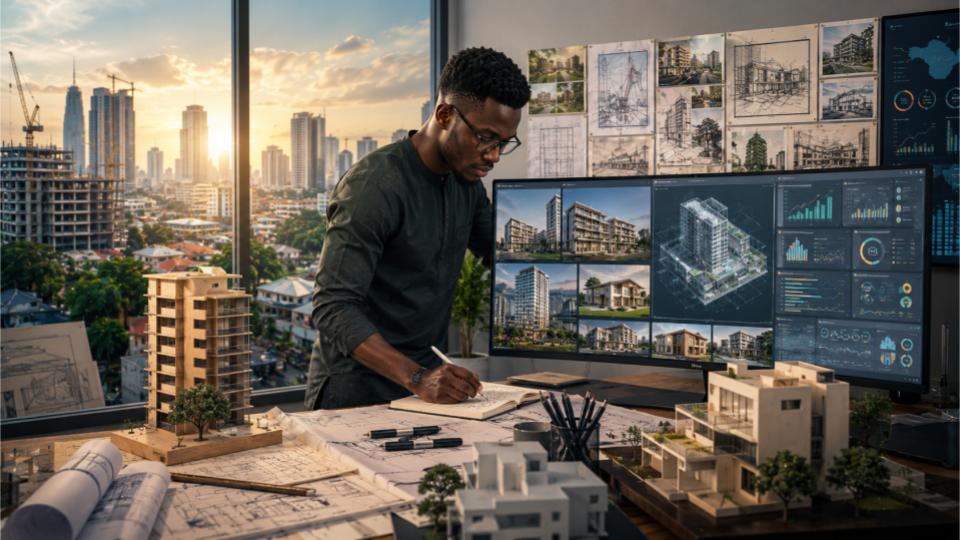
AI can now generate architectural concepts, produce photorealistic renderings, and draft structural documentation in the time it takes a junior drafter to make a cup of tea. The question is whether that makes architects obsolete or simply makes obsolete the version of architecture that was never the real value anyway.
Damilola studied architecture at Obafemi Awolowo University in Ile-Ife, spending five and a half years learning to draw by hand before AutoCAD, then learning CAD before Revit, then adding SketchUp and Lumion to her workflow as her firm demanded it. She graduated in 2020, served her internship, and joined a mid-sized architecture practice in Lagos. She is good at her job. Her bosses say so. Her clients, when they eventually become clients, tend to become repeat clients. But in early 2025, a conversation in her office conference room shook something loose in her that she is still working through. A partner had been demonstrating a new AI design tool, one that could take a written brief describing a two-storey residential building in Lekki Phase 1 and generate, within forty seconds, twelve photorealistic concept variations with corresponding floor plan sketches. The quality was not perfect. But it was good enough to show a client. It was, if she was being honest with herself, better than the concept sketches she had spent three hours producing for her current project the previous afternoon. She went home that evening and spent two hours searching the internet for variations of the question that every architect in Nigeria with access to the internet was either actively searching or desperately trying not to think about: is my career about to disappear?
That anxiety is legitimate. It is also, based on the evidence available in 2026, significantly more complicated than either the doom narrative or the dismissive reassurance narrative suggests. AI is genuinely and substantially changing what architecture practice looks like inside Nigerian firms. It is automating tasks that took junior architects and drafters considerable time. It is producing visualisations that previously required expensive rendering software and significant skill to operate. And it is doing all of this at a pace that has caught most architecture education institutions in Nigeria completely unprepared. But it is not replacing architects. Not in the way the fear imagines. What it is replacing is a specific set of lower-order architectural tasks that were never, if we are honest about what architecture actually is, the core of the profession’s value.
THE SHORT ANSWER
AI will not replace Nigerian architects. It will replace the architectural tasks that do not require an architect to perform them. That is a meaningful distinction and one that determines whether individual architects thrive or struggle in the next decade depending entirely on how they respond to it.
| Statistic | Value | What It Means |
|---|---|---|
| Time to Generate AI Design Concepts | 40 seconds | Leading AI design tools can generate 12 photorealistic architectural concept variations from a written design brief in 2026. |
| AI Adoption by Nigerian Architecture Firms | 68% | Nigerian architecture firm principals surveyed report using at least one AI tool in their practice by early 2026. |
| Reduction in Rendering Time | 35% | Nigerian firms that have fully integrated AI rendering tools report an average 35% reduction in rendering and visualization time. |
| Nigeria’s Housing Demand by 2030 | 4.2 million | Nigeria is estimated to require 4.2 million new housing units by 2030, highlighting the country’s largest long-term opportunity for architects and the construction industry. |
What AI Is Actually Doing Inside Nigerian Architecture Firms in 2026
Before the question of whether AI replaces architects can be answered honestly, it needs to be answered specifically. AI is not a monolithic threat that arrives uniformly across a profession. It is a collection of specific tools that automate specific tasks with varying degrees of effectiveness. Understanding which tasks are genuinely being transformed by AI inside Nigerian architecture practice in 2026 is the necessary foundation for any clear-eyed assessment.
Concept generation and early-stage visualisation
Tools like Midjourney, Adobe Firefly, and a range of architecture-specific AI image generators have dramatically accelerated the earliest stages of the design process. What previously required a skilled illustrator or a CAD-proficient designer several hours to produce can now be generated in seconds from a written description. For client presentations, site feasibility studies, and early design development discussions, these tools have genuine value and Nigerian firms that have adopted them report significant time savings at the front end of projects.
The critical limitation is equally important to understand. These tools generate images. They do not generate architecture. The photorealistic rendering of a building that looks beautiful in a rendered image and the design of a building that functions correctly, meets Nigerian building code requirements, works within a specific Lagos soil condition, accommodates the social patterns of its intended users, and manages the thermal performance demands of a West African climate are entirely different things. AI can produce the first. It currently cannot produce the second without substantial human expertise guiding every step.
Documentation and technical drawing
AI-assisted features within AutoCAD and Revit, including automated dimension placement, specification generation, and intelligent clash detection in BIM workflows, have reduced the time required to produce technical documentation. For routine residential or commercial projects following standard typologies, these tools are genuinely useful, especially in Nigerian practices where junior staff time spent on repetitive documentation tasks has historically been significant.
The Nigerian Context That AI Cannot Yet NavigateNigerian building and planning regulations vary significantly by state, local government area, and site-specific conditions. The Abuja Municipal Area Council approval process is entirely different from the Lagos State Physical Planning Permit Authority requirements. AI tools trained primarily on global datasets have minimal useful knowledge of these specific, locally administered regulatory processes that a practising Nigerian architect navigates as a core professional service. Until AI has comprehensive, up-to-date knowledge of these specific Nigerian contexts, the regulatory navigation function of a qualified Nigerian architect remains firmly human territory.
Which Architectural Tasks AI Is Genuinely Automating and Which It Is Not
| Architectural Task | AI Automation Level | What AI Can Do | What Still Requires a Human Architect |
|---|---|---|---|
| Photorealistic Rendering | High | Generate photorealistic images from basic 3D models within seconds | Artistic direction, composition judgment, context-appropriate material selection |
| Concept Visualisation | High | Generate multiple design concept images from written briefs | Evaluating concepts against design intent, spatial quality, local context fit |
| Standard Documentation | Moderate | Assist with dimensions, specifications, schedules in standard typologies | Non-standard situations, Nigerian code compliance, site-specific adaptation |
| Preliminary Site Analysis | Moderate | Solar orientation, basic massing studies, access analysis on available map data | Site visits, local knowledge, soil conditions, neighbourhood social context |
| Client Communication | Low | Draft basic client correspondence and meeting summaries | Reading client personality, managing expectations, translating aspirations to design |
| Nigerian Regulatory Approval | Low | Minimal useful support given local regulatory specificity | All stages of the Nigerian planning and building permit process |
| Site and Construction Management | Low | Digital site documentation and progress photo analysis | All direct site supervision, contractor management, quality control |
| Cultural Context Design | Low | Surface-level aesthetic suggestions from cultural training data | Deep understanding of how Nigerians actually live in and use buildings |
The Real Architects Who Are Thriving Alongside AI in Nigeria Right Now
A ten-person architecture and interior design practice in Victoria Island, Lagos, began integrating AI visualisation tools into its workflow in mid-2024. The firm’s principal, who asked not to be identified by name, described the before and after in straightforward terms. Before integration, producing a full client presentation package for a residential project, including rendered elevations, interior mood boards, and materials palette, required approximately forty hours of combined staff time spread across junior architects and a dedicated visualisation specialist. After integrating Midjourney for concept generation, an AI rendering plugin for their existing 3D workflow, and Adobe Firefly for materials presentations, the same package now takes approximately eighteen hours.
The firm has not used the time saving to reduce headcount. It has used it to take on more projects. The number of active commissions the firm manages simultaneously has increased from eight to fourteen without any additional hires. The architects are spending less time rendering and more time in client conversations, site visits, and design development work, which the principal describes as significantly more professionally satisfying for the senior staff in particular.
Chidinma graduated from the University of Abuja in 2023 and, rather than joining a conventional practice, chose to establish herself as an independent architectural visualisation consultant working primarily for international clients. She recognised early that AI rendering tools had dramatically lowered the skill floor for producing high-quality architectural visualisations, which simultaneously threatened traditional visualisation specialists and created an opportunity for someone with foundational architectural training to provide a more architecturally informed visualisation service than non-architects using the same tools could offer.
She learned Midjourney, Stable Diffusion-based architecture rendering workflows, and developed a process for creating AI-assisted visualisations that she then refined and curated using her architectural knowledge and judgment. Her core pitch to clients, primarily small UK and US architecture firms needing high-quality visualisations at competitive rates, was that her work combined the speed and cost advantages of AI tools with the architectural understanding that ensured the images actually looked like buildings rather than beautiful but spatially incoherent AI hallucinations.
By early 2026, her monthly earnings had exceeded N600,000, working almost entirely remotely from Abuja for a client base that had never set foot in Nigeria.
Monthly earnings: N600,000+ working remotely from Abuja. Client base: UK and US architecture firms. Competitive edge: architectural training plus AI tool proficiency. The AI tools did not replace her value. They enabled it.
The architects I see struggling in 2026 are those who defined their professional identity around technical production tasks, drafting, rendering, documentation production. When AI tools can do those things faster and cheaper, their positioning becomes genuinely vulnerable. The architects who are doing well are those who always understood that their real value was in thinking, in relationships, in reading a brief and a site and a client in ways that no amount of training data can replicate. For them, AI is nothing but a productivity multiplier.
Arch. Yetunde Adegoke
–Principal, Adegoke Associates Architects, Lagos. Fellow, Nigerian Institute of Architects (FNIA)
What AI Genuinely Cannot Do in Nigerian Architecture Practice
The most useful corrective to AI anxiety in architecture is not reassurance. It is specificity. Rather than saying vaguely that AI cannot replace human creativity, it is more useful and more honest to identify exactly what it cannot do in the specific context of Nigerian architecture practice in 2026.
It cannot read a Nigerian site the way a trained architect can
A site in Onitsha with its specific sun orientation, its relationship to the Onitsha Main Market, the prevailing wind direction from the Niger River, the density and character of the surrounding built fabric, the specific social patterns of how the neighbourhood actually uses its outdoor spaces, and the specific sensitivities of the likely client regarding security, privacy, and ventilation does not exist in any AI training dataset in a way that would allow a generative tool to respond meaningfully to it. A Nigerian architect who visits that site, walks its boundaries, observes it at different times of day, and has a decade of experience designing in similar West African urban contexts brings knowledge to that site that no AI system currently comes close to replicating.
It cannot manage the Nigerian construction and regulatory process
Architecture in Nigeria does not end with a beautiful design. It ends with a building that has been approved by the relevant state or local government authority, coordinated with structural and MEP engineers whose specific experience includes Nigerian material supply realities, built under supervision by a contractor navigating the specific cost pressures and quality standards of the Nigerian construction market, and handed over to a client who understands its maintenance requirements in a context of irregular power supply and water access. Every single stage of that process requires a human professional with specific Nigerian contextual knowledge that no AI system can currently provide.
What strikes me most about the AI panic in architecture is how it reveals a misunderstanding of what architects actually do. If you think an architect’s job is to produce drawings and renderings, then yes, AI is a significant threat to your employment. If you understand that an architect’s job is to take a client’s needs and resources and site conditions and transform them into a building that actually works for human beings in a specific place and time, then AI is not your replacement. It is your new power tool. A powerful one, but a tool.
Prof. Kunle Adewale
–Professor of Architecture, University of Lagos. Founding Director, Centre for African Urban Research
The Housing Crisis That Makes Nigerian Architects More Necessary Than Ever
While the debate about AI displacement plays out in architecture offices and university studios, there is a counter-narrative that does not get nearly enough attention: Nigeria has one of the most severe housing deficits in the world, and the scale of what needs to be built represents an architectural demand that would consume the full productive capacity of every currently registered Nigerian architect many times over, even if every one of them were working at peak efficiency with every available AI tool.
The Nigerian government’s own estimates put the national housing deficit at approximately 17 to 20 million units. Even with the most optimistic projections for economic growth and construction sector capacity, closing that gap in the next two to three decades would require a rate of housing delivery that has never been achieved in Nigeria’s history. Achieving it with buildings that are properly designed for Nigerian climate, culture, and context, structurally sound, energy-efficient, and appropriate for the incomes and aspirations of the Nigerians who will occupy them requires architects. Millions of buildings worth of them.
The Real Threat to Nigerian Architects Is Not AIThe more significant threat to Nigerian architecture as a profession is the persistent exclusion of qualified architects from large portions of the housing market because of cost, because building without professional supervision has been normalised for middle and lower-income construction, and because the formal regulatory framework that requires architectural input has been inconsistently enforced. AI, by reducing the cost and time of architectural services, may actually help bring professional design within reach of a broader segment of the Nigerian market rather than eliminating it.
What Nigerian Architects and Architecture Students Should Do Right Now
- Learn at least two AI design tools to a professional standard this year — The architects who will be most competitive over the next five years are those who can deploy AI tools as genuine productivity multipliers within their existing design practice, not those who resist them. Midjourney for concept generation and an AI rendering plugin for whatever 3D software you already use are reasonable starting points. The goal is not to become an AI tool specialist. It is to ensure that you can use AI to do in two hours what previously took ten, freeing your professional attention for the higher-order work that AI cannot yet approach.
- Deepen your knowledge of Nigerian building regulation, code, and approval processes — This is the knowledge domain where AI has the least current capability and where Nigerian architectural expertise is most genuinely irreplaceable. Understanding the specific requirements and processes of the Lagos State Physical Planning Permit Authority, the Abuja Municipal Area Council, and the equivalent bodies in whichever states you practice is professional knowledge that cannot be found in an AI training dataset and cannot be replicated by a client attempting to bypass professional services.
- Build your expertise in African climate-responsive and culturally appropriate design — The design principles specific to West African climate, the cultural patterns of how Nigerians actually inhabit domestic and commercial space, the material palette that is available and appropriate in Nigerian construction, and the energy strategies that work without reliable grid connection are all areas of specialist knowledge that AI tools trained primarily on global datasets do not handle well. Nigerian architects with genuine expertise in this domain have a competitive advantage that only deepens over time.
- Develop your client relationship and project management skills with deliberate intent —If there is one consistent finding from all the research on which professional skills AI is least likely to replicate in the near to medium term, it is the ability to build trust with clients, to read and manage complex interpersonal situations, and to coordinate multiple stakeholders through a long and often stressful process toward a successful outcome. For architects, this is the project management and client relationship function. Nigerian architects who invest in developing this capacity are building something that AI cannot currently threaten.
- Consider positioning yourself at the interface of AI tools and architectural practice — The case study of Chidinma from Abuja illustrates a real and growing opportunity. There is currently a shortage of people who combine genuine architectural understanding with practical competence in AI design and visualisation tools. Positioning yourself at that interface, either within a firm or as an independent practitioner, places you in a market where demand is growing and supply is limited.
- Stay current with AI tool developments through deliberate regular review — AI tools are changing rapidly enough that what was true of their capabilities six months ago may not be true today. Setting aside time monthly to review what new tools have launched, what existing tools can now do that they could not previously do, and how leading Nigerian and international firms are integrating AI into their practice is not optional for architects who want to maintain genuine awareness of their professional landscape in 2026 and beyond.
The Honest Bottom Line for Nigerian Architecture StudentsIf you are studying architecture in Nigeria in 2026 and wondering whether AI will have made your degree worthless by the time you graduate, the evidence says no, but with a significant caveat. The degree becomes worthless only if you graduate believing that your value lies in producing drawings and renderings that AI can now produce faster and cheaper. The degree retains and grows in value if you graduate understanding that architectural thinking, site knowledge, cultural intelligence, regulatory expertise, and human relationship management are what the profession actually sells, and that AI tools are the most powerful assistant those skills have ever had available to them.
Architecture is the art and science of organising space for human life within the constraints of site, budget, culture, and time. AI can generate images of spaces. It cannot yet make the thousands of decisions that turn an image of a space into a building that a human being can actually live their life inside. That is still the architect’s work. It always was.
–Chukwuemeka Adeyemi — Careerdoor, May 2026
Frequently Asked Questions About AI and Architecture Careers in Nigeria
Will AI replace architects in Nigeria?
AI will not replace architects in Nigeria in the foreseeable future, but it is significantly changing which tasks architects spend their time on and which skills determine their professional value. AI tools are automating repetitive drafting, rendering, and documentation tasks that took significant junior architect time but were never the intellectual core of the profession. Architects who continue to define their value primarily through those tasks will face real pressure. Architects who position themselves as design thinkers, site context specialists, regulatory navigators, and client relationship managers will find that AI makes them more productive and more competitive rather than redundant.
Which architecture tasks is AI already doing in Nigerian firms in 2026?
In Nigerian architecture firms that have adopted AI tools, the primary applications in 2026 include generating photorealistic renderings from basic 3D models, producing multiple early-stage design concept variations from written briefs, assisting with standard documentation and scheduling within BIM platforms, preliminary solar and massing analysis, and drafting client presentation materials. The tasks that remain firmly in human territory include site visits and site reading, client relationship management, translation of client aspirations into spatial design decisions, navigation of Nigerian state and local government planning approval processes, construction site supervision and quality control, and cultural and contextual design intelligence specific to Nigerian environments.
What AI tools are Nigerian architects using in 2026?
Nigerian architects in 2026 are using Midjourney and Adobe Firefly for concept visualisation and client presentation materials, AI-enhanced features within Autodesk’s Revit and AutoCAD for documentation assistance and clash detection in BIM workflows, Stable Diffusion-based rendering tools for photorealistic project visualisations, and various AI writing assistants for generating specifications, reports, and client communications. Adoption rates vary significantly between larger Lagos and Abuja firms and smaller practices in other Nigerian cities, with early adopters concentrated in the design-focused and internationally connected firms that tend to operate in the commercial and high-end residential markets.
Should Nigerian architecture students learn AI tools in 2026?
Yes, Nigerian architecture students should learn AI design and visualisation tools in 2026, but with a critical understanding: AI tools should supplement and accelerate foundational design thinking, not replace it. The architects who will thrive in the AI era are those who bring genuine design intelligence to AI-assisted workflows, who can evaluate whether an AI-generated concept actually works architecturally rather than just looking appealing as an image, and who understand the difference between an AI-generated rendering and a buildable design. Learning Midjourney, AI rendering tools, and AI-assisted BIM workflows while maintaining strong hand drawing, spatial thinking, material knowledge, and site reading skills is the combination that will define the most competitive Nigerian architecture graduates of the next decade.
Conclusion
Damilola, the architect from Victoria Island who opened this story, has made peace with the AI question, though it took most of 2025 to get there. She has added Midjourney to her workflow. She uses it for early-stage concept exploration with clients, producing variations in the first meeting that previously she would have taken a week to develop. She is genuinely faster and her clients are more engaged in the early design process because they can see ideas quickly and respond to them. She is also, she told me in January 2026, more clearly aware of what she herself brings to a project that the AI tool does not. The knowledge of how a family in Lekki actually moves through a house at different times of day. The instinct for which client comment reveals an unexpressed need rather than a stated preference. The ability to walk a site in Lagos and understand in twenty minutes what a building should do for the street. Those things have not become less valuable because an AI can generate a beautiful rendering in forty seconds. If anything, they have become more clearly valuable precisely because everything else has become cheaper and faster. That, she said, is not a cause for panic. It is a cause for clarity.
