

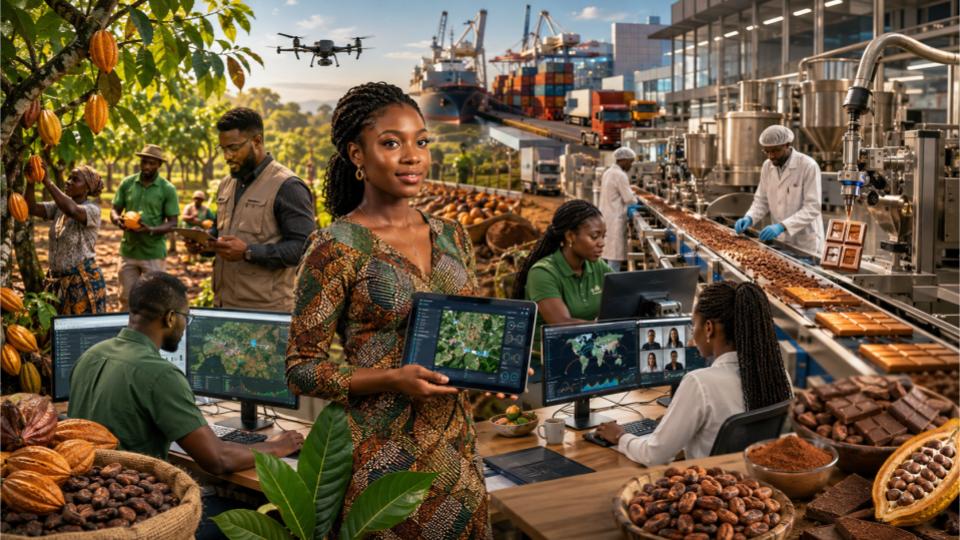
Nigeria has just declared an end to raw cocoa exports. Beneath the farming headlines sits a quieter story about GIS mapping, agritech software, traceability data and remote digital work that could open new doors for young Nigerians who have never planted a cocoa seed in their life.
On Tuesday, July 14, 2026, something shifted quietly in Abuja that most Nigerian job seekers scrolling through their phones for vacancies probably did not even notice. At the BAT International Conference Centre, President Bola Tinubu, represented by the Minister of Agriculture and Food Security, Senator Abubakar Kyari, stood before ministers, governors, farmers and investors from Nigeria, Ghana, Cote d’Ivoire and Cameroon and declared that Africa’s century of shipping raw cocoa beans abroad was over. Nigeria, he said, would grind its beans at home, press its butter at home, make its chocolate at home, brand it at home and sell it to the world on its own terms.
It sounded like a farming and trade announcement, and on the surface it is. But if you look closely at what it will actually take to move Nigeria from exporting sacks of unprocessed beans to exporting branded chocolate that competes on European and American shelves, you start to see a different picture. You see mapping projects, data systems, export compliance software, digital marketing campaigns, remote administrative roles and yes, AI powered quality checks. None of that requires a cutlass or a farm boot. Most of it requires a laptop, decent internet and a Nigerian willing to learn a new skill.
What the policy actually says
At the Cocoa Value Addition Summit 2026, themed From Bean to Brand, Nigeria joined Ghana, Cote d’Ivoire and Cameroon, the four countries that together account for roughly two thirds of global cocoa production, to sign the Abuja Declaration. The agreement establishes a Cocoa Value Addition Alliance meant to coordinate policy, harmonise standards and give African producing nations more bargaining power in a global chocolate industry that Tinubu said is now worth well over one hundred and thirty billion dollars, with some estimates approaching one hundred and sixty five billion dollars.
Nigeria also signed a separate national compact, the Cocoa Value Addition Accord, binding the federal government, state governors in cocoa producing regions, farmer groups, industry associations and development finance institutions to specific targets on processing capacity, farmer income and investment. The Minister of State for Industry, Senator John Owan Enoh, put the frustration plainly. He said Nigeria was no longer interested in exporting anonymous sacks, but in exporting value, adding that a country chasing a one trillion dollar economy cannot keep shipping out raw materials while other nations earn the real money from processing and branding.
Seven of every ten cocoa pods on this earth ripen under the African sun, grown by African hands on African soil, yet Africa earns barely six cents of every dollar generated by the global chocolate industry, according to figures cited at the summit.
On the ground, the numbers are already moving. Nigeria’s cocoa sector involves more than three hundred thousand farming families spread across about 1.4 million hectares, mostly in states like Ondo, Cross River, Osun, Ekiti and Abia, and the country produces over three hundred thousand tonnes of cocoa annually, roughly six to seven percent of global output. National grinding capacity has climbed past one hundred and twenty thousand tonnes a year, although the Bank of Industry says effective grinding still sits closer to fifty thousand tonnes, which is exactly the gap investors are now racing to fill.
The most visible proof of that race is rising in Sagamu, Ogun State, where Sunbeth Global Concepts is building what will become Nigeria’s largest cocoa processing plant, a seventy thousand metric tonne facility scheduled for commissioning in 2027. The Bank of Industry has already disbursed more than one hundred and sixty four billion naira across the food and agro processing sector in 2025 alone, and it recently secured a sixty million euro facility from the European Investment Bank specifically to back cocoa related projects.
| Key Statistic | 2026 Figure | What It Means |
|---|---|---|
| Cocoa Farming Families | 300,000+ | Estimated number of Nigerian families engaged in cocoa farming across major producing states. |
| Sagamu Cocoa Processing Plant Capacity | 70,000 tonnes | Planned annual processing capacity of the new Sagamu cocoa processing facility, expected to begin operations in 2027. |
| Nigeria’s National Grinding Capacity | 120,000 tonnes | Current annual cocoa grinding and processing capacity, according to government figures. |
| Bank of Industry (BOI) Agro-Processing Disbursement | ₦164 billion | Amount disbursed by the Bank of Industry to support agro-processing businesses in 2025. |
| Global Chocolate Industry Value | $165 billion | Estimated annual value of the worldwide chocolate industry. |
| Africa’s Share of Chocolate Value | 6 cents per $1 | Africa currently retains only about 6 cents of every $1 generated from the global chocolate value chain, despite producing most of the world’s cocoa. |
Why a cocoa policy touches the digital job market at all
Here is the part many people miss. A country cannot simply announce that it wants to grind, process and brand cocoa without building the digital scaffolding underneath it. Three forces make this especially true right now, and each of them is quietly digital.
1. Traceability rules are now non negotiable
The European Union’s Deforestation Regulation begins applying to large and medium operators from December 30, 2026, and it requires plot level traceability for every batch of cocoa entering the EU, a market that buys roughly sixty percent of global cocoa exports. That single regulation alone means every cooperative, aggregator and processor that wants to sell into Europe needs digital farm maps, GPS coordinates, geotagged photos and data systems that can prove exactly which plot a bag of beans came from. Someone has to build that software. Someone has to walk farms with a tablet or drone and capture that data. Someone has to clean, verify and upload it. None of those someone’s needs to own a farm.
2. New factories need digital operations, not just machines
A seventy thousand tonne processing plant does not run on manual paperwork. It needs inventory management systems, quality control dashboards, sometimes AI assisted defect detection on the production line, logistics coordination software and remote reporting tools that plant managers in Lagos or Abuja can check without physically standing on the factory floor in Sagamu.
3. Branding and market access are digital by default
Selling Nigerian made chocolate to the world on Nigeria’s own terms, as the president put it, means building actual consumer brands, e commerce storefronts, export documentation portals and marketing content that can compete with Swiss and Belgian chocolate brands online. That is content writing, graphic design, social media management, search engine optimisation and customer support work, almost all of which can be done remotely from anywhere in Nigeria with a stable connection.
The kinds of jobs this could realistically create
| Job Type | What It Involves | Typical Monthly Range (Illustrative) |
|---|---|---|
| GIS and farm mapping technician | Using drones, GPS apps and satellite imagery to map cocoa plots for EU traceability compliance | N180,000 to N400,000 |
| Agritech data analyst | Cleaning and analysing farm, yield and export data for cooperatives and processors | N200,000 to N450,000 |
| Supply chain software support | Helping factories and exporters use inventory, logistics and traceability platforms | N220,000 to N500,000 |
| Export brand content and SEO writer | Building websites, blogs and marketing copy for Nigerian chocolate brands entering foreign markets | N120,000 to N300,000 |
| Remote virtual assistant for agro exporters | Handling emails, scheduling and documentation for cooperatives dealing with overseas buyers | N100,000 to N250,000 |
| AI assisted quality control operator | Monitoring camera and sensor based defect detection systems on processing lines | N150,000 to N350,000 |
These figures are illustrative estimates based on comparable digital and agritech roles already active in the Nigerian market, and actual pay will vary by employer, location and experience. They are meant to give a sense of scale, not a guarantee.
Case Study
From Akure to a Laptop: Tobi’s Story
Tobi Fashina, twenty six, grew up in Akure, Ondo State, watching his uncle sell cocoa beans to middlemen for whatever price they offered that week. Tobi never wanted to farm. He studied computer science at the Federal University of Technology, Akure, and spent two years doing small freelance data entry jobs on Upwork while searching for something steadier.
In early 2026, a Lagos based agritech startup working with cocoa cooperatives in Ondo and Cross River began hiring young people to help digitise farm records ahead of the EU traceability deadline. Tobi applied after seeing the role shared in a WhatsApp group for tech graduates. His job now involves visiting partner cooperatives with a tablet, capturing GPS boundaries of farms using a mapping app, and uploading the data to a cloud dashboard that the company uses to prove compliance to European buyers.
He earns two hundred and eighty thousand naira a month, works partly from home and partly in the field, and says the most surprising part is that his cocoa farming relatives now come to him for advice on export requirements, something he learned entirely from a laptop and a mapping course he took online. Tobi is a composite illustration built from patterns emerging in Nigeria’s agritech and traceability sector, not a specific named individual, and is used here to show the kind of opportunity now opening up.
Skills Nigerians should start building now
Nobody needs to wait for the Sagamu plant to open in 2027 before preparing. Several of these skills are already in demand across agritech startups, development finance projects and export focused businesses.
- Basic GIS and mapping tools such as QGIS, Google Earth and mobile farm mapping apps, which are increasingly needed for traceability documentation.
- Data analysis and spreadsheet skills using Excel, Google Sheets or simple Python, useful for cleaning farm and export data.
- Digital marketing and content creation for brands trying to sell Nigerian chocolate and cocoa products internationally.
- Supply chain and logistics software familiarity, since new processing plants will run on digital inventory and tracking systems.
- Remote customer support and virtual assistance, since export businesses dealing with foreign buyers need people who can manage communication across time zones.
- Basic understanding of AI tools for quality inspection, translation and document processing, which are becoming standard in modern agro processing operations.
Where to actually learn these skills
Free and low cost resources already exist for most of this. Google’s Geo for Good programme and QGIS tutorials on YouTube can teach basic mapping. Coursera and ALX Africa offer data analysis courses that many young Nigerians already use to break into remote work. Local hubs such as CcHub in Yaba, Lagos, and various state innovation hubs also run short courses relevant to agritech and digital skills, and cooperative societies in cocoa producing states are increasingly looking for young people who understand both the local farming context and basic digital tools.
A note on expectations
This article discusses an emerging policy area and reasonable projections about where digital jobs could appear, not guaranteed employment outcomes. The Sagamu plant is not yet commissioned, effective national grinding capacity still trails installed capacity, and the pace of job creation will depend on private investment, power supply, funding and how quickly cooperatives and processors actually digitise. Readers should treat salary figures as illustrative estimates and do their own research before making career or financial decisions based on this policy.
The honest challenges nobody should ignore
It would be dishonest to present this as an automatic pipeline of jobs. Nigeria’s grinding capacity gap, the fifty thousand tonnes actually processed against one hundred and twenty thousand tonnes of installed capacity, exists precisely because turning announcements into working factories is hard. Power supply remains unreliable in many of the towns where cocoa processing would ideally happen. Financing, even with the Bank of Industry’s involvement and the European Investment Bank facility, still needs to reach smaller agritech and service businesses, not just large plants. And the EU traceability deadline, while it creates demand for mapping and data work, also creates real pressure on smallholder farmers who may struggle with compliance costs, something Minister Enoh himself acknowledged when he said such costs must not be pushed onto farmers.
The digital jobs described in this article will not appear overnight, and they will likely start small, concentrated around pilot projects, cooperatives and startups working directly with cocoa producing states before scaling nationally. Anyone building skills toward this space should treat it as a medium term opportunity tied to the 2026 to 2028 period, not an instant vacancy list.
What this means for the Nigerian job market in 2026
Nigeria’s digital economy has spent the last few years chasing opportunities in fintech, e commerce and outsourced remote work for foreign companies. The cocoa value addition policy adds something slightly different, a homegrown industrial push that happens to need digital skills as a support layer rather than as the main product. That distinction matters. It means the demand is coming from within Nigeria’s own agricultural export ambitions, tied to a one trillion dollar economy target by 2030, rather than depending entirely on foreign clients or global tech hiring trends.
For young Nigerians frustrated by saturated tech job boards, this is worth watching closely. A GIS technician working with a cocoa cooperative in Ile Ife, a data analyst supporting a processing plant in Sagamu, or a content writer building the online presence of a new Nigerian chocolate brand are all real possibilities emerging from a policy that most job seekers currently associate only with farmers and export statistics.
The cocoa pod and the circuit board do not look like natural partners. But in Nigeria’s push to finally capture value from what its farmers have grown for generations, digital skills may end up being one of the quiet threads holding the whole plan together.
Frequently Asked Questions
At the Cocoa Value Addition Summit in Abuja on July 14, 2026, the Nigerian government declared it would stop exporting raw cocoa beans and instead push local grinding, processing and chocolate manufacturing, with Nigeria, Ghana, Cote d’Ivoire and Cameroon signing the Abuja Declaration to coordinate the shift across the region.
Local processing, new EU traceability rules and new factories all require supporting digital infrastructure such as farm mapping, supply chain software, quality monitoring tools, digital marketing and remote administrative support, which opens doors for Nigerians with GIS, data, agritech and digital skills, even those with no farming background at all.
No. Most of the digital roles opening up around cocoa value addition, including data entry, GIS mapping, content writing, virtual assistance and software support, require digital and computer skills rather than agricultural experience.
Useful skills include basic GIS and mapping tools, spreadsheet and data analysis, supply chain and traceability software, digital marketing for export brands, and remote customer support, since these directly support the compliance and branding needs created by the new policy.
