

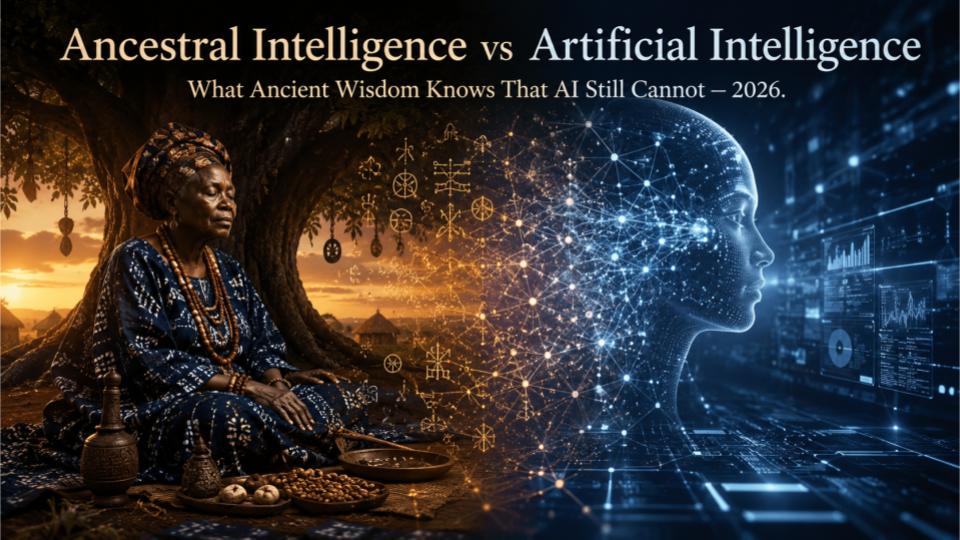
Let me tell you about my grandmother. She could look at the sky over Enugu on a Tuesday morning and tell you — without a phone, without a weather app, without any screen at all — whether your cassava farm would see rain before Friday. She was right, more often than not. Not because of luck. Because of something that took generations to build, something quietly passed down through observation, story, experience, and an intimate relationship with the land.
Now in 2026, we have artificial intelligence systems that can model atmospheric pressure across a continent, cross-reference humidity data from thousands of weather stations, and produce a seven-day forecast with satellite-level precision. And yet, there is still something in what my grandmother did that no algorithm has fully replicated. Something in the knowing. Something in the feeling.
This is not an anti-technology piece. Far from it. This is an honest conversation about two very different kinds of intelligence and what each of them brings to the table — especially for Nigerians who are navigating one of the most competitive, most unpredictable job markets on the African continent right now.
Ancestral intelligence was not superstition. It was compressed data — thousands of years of pattern recognition stored not in servers, but in people.
What Exactly Is Ancestral Intelligence?
Before we compare, let us define. Ancestral intelligence, sometimes called indigenous knowledge or traditional wisdom, refers to the accumulated understanding that communities develop over hundreds and often thousands of years of lived experience. It is encoded in proverbs, in farming practices, in healing traditions, in communal decision-making processes, in architecture, in how families structure themselves, in how disputes are resolved.
For the Yoruba, it lives in the Ifa divination system, a body of knowledge so sophisticated that UNESCO recognized it in 2008 as an Intangible Cultural Heritage of Humanity. For the Igbo, it lives in Ofor and Ogu, the principles of righteous authority. For the Hausa-Fulani, it lives in centuries of pastoral knowledge about cattle, climate, and land. For the Ijaw, it lives in an intimate understanding of the Niger Delta ecosystem that took generations of riverside living to build.
None of this is primitive. All of it is data. What separates it from artificial intelligence is not complexity — it is the medium in which it is stored and the process by which it was gathered.
Key Insight for Nigerian ProfessionalsIn an era where companies are automating roles at scale, the professionals who understand both ancestral intelligence and artificial intelligence will not just survive the transition. They will lead it. Cultural fluency is becoming one of the most sought-after skills in African enterprise.
How AI Works and Where It Is Brilliant
Artificial intelligence in 2026 is genuinely remarkable. There is no point pretending otherwise. Machine learning models can now diagnose certain cancers earlier than most radiologists, write legal briefs that pass junior partner review, generate functional code from a plain-English description, and hold a customer service conversation so naturally that callers sometimes do not realize they are speaking to a machine.
In the Nigerian context specifically, AI tools have started changing how businesses operate. Fintech companies in Lagos are using AI fraud detection systems that process millions of transactions per second. Agricultural startups in Abuja are deploying drone-based AI crop monitoring that gives smallholder farmers access to the kind of precision data that was once only available to industrial agribusinesses. HR platforms are using AI screening tools to sort through thousands of job applications in a fraction of the time it would take a human recruiter.
AI’s core strength is pattern recognition at scale. Feed it enough data, give it enough computational power, and it will find relationships in that data that a human mind — constrained by time, attention, and biological processing limits — simply cannot see.
But here is where it gets interesting. Here is where, in 2026, the conversation is still very much open.
What Ancestral Intelligence Still Does Better
There are at least six domains where ancestral intelligence continues to outperform its artificial counterpart. And these are not small, peripheral domains. For anyone building a career in Nigeria right now, these are central.
1. Understanding People Without Data Points
A seasoned Igbo trader can walk into a room and read the energy of a negotiation. She knows when a potential partner is genuinely interested and when they are stalling. She knows which concession to make and when to stay firm. She has never studied behavioral economics. She learned this by watching her mother negotiate, by sitting in on market meetings, by navigating the complex social currency of the Onitsha Main Market for twenty years.
AI needs data to make judgments. Human emotional intelligence, refined through cultural experience, can operate in data-sparse environments with remarkable accuracy. A good manager — the kind who actually inspires loyalty in their team — does this every day. They read the room. They know which staff member is burning out before the performance metrics show it. They sense when an office is shifting culturally, when trust is eroding, before anyone has written a complaint.
No AI in 2026 can reliably do this. The systems that try to analyze facial micro-expressions or vocal tone are still error-prone, heavily biased toward Western data sets, and deeply distrusted by most users — rightly so.
2. Contextual Ethics and Moral Reasoning
This one is perhaps the most important and the least discussed. Ethical decision-making is not just about knowing the rules. It is about understanding the weight of relationships, the history behind a conflict, the unspoken social contract that holds a community together.
In many traditional Nigerian settings, the process of resolving a dispute between two families is extraordinarily sophisticated. You bring in elders who understand the history of both sides. You create space for each party to speak without interruption. You factor in the health of the broader community, not just the immediate grievance. The resolution is not simply about who was technically right — it is about restoring peace in a way that allows both parties to walk away with their dignity intact.
AI systems, when asked to make ethical judgments, default to frameworks encoded by their designers — frameworks that carry the biases, cultural assumptions, and blind spots of their creators. In 2026, most of the world’s most powerful AI systems were trained primarily on Western internet data, which means they carry deep structural biases when applied to African social contexts.
An AI cannot yet understand why, in a specific Yoruba family setting, certain decisions must flow through the oldest male relative even if a younger person has better information. It cannot understand the concept of face-saving in Hausa business culture well enough to navigate a high-stakes negotiation without causing offense. These are not bugs that can be patched with more training data. They are forms of knowledge that require embodied cultural experience.
3. Long-Term Ecological Knowledge
Here is something that scientists have increasingly come to appreciate: traditional farming communities in Nigeria often know things about their local ecosystems that formal research has not yet documented. Indigenous farmers in Benue State have cultivated varieties of yam that are naturally resilient to certain pests — not because of genetic engineering, but because of centuries of careful selection. Fishing communities in Bayelsa understand seasonal migration patterns of fish species in ways that took marine biologists years to confirm with research equipment.
AI can analyze satellite imagery. It can process climate models. It can predict which areas face drought risk in a given year. But it cannot yet replicate what an 80-year-old farmer in Kogi State knows about a specific patch of land she has cultivated her entire life — the way the soil behaves after a certain kind of rain, the particular insects that appear before a good harvest, the signs in the trees that tell her something is changing underground.
4. Community Trust and Social Capital
In the Nigerian job market, especially at senior levels, who you are to the community still matters enormously. Not who your LinkedIn profile says you are. Not what your AI-curated portfolio shows. But who you actually are — your reputation, your network built through genuine relationship, the community that will vouch for you when things get difficult.
Ancestral intelligence encoded this understanding deeply. Ubuntu — the Bantu concept captured in the Yoruba phrase “Eniyan ni eniyan nitori eniyan miiran” — holds that a person becomes more fully themselves through their relationships with others. This is not just philosophy. It is a practical operating principle.
AI optimizes for individual metrics. Ancestral intelligence optimizes for community health. In a world where trust has become one of the scarcest and most valuable commodities in business, the leaders who understand how to build genuine social capital will have an advantage that no algorithm can replicate.
5. Storytelling as Knowledge Transfer
Before writing, before servers, before the cloud, African civilizations transferred knowledge across generations through story. The Griots of West Africa were not entertainers. They were living libraries. They held genealogies, histories, moral frameworks, and practical knowledge in narrative form, and they transmitted it with a fidelity and emotional resonance that written text often cannot match.
In 2026, the most effective communicators — the leaders who can move organizations, win clients, inspire teams — are still the best storytellers. Not the ones who produce the most technically accurate reports. Not the ones whose AI writing assistant produces the cleanest prose. The ones who can take a complex idea and make another human being feel it.
This is a skill that ancestral cultures refined over millennia. It is still not something AI does well. AI can generate coherent narrative. It cannot yet tell a story that makes a room go quiet, that makes a hiring panel remember your name six months later, that makes a client call you back because they felt something in the way you described your vision.
6. Surviving Ambiguity and Uncertainty
Nigeria has always required a particular kind of mental resilience. The power goes off. The policy changes overnight. The road that existed yesterday is flooded today. The contract that was signed last week is being renegotiated this morning. Nigerians who succeed — and many do, spectacularly — have developed an intuitive capacity for navigating uncertainty that is, in its own way, a form of intelligence.
AI needs structured inputs. It breaks down in genuinely novel situations — situations that do not resemble anything in its training data. It can struggle with sudden context switches, with contradictory information, with environments where the rules keep changing. It performs best when the world is predictable and the data is clean.
Ancestral wisdom was forged precisely in unpredictability. The proverbs, the flexible decision-making frameworks, the community structures — these were all designed to help people make good decisions in the absence of certainty. That is a skill Nigerian professionals carry in their bones, often without even naming it.
A Comparison: Side by Side
| Domain | Artificial Intelligence (2026) | Ancestral Intelligence |
|---|---|---|
| Data processing speed | Exceptional — billions of operations per second | Limited by human cognition |
| Human emotional reading | Still unreliable, bias-prone | Often excellent, especially within own cultural context |
| Ethical nuance | Framework-bound, culturally biased toward training data | Contextual, community-tested, relationship-aware |
| Local ecological knowledge | Dependent on available datasets, often incomplete | Deep, place-specific, multi-generational |
| Community trust-building | Cannot build genuine human relationship | Core competency |
| Scalability | Highly scalable across millions of users | Limited to personal network and community |
| Navigating ambiguity | Struggles significantly outside training distribution | Adapted to operate effectively in uncertainty |
| Storytelling and persuasion | Competent but lacks emotional authenticity | Can be extraordinary — culturally embedded |
What This Means for the Nigerian Job Market Right Now
Let us bring this home, because this is ultimately what matters if you are a fresh graduate from the University of Lagos, a mid-level professional at a Lagos fintech firm, a job seeker in Kano, or an entrepreneur in Port Harcourt trying to figure out where the opportunities are.
The Nigerian job market in 2026 is at a fascinating inflection point. On one side, you have serious AI-driven disruption. Entry-level data entry roles are being automated. Basic customer service is increasingly handled by chatbots. Some content creation, basic coding, and administrative functions are being done faster and cheaper by AI tools. If you are still waiting for a job that is a carbon copy of what existed five years ago, you may be waiting a long time.
On the other side, there is something specific to the Nigerian context that is creating opportunities that AI cannot fill. Nigeria is a high-context culture. We communicate through relationships, through what is left unsaid, through the code-switching that happens between Pidgin English and formal English in the same conversation, through the implicit understanding of rank and respect that governs how meetings actually run (regardless of what the org chart says). AI struggles enormously in high-context cultural environments.
The Roles That Are Growing in Nigeria Despite AI
- Community engagement managers who can navigate the complex social geography of Nigerian cities and towns — roles that require human trust, local knowledge, and cultural fluency that no algorithm can replicate
- AI oversight and ethics roles — companies deploying AI in Nigerian contexts need people who understand both the technology and the local cultural terrain to catch the ways these systems go wrong in practice
- Storytellers and brand communicators who can translate a brand’s message into something that resonates authentically with Nigerian consumers across different ethnic and regional contexts
- Agricultural knowledge officers who can bridge traditional farming wisdom with modern precision agriculture tools — Nigeria’s food security challenges make this one of the most important hybrid roles emerging right now
- Conflict resolution and negotiation professionals who understand both formal legal frameworks and traditional dispute resolution processes — essential in a country where both systems often operate in parallel
- Community health workers who combine modern medical knowledge with the kind of local trust and cultural communication skills that are essential to getting rural Nigerians to actually access and act on health information
How to Position Yourself at the Intersection
The professionals who will thrive in Nigeria over the next decade are not those who simply embrace AI and abandon traditional ways of knowing. Nor are they those who dismiss AI as irrelevant or foreign. They are the ones who understand how to hold both — who know when to deploy a language model and when to pick up the phone and have a real conversation with someone in their network.
Here is a practical way to think about it. Your ancestral intelligence — your cultural fluency, your community roots, your ability to read a room, your oral tradition, your intuitive understanding of how trust is built in Nigerian society — is not a liability in an AI world. It is a competitive advantage. It is the thing that will make you irreplaceable to any organization trying to operate effectively on African soil.
But you also need to understand the tools. Not because AI will replace you, but because the people who know how to use AI tools effectively will be able to do more, faster, and will free up their time and cognitive bandwidth for the high-value human work that you are uniquely positioned to do.
The Yoruba say, “Oju to ba ri egan ko ni ri egan loran.” The eye that has seen the bush cannot mistake it for a knife. See both intelligences clearly and you will never be confused about where your advantage lies.
A Note to Nigerian Employers and Educators
If you are building teams or shaping curriculum in Nigeria today, there is an urgent conversation that is not happening loudly enough. The education system has, for decades, been oriented toward producing workers who can plug into global systems — English fluency, Western academic frameworks, internationally portable credentials. That orientation was not wrong. But it has sometimes come at the cost of valuing what Nigerian students already know before they walk through the door.
The student from a farming community in Plateau State who grew up watching her family solve complex resource allocation problems without a spreadsheet, who learned conflict resolution at the feet of her community’s elders, who knows how to build trust in an environment where formal institutions are not always reliable — this student brings a form of intelligence that is genuinely valuable and that no AI training program will teach her.
The challenge for Nigerian employers is to create environments where both kinds of intelligence are valued and where they can inform each other. The challenge for educators is to stop treating traditional knowledge as something to be left behind at the university gate and start recognizing it as intellectual capital — something to be developed, refined, and applied.
The Bigger Picture: Africa’s Moment
There is a broader story here that Nigerians should be paying attention to. The global AI conversation in 2026 is increasingly recognizing a problem that Africans have been pointing to for years. These systems are biased. They reflect the values, assumptions, and blind spots of their creators. They perform badly in contexts they were not trained for. And they are being deployed at scale in communities whose knowledge, languages, and ways of knowing are barely represented in the training data.
This is not just a technical problem. It is a cultural and political one. And the people who are going to solve it — the people who are going to build AI systems that actually work for African communities, that understand Yoruba proverbs and Hausa social structures and Igbo market dynamics and Ijaw ecological knowledge — are going to be Africans who hold both intelligences at once.
Nigeria, as the most populous country on the continent, with the largest economy, with the most diverse collection of languages and cultures, with a diaspora that stretches across every major city in the world, is uniquely positioned to lead this work. But it requires taking ancestral intelligence seriously as intelligence — not as folklore, not as tradition, not as something that belongs only to village elders. As a living, adaptable, sophisticated form of knowing that has proven its worth across millennia and will continue to prove its worth in the century ahead.
Final Thoughts
My grandmother passed away in 2019, before the current wave of generative AI had fully arrived. I have thought about her a lot while writing this piece. I have thought about what she would have made of ChatGPT, of the AI tools that can now write essays and plan farming calendars and compose songs. I think she would have found them useful, the way she found a good machete useful — as a tool, something to make certain tasks easier. But she would not have confused the tool for the hand that holds it.
That distinction — between the tool and the intelligence that guides it — is what this whole conversation is really about. Artificial intelligence is an extraordinary tool. It will reshape the Nigerian economy, the way work is done, the way problems are solved. That is not a question. The question is whose intelligence will guide how it is used, whose values will shape what it optimizes for, whose wisdom will catch it when it goes wrong.
The answer, for anyone serious about Nigeria’s future, has to include the intelligence that was already here — encoded in proverbs, in markets, in community structures, in the quiet knowing of people who have navigated this land for longer than any dataset can record.
Use both. Value both. And do not let anyone tell you that what your ancestors knew has no place in a world of large language models. That argument is, as my grandmother would have put it, the kind of thing only someone with no real knowing would say.
Frequently Asked Questions (FAQs)
1. What is ancestral intelligence?
Ancestral intelligence refers to the knowledge, instincts, cultural wisdom, survival strategies, and human understanding passed down through generations. It includes intuition, storytelling, spirituality, emotional intelligence, traditional healing practices, community values, and lived human experience that technology cannot easily replicate.
2. Can artificial intelligence fully replace human wisdom?
No. AI can process data, automate tasks, and generate predictions, but it still lacks human intuition, emotional depth, moral judgment, cultural understanding, and spiritual awareness. While AI is powerful, it cannot truly replicate the full complexity of human consciousness and ancestral knowledge.
3. Why is ancestral wisdom becoming important again in the AI era?
As AI becomes more integrated into daily life, many people are rediscovering the importance of human connection, cultural identity, ethical thinking, and emotional intelligence. Ancient wisdom offers perspectives on leadership, relationships, resilience, and community that modern technology often overlooks.
4. What are the biggest limitations of AI in 2026?
Some major limitations of AI in 2026 include:
- Lack of genuine emotions and empathy
- Inability to understand spiritual or cultural meaning deeply
- Dependence on human-created data
- Weak moral judgment in complex ethical situations
- Difficulty replicating intuition, creativity, and lived human experience
These limitations are why human wisdom and ancestral intelligence still matter in an increasingly digital world.
