

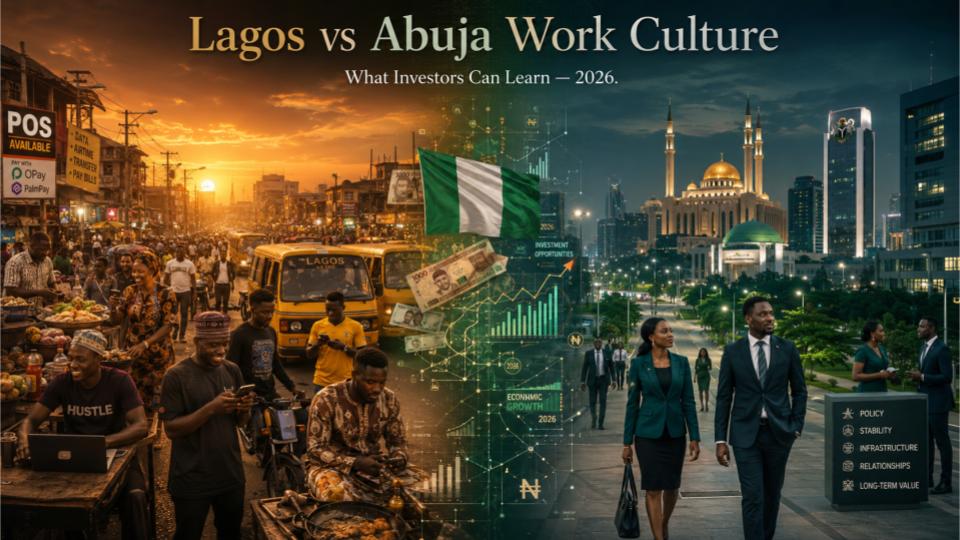
There is a conversation that happens in certain business circles, usually among people who have tried to invest in Nigeria from outside and found it more complicated than their spreadsheets suggested. It usually goes something like this: “Nigeria has all the ingredients for massive growth, but I just cannot figure out how it actually works.”
The answer, more often than not, is sitting inside the daily work culture of Lagos and Abuja. Not in GDP projections or World Bank reports. In the way a sales executive in Victoria Island answers emails at 11pm. In the way a government contractor in Maitama builds relationships over three months before anyone mentions money. In the way a young Surulere entrepreneur runs four income streams simultaneously and treats each one with the seriousness of a full corporation.
Nigeria’s economy does not operate the way most external observers expect. It operates the way it has always operated — through human energy, through networks, through relentless improvisation, and through a set of cultural values that reward speed in one city and patience in the other. Understanding those values is not optional for investors in 2026. It is the difference between building something that lasts and spending a lot of money learning an expensive lesson.
Why Lagos and Abuja Matter to Investors
Nigeria is not a monolithic market. Anyone who has spent meaningful time in the country knows this. There are 36 states, over 500 ethnic groups, and regional economies that function almost like separate countries in terms of culture, purchasing power, and business behavior. But if you are trying to understand where the money moves and where it pools, two cities tell most of the story.
Lagos is Nigeria’s commercial heartbeat. It is where most of the private sector activity happens, where consumer trends begin, where fintech disrupts, where the informal economy generates staggering volumes of cash. Depending on how you measure it, Lagos contributes somewhere between 25 and 30 percent of Nigeria’s total GDP — from a single state. It is the kind of statistic that sounds impossible until you have spent time in the city and felt its relentless economic velocity firsthand.
Abuja is a different kind of power center. It is the seat of government, which means it is where policy is made, where federal contracts flow, where the consultancy industry runs deep, and where spending behavior tends to be shaped more by institutional budgets than by personal hustle. The professionals who thrive in Abuja are generally those who understand how to move within structured systems, how to build relationships over long timelines, and how to position for recurring institutional business rather than quick consumer wins.
For investors, understanding how these two cities operate is not just useful background knowledge. It is essential intelligence about where to position, what products to build, what services to offer, and what kind of workforce you will be managing.
- Speed, risk appetite, hustle
- Informal economy dominance
- Consumer volume and density
- Fast digital adoption
- High competition, high reward
- Multi-income entrepreneurship
- 24-hour economic activity
- Structure, patience, networks
- Government and policy influence
- Premium service market
- Long-cycle relationship deals
- Professional branding matters
- Institutional and consulting culture
- Stability and perception-driven
The Hustle Culture of Lagos
To understand Lagos, you need to understand what daily survival requires. The city does not make things easy. Traffic can swallow two to three hours of a person’s day before they even reach the office. Power cuts can happen multiple times before noon. The cost of living moves faster than most salary increments. And yet, Lagos keeps producing some of the most commercially savvy, innovative, and resourceful workers you will find anywhere on the continent.
This is not accidental. The conditions of Lagos have shaped a particular kind of professional — one who has internalized the idea that waiting is not a strategy, that no single income source is ever completely safe, and that relationships are currency. The Lagos professional has typically developed a secondary income stream, whether that is a small business on the side, a trading operation, a digital service, or a professional consultancy running quietly alongside their nine-to-five. This is not moonlighting in the pejorative sense. It is rational risk management built into a city where formal employment has never reliably guaranteed financial security.
What does this mean for investors? Several things. First, your workforce in Lagos will be commercially alert in ways that workers in more economically stable environments are not. A customer service manager in Lagos often understands consumer psychology from personal experience because they have been both the vendor and the customer in informal market settings. A logistics coordinator likely has a natural grasp of supply chain improvisation because they have watched it done creatively their whole life.
Lagos has made entrepreneurs out of people who never planned to be. That instinct does not disappear when they put on a corporate lanyard.
Second, the speed of commercial activity in Lagos is genuinely extraordinary. Trends cycle fast. Consumer preferences shift quickly. A product that captures attention in Lagos today can achieve distribution scale within weeks through the combination of social media influence, Whatsapp commerce, and informal distribution networks that have no real parallel in most other African cities. If your business model requires rapid consumer feedback and fast iteration, Lagos gives you that environment.
Third, the informal economy in Lagos is not a fringe phenomenon. It is a substantial portion of real economic activity. Oshodi Market, Computer Village in Ikeja, Balogun Market on Lagos Island, the road-side traders on Carter Bridge — these are not margins. They are the engine. Smart investors who find ways to serve, digitize, or connect to these informal networks are accessing markets that formal business models frequently overlook entirely.
Abuja’s Structured Professional Environment
Abuja operates on a different rhythm. If Lagos is the sprint, Abuja is the long game. The city was planned, which means it carries a planning culture that permeates how professionals there think about time, positioning, and opportunity. Government drives Abuja’s economy — not just as an employer, but as the central force shaping what kinds of businesses thrive and what kinds struggle.
The professional culture in Abuja values presentation, credentials, and long-term relationship investment in ways that Lagos does not always require. A deal that might close in a Lagos boardroom after two meetings can take months of cultivation in Abuja — not because people are inefficient, but because the institutional culture that shapes business there is built around formal processes, approvals, and due diligence that reflects government procurement patterns.
This has concrete investment implications. Service businesses in Abuja that cater to professionals, government affiliates, and the diplomatic community can command significantly higher price points than equivalent offerings in Lagos. The Abuja consumer who is embedded in government or high-level consulting is often less price-sensitive and more quality-sensitive. They want the best restaurant, the best hotel, the most professional service provider — and they are willing to pay for it if the brand positioning is credible.
Real estate in Abuja’s Maitama, Asokoro, and Wuse II districts has consistently held value better than comparable Lagos real estate during economic downturns, partly because institutional tenants — embassies, government agencies, large NGOs — provide rental stability that purely commercial Lagos markets cannot always match.
For investors building B2B businesses or government-adjacent services, Abuja is often the right first market. The relationships you build there are long-term and sticky. A contract or partnership in Abuja, once properly established, tends to have longer tenure and more predictable renewal than many Lagos commercial relationships, which are subject to the city’s more competitive and faster-moving market dynamics.
Consumer Spending Patterns in Both Cities
One of the more useful things an investor can study is how people in Lagos and Abuja actually spend money — not what they say they value, but what their wallets reveal. The patterns in 2026 tell a story about two distinct consumer psychologies operating inside the same national economy.
Lagos consumers spend on convenience at an extraordinary rate. Traffic means time is genuinely precious, which is why food delivery, ride-hailing, laundry services, and anything that reduces friction in daily life has found explosive demand in Lagos. The success of companies like Bolt and Chowdeck in Lagos is not primarily a technology story. It is a response to a city that makes ordinary tasks genuinely difficult and rewards anything that makes them easier. For investors, the Lagos consumer is essentially asking one constant question: “Does this save me time or reduce my stress?” If the answer is yes and the price is reasonable, adoption tends to be fast.
Abuja consumers, shaped by the relatively more structured lifestyle of a planned capital city, spend differently. The premium on status and professional appearance is higher. Spending on professional wardrobe, quality dining, interior design, and branded experiences is proportionally significant. An Abuja professional with a government salary or a consultancy income tends to invest in visible markers of professional standing in a way that reflects the culture of the city — a culture where who you are seen to be has direct economic consequences for the business relationships you can build.
Remote Work and Digital Business Growth
The remote work conversation that began globally in 2020 has taken on a distinctly Nigerian character by 2026. For Lagos especially, remote and hybrid work arrangements have been transformative in ways that go beyond what most post-pandemic analyses capture. When a Lagos professional removes their daily commute from the equation, they gain back two to four hours per day. That time does not go to leisure. In the Lagos context, it largely goes to building additional income streams, deepening skills, and pursuing business ideas that the commute previously made impossible.
The result has been a significant expansion of the Nigerian digital services economy. Freelance writing, graphic design, video editing, social media management, virtual assistance, online tutoring, and software development have all seen substantial growth among Lagos-based workers who are using remote work flexibility to operate globally while living locally. Platforms like Toptal, Contra, and various African-focused remote work marketplaces have seen Nigerian talent registration increase sharply since 2023.
For investors building businesses that require digital talent, this represents both an opportunity and a talent competition you need to account for. The skilled young Nigerian worker in 2026 is not automatically available to your Lagos office just because you are offering a competitive naira salary. They are comparing that offer against the possibility of earning in dollars, euros, or pounds while working from home. This does not make Nigerian talent inaccessible. It makes the terms of access more competitive and more interesting than they were five years ago.
Abuja’s remote work story is slightly different but equally important. Government-adjacent workers in Abuja have been slower to fully embrace remote arrangements because the culture of government work values physical presence for relationship and political reasons. But the private sector in Abuja — the consultancies, the NGOs, the multinational offices — has moved more aggressively toward hybrid models, and the demand for co-working infrastructure in Abuja has grown accordingly.
What Young Nigerians Are Prioritizing in 2026
Nigeria has one of the youngest populations on the planet, and in both Lagos and Abuja, the under-35 cohort is shaping economic behavior in ways that are not always captured in formal statistics but are highly visible to anyone paying close attention.
Young Nigerian professionals in 2026 are prioritizing four things with a consistency that cuts across both cities: financial independence, skill acquisition, digital presence, and flexibility. The desire for financial independence is not just idealistic. It is practical. The economic turbulence of the 2020s — including naira devaluations, inflation cycles, and the disruption of the japa wave as tens of thousands of skilled Nigerians emigrated — has taught young Nigerians that institutional loyalty is not a reliable path to financial security. The response has been a generation that builds security through skill, hustle, and multiple income channels rather than through career ladders.
Skill acquisition has become genuinely cultural among young Lagos and Abuja professionals. The appetite for online courses, professional certifications, and skills-based bootcamps is remarkable. Schools like AltSchool Africa, Semicolon, and various Google and Meta certification programs have found substantial markets among young Nigerians who see human capital investment as the most reliable asset they can hold in an unstable currency environment.
A young Nigerian professional investing in a tech certification is not just building a career. They are buying a form of dollar-denominated insurance against naira volatility.
The Rise of Side Hustles and Micro Businesses
Nigeria has always had a culture of multiple income streams, but 2026 has seen this formalize in interesting ways. What was once purely informal is becoming structured. Young professionals who once ran side businesses through Whatsapp groups and Instagram DMs are now registering on platforms, using payment gateways, building proper brands, and thinking about scale in ways that previous generations of informal traders did not.
In Lagos, the micro-business category is enormous and growing. Home bakers selling through Instagram, fashion designers with Paystack storefronts, fitness coaches running Zoom-based training programs, content creators monetizing through YouTube and TikTok partnerships, social media managers servicing multiple brands from a phone and a good internet connection — these are not hobbies. They are businesses generating real revenue and employing real labor, often entirely outside formal employment structures.
For investors, this creates several openings. Financial products tailored to micro-business cash flows are badly underserved. Business tools built for solo operators and small teams that do not require enterprise-level contracts or expensive onboarding are in high demand. Logistics solutions that serve last-mile e-commerce at volumes too small for major platforms but too large for pure manual handling represent a genuine gap. The creator economy in Nigeria is also still relatively early-stage in terms of formal monetization infrastructure — the tools that Western creators take for granted are often either unavailable, expensive, or poorly adapted for the Nigerian digital environment.
Tech, Real Estate, and Service Industry Opportunities
Let us be specific about where the Lagos and Abuja work culture signals genuine investment opportunity in 2026, because the high-level narrative is only useful if it points to concrete action.
Technology and Fintech
Lagos remains the most promising African fintech market after South Africa, and in several categories it is actually ahead. The combination of a large unbanked population, high mobile penetration, a culture of digital payment adoption driven by companies like Flutterwave, Moniepoint, and OPay, and a workforce that has internalized digital commerce means that technology businesses with genuine utility find real traction. The key word is genuine — Nigerian consumers are sophisticated and have been over-marketed to. Products that actually solve real problems spread fast. Products that do not solve real problems die quickly, regardless of how much they spend on marketing.
Real Estate in Both Cities
Real estate in Lagos and Abuja continues to attract serious investor attention, but the 2026 opportunity has shifted somewhat from where it was five years ago. Mid-income housing is chronically undersupplied in both cities. The premium market in Abuja is relatively well-served. The truly large opportunity is in housing products that can serve the professional class — people earning decent incomes who are locked out of homeownership by mortgage market dysfunction. Any business model that finds a way to make property accessible to this segment at scale is addressing one of the most significant structural gaps in both urban economies.
Premium Services and the Experience Economy
Abuja’s premium services market is less saturated than Lagos and growing. High-quality gyms, branded co-working spaces, professional development programs, premium healthcare facilities, quality hospitality — the demand in Abuja from a financially capable professional class is consistent and relatively underserved compared to the equivalent market in Lagos.
What Foreign Investors Often Misunderstand
After spending time with foreign investors who have tried and failed in the Nigerian market, certain patterns of misunderstanding repeat themselves often enough to be worth naming directly.
The first is treating Nigeria as a single market. It is not. Even Lagos and Abuja, separated by a domestic flight, operate by different rules. A go-to-market strategy that works in Lagos will not automatically translate to Abuja, and a product priced correctly for the Abuja professional market may be positioned entirely wrong for the Lagos mass consumer market.
The second is underestimating the importance of local partnership and local knowledge. The regulatory environment in Nigeria is complex and evolving. The informal networks that determine how contracts move, how products get distributed, and how brand trust is built require navigation by people who genuinely understand the terrain. Foreign investors who try to operate Nigeria from the outside, relying on data and remote management, consistently underperform those who invest in real local presence and genuine partnership.
The third, and perhaps most important, is misreading Nigerian resilience as evidence that the market does not have serious structural challenges. It does. Power infrastructure, logistics, regulatory unpredictability, and currency instability are real constraints. The fact that Nigerian businesses find ways to operate and grow despite these constraints is a testament to extraordinary human adaptability — not evidence that the constraints are not costly. Investors who underestimate the operational cost of these challenges routinely find their unit economics look very different on the ground than they did in the financial model.
Infrastructure Challenges and Business Adaptation
Every serious investor in Nigeria needs a clear-eyed view of what infrastructure gaps cost in real operational terms. This is not pessimism. It is basic commercial intelligence.
In Lagos, power supply is unreliable enough that most businesses operate their own backup generation. This is a significant ongoing cost, but it is also a known cost that is now built into most serious business models. The interesting commercial development around this constraint is the rise of embedded energy solutions — solar installations, shared grid operators, and generator-as-a-service models that have turned Nigeria’s power deficit into a genuine commercial category.
Road infrastructure in both cities creates delivery and logistics costs that dramatically affect e-commerce unit economics. The businesses that are winning in Nigerian e-commerce are those that have redesigned their logistics architecture around the reality of Lagos and Abuja traffic rather than assuming a routing model that works in Atlanta or London will work in Ikeja or Garki.
The Human Capital Advantage in Nigeria
Here is the thing that is easy to miss when you focus too much on infrastructure challenges. Nigeria’s human capital is genuinely exceptional in ways that matter commercially. The combination of English fluency, mathematical ability, commercial drive, and exposure to both local market complexity and global digital culture creates a workforce that, in the right environment, outperforms equivalent cohorts in markets with better infrastructure but less intellectual sharpness and commercial hunger.
The Nigerian professional who has navigated Lagos for five years has developed a set of problem-solving instincts, client management skills, and commercial agility that cannot be taught in a business school classroom. They have been tested in conditions that most professionals in more stable economies simply never face. That experience has real commercial value for investors who know how to recognize and develop it.
The challenge — and this is where many Nigerian businesses struggle — is retention and development. The japa wave accelerated a brain drain that is real and ongoing. The businesses that are building sustainably in Nigeria in 2026 are generally those that have found ways to make staying in Nigeria financially competitive with leaving, through equity participation, dollar-denominated compensation components, genuine career development paths, and work cultures that treat Nigerian talent as a premium asset rather than a low-cost resource.
Lessons Investors Can Apply Immediately
- 01 Spend real time in both cities before committing capital. No amount of secondary research replaces the experience of being in Balogun Market on a Tuesday, sitting in a Wuse II co-working space on a Thursday morning, and watching how both environments actually function. Your investment thesis will change after that experience — almost always for the better.
- 02 Build your entry strategy around one city first. If your model is B2B or government-adjacent, start in Abuja. If it is consumer or digital-first, start in Lagos. The temptation to do both simultaneously is understandable but often leads to an underfunded presence in two markets rather than a strong presence in one.
- 03 Hire people who have survived the market, not just succeeded in it. The professionals who have built businesses, lost them, rebuilt, adapted, and are still operating with optimism in Nigeria’s economy have an operating wisdom that is commercially valuable far beyond their formal credentials.
- 04 Price for the actual consumer, not the theoretical one. Nigerian consumers are price-aware and value-conscious in ways that require careful calibration. The sweet spot between accessible and premium is narrow, but it is where the most sustainable businesses operate.
- 05 Plan for regulatory change. Nigerian business regulation has moved quickly in recent years. Tax frameworks, foreign exchange policies, data protection rules, and sector-specific regulations have all shifted in ways that affected business models significantly. Build compliance flexibility into your operating model from day one.
Future Trends Shaping Nigeria’s Workforce
Looking ahead from mid-2026, several trends are likely to shape the Lagos and Abuja work culture and their investment implications over the next three to five years.
The continued growth of Nigerian tech talent is near certain. The infrastructure for producing skilled digital workers — bootcamps, university programs, online certifications, peer learning communities — is significantly better than it was even three years ago. The pipeline of technically capable young Nigerians entering the workforce is large and growing, and the question for investors is whether Nigerian businesses can offer competitive enough environments to retain a meaningful portion of that talent domestically.
The formalization of the gig and creator economy is also accelerating. Regulation will eventually catch up with the informal digital economy, and when it does, it will create both compliance costs and commercial opportunities for businesses that have built infrastructure to support this sector. The businesses that are building those relationships now — with creators, freelancers, and informal traders — will have a structural advantage when the regulatory environment matures.
Finally, the physical footprint of work is changing in both cities. The traditional office as the primary workplace is giving way to hybrid models faster than many Nigerian employers expected. This is creating demand for better co-working infrastructure, for productivity tools adapted to Nigerian connectivity realities, and for HR technology that can manage distributed teams operating across multiple income streams and locations. Each of these is a genuine investment category with largely unsaturated markets in Nigeria today.
Final Thoughts
Nigeria’s two most important cities are not just geographic locations or economic statistics. They are living demonstrations of how human beings adapt, create, and build in conditions that would defeat less resilient populations. Lagos shows you what happens when commercial energy meets urban density and no one is waiting for formal structures to provide the answer. Abuja shows you what happens when institutional culture shapes professional behavior and the patient professional wins consistently over the short-term opportunist.
Together, they give you a remarkably complete picture of how Nigerian economic life actually functions — with all its contradictions, its astonishing creativity, its structural challenges, and its genuine potential. The investors who succeed in this market in 2026 and beyond are not those who arrive with the most capital. They are those who take the time to understand what they are actually looking at when they look at Lagos and Abuja.
The cities will tell you everything you need to know. You just have to be paying attention.

1 Comment
This is great write up
More knowledge