

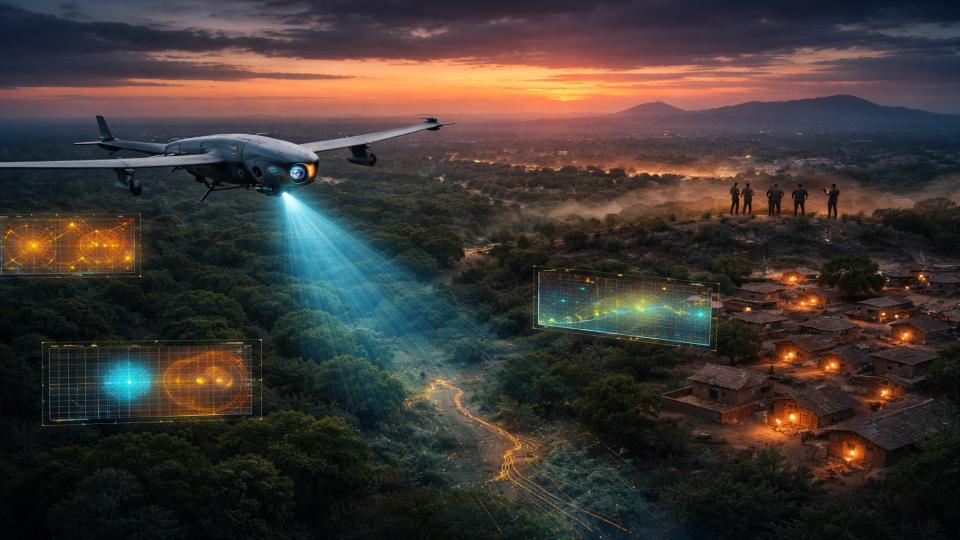
A friend of mine from Zamfara State told me something that has stayed with me since he said it in 2023. His family had abandoned their farm, land that his grandfather cleared with his own hands, because bandits had made the surrounding bush too dangerous to enter. They moved to Gusau and he took up okada riding to survive. He was not the only one. Entire farming communities in Zamfara, Katsina, and Sokoto relocated in that period, leaving behind land, livestock, and livelihoods that took generations to build. When I spoke with him again in early 2026, he had something different to say. He told me that soldiers had started using what he called “flying machines with cameras” to monitor the forest routes where bandits used to move freely. Attacks on his former village had dropped. Some displaced families were quietly going back.
Those flying machines were AI-powered surveillance drones, and they represent just one part of a much larger shift in how Nigeria is beginning to use artificial intelligence in the fight against insecurity. AI is combating insecurity in Northern Nigeria not as a slogan but as a set of practical, deployed tools that are making a measurable difference in specific locations. This guide explains how that is happening, which technologies are involved, what careers and digital skills are emerging from this shift, and how young Nigerians, particularly those in the north, can position themselves to benefit from this growing sector.
The Security Challenges That Make Northern Nigeria Different
To understand why AI is so relevant to Northern Nigeria’s security situation, you first have to understand what makes the security challenges there particularly resistant to conventional solutions. This is not simply a policing problem that more officers would solve.
The North covers an enormous geographic area, much of it forested, semi-arid, and sparsely populated. States like Zamfara, Kebbi, Sokoto, Katsina, and parts of Niger and Kaduna contain vast ungoverned spaces where criminal groups move freely because no surveillance infrastructure exists to monitor them. The borders with Niger, Chad, and Cameroon add cross-border dimensions that no single state government can address alone. Layer on top of this the challenge of slow emergency response in communities that are sometimes hours from the nearest security outpost, and you begin to understand why traditional methods struggle.
These are precisely the conditions where AI-powered tools offer the most value. AI does not get tired. It can monitor thousands of square kilometers simultaneously. It can process months of incident data overnight to identify patterns that no analyst working manually could detect. And it can operate in environments where putting human personnel would be dangerous.
7 Ways AI can Combat Insecurity in Northern Nigeria Right Now
1. Smart Drone Surveillance Over Forests and Remote Communities
AI-powered drones fitted with thermal imaging and computer vision cameras can cover terrain that ground patrols simply cannot access efficiently. In parts of Zamfara and Katsina, the Nigerian Army and Air Force have deployed reconnaissance drones that use AI to detect unusual human movement patterns in forests and flag them for human review. The AI does not make deployment decisions but it dramatically reduces the time between detecting a threat and getting that information to commanders. Villages that were once invisible to security forces are now monitored regularly.
2. Predictive Crime Analysis Using Historical Incident Data
AI crime prediction tools work by analyzing patterns in historical attack data, including timing, location, methods, and seasonal factors, to identify where future incidents are statistically likely to occur. Security agencies that use this kind of tool can pre-position personnel and resources in high-risk zones before incidents happen rather than always responding after the fact. This shift from reactive to preventive security is one of the most significant things AI brings to the Nigerian context.
3. Satellite Monitoring and Intelligence for Ungoverned Spaces
Commercial satellite imagery combined with AI analysis can detect newly formed encampments, track movement across large territories, and identify changes in vegetation that indicate recent human activity. Platforms like Palantir and Planet Labs work with African governments specifically on this kind of analysis. The Nigerian government has explored satellite intelligence partnerships for border monitoring and insurgency tracking in the Lake Chad Basin region.
4. AI-Powered Emergency Response Routing and Coordination
One of the least visible but most practically important AI security applications is improving the speed and coordination of emergency responses. AI dispatch systems can calculate optimal routes for security forces in real time accounting for road conditions, unit locations, and incident severity. In states where response times have historically been dangerously slow, even a 20 to 30 percent improvement in response coordination can directly save lives.
5. Community Alert Systems Using SMS, USSD, and Voice AI
Not every community affected by insecurity in Northern Nigeria has smartphone access or reliable data connectivity. AI-powered alert systems built on basic GSM infrastructure allow villagers to report threats via SMS or USSD codes, receive alerts in local languages including Hausa and Fulfulde, and participate in community early warning networks without needing a smartphone or internet connection. This inclusion of low-connectivity communities is critical in the Nigerian context and makes AI-based security genuinely accessible at the grassroots level.
6. Social Media and Online Threat Detection
Criminal and extremist groups in Nigeria use WhatsApp, Facebook, Telegram, and X to coordinate activities, spread propaganda, and recruit members. AI tools that monitor these platforms for keywords, coded language, and suspicious patterns can identify planned activities before they materialize. This kind of signals intelligence work requires both AI capability and human analysts who understand the local linguistic and cultural context, creating a specific demand for Nigerian professionals with both digital skills and regional knowledge.
7. Financial Crime Tracking and Ransom Payment Analysis
Banditry and kidnapping in Northern Nigeria are fundamentally economic activities. Disrupting the financial flows that sustain criminal networks weakens them structurally. AI-powered financial intelligence tools can detect unusual transaction patterns, flag suspected ransom payments, and map the banking and mobile money networks through which criminal proceeds move. This financial disruption approach is increasingly part of the Nigerian government’s counter-banditry strategy in partnership with the Central Bank of Nigeria and international financial intelligence units.
In 2024, a collaboration between the Nigerian Air Force and a Lagos-based defense technology startup piloted an AI drone monitoring system in parts of Zamfara State. Within six months of deployment, the military reported a measurable reduction in bandit movement along two major forest corridors that had previously been completely unmonitored. The technology did not end insecurity. But it changed the terms of the problem in a specific geography for the first time in years.
Digital Skills You Can Learn to Work in AI Security in Nigeria
Here is the part of this conversation that most people miss when they read about AI and security. These technologies do not operate themselves. They need people to build them, maintain them, analyze the data they generate, and communicate their findings to decision makers. And a significant portion of those people can be based in Nigeria, including in the north, working for both Nigerian and international organizations.
| Digital Skill | How It Applies to Security | Where to Learn | Job Demand |
|---|---|---|---|
| Data Analysis | Analyzing crime incident data, threat pattern identification, reporting for security agencies | Coursera, ALX Africa, Google Data Analytics Certificate | Very High |
| Cybersecurity | Protecting government and security agency digital infrastructure from attacks | Cisco NetAcad (free), CompTIA Security+, ISC2 CC Certificate | Very High |
| Machine Learning Basics | Building predictive models for crime forecasting and threat detection systems | Coursera Andrew Ng ML course, fast.ai, ALX AI Programme | High |
| GIS and Satellite Data Analysis | Interpreting satellite imagery, mapping threat zones, analyzing geographic movement patterns | ESRI free training, QGIS tutorials, Coursera GIS specialization | Growing |
| Drone Operation and Maintenance | Operating surveillance drones, maintaining hardware, managing flight data | Nigeria Civil Aviation Authority certification, private drone schools in Lagos and Abuja | Growing |
| Software Development | Building security apps, alert systems, data dashboards, and reporting platforms | Side Hustle Nigeria, AltSchool Africa, self-taught via freeCodeCamp | High |
| Open Source Intelligence (OSINT) | Monitoring social media and online platforms for threat signals using AI-assisted tools | Bellingcat OSINT courses, SANS free resources, YouTube OSINT communities | Emerging |
Good News for Northern NigeriansFluency in Hausa, Fulfulde, Kanuri, or other northern Nigerian languages is a genuine professional advantage in AI security roles that require understanding of regional threat communications and community alert systems. This is a skill that no amount of formal training can replicate, and it makes northern Nigerian professionals specifically valuable in this sector.
AI and Security Tech Job Opportunities Available to Nigerians in 2026
The career opportunities emerging at the intersection of AI and security in Nigeria span both government and private sector pathways, and a growing number of them are remote-friendly roles that can be done from anywhere in the country.
| Role | Who Hires | Monthly Range (Naira) | Remote Possible |
|---|---|---|---|
| AI Security Analyst | Defense tech startups, private security firms, NGOs | N300,000 – N800,000 | Yes |
| Intelligence Data Analyst | Government agencies, international NGOs, UN security programmes | N250,000 – N700,000 | Partial |
| Cybersecurity Specialist | Banks, government, telecom companies, international clients | N350,000 – N1,000,000 | Yes |
| Drone Operator and Technician | Military contractors, agriculture companies, media organizations | N150,000 – N400,000 | Field-Based |
| GIS and Satellite Analyst | International development organizations, humanitarian agencies | N300,000 – N750,000 | Yes |
| OSINT Research Analyst | Media organizations, NGOs, private intelligence firms | N200,000 – N600,000 | Yes |
| Risk and Threat Analyst | Insurance companies, international businesses operating in Nigeria | N400,000 – N1,200,000 | Yes |
A young Nigerian from Kano or Maiduguri who learns data analysis, picks up basic cybersecurity skills, and develops genuine OSINT capability is qualified for roles that international organizations working on Nigerian security are actively struggling to fill right now. The skills gap is real and it works in your favor.
Challenges That AI Must Overcome to Fully Work in Northern Nigeria
It would be dishonest to present AI as a complete solution to insecurity in Northern Nigeria without naming the real obstacles that limit what these tools can currently achieve. These are not reasons to dismiss AI. They are challenges that themselves create opportunities for skilled Nigerian professionals who can help solve them.
1. Power Supply Gaps
AI surveillance and communication systems require reliable power to run continuously. In much of Northern Nigeria, power supply is too unreliable to sustain always-on security technology without solar or generator backup infrastructure, which adds cost and complexity to deployments.
2. Limited Internet Coverage
Cloud-based AI tools require data connectivity to function. Large parts of rural Northern Nigeria have poor or no mobile data coverage. Expanding connectivity through satellite internet solutions like Starlink is beginning to address this, but rural coverage gaps remain a significant constraint.
3. Data Privacy and Civil Liberties
AI surveillance systems that monitor communities raise legitimate questions about privacy, data storage, and the potential for misuse by security agencies. Nigeria currently lacks comprehensive data protection laws that specifically govern AI security systems, and this legal gap needs to be addressed as deployments expand.
4. Security Agency Training Deficit
Even where AI tools are deployed, their effectiveness depends entirely on whether the security personnel using them are properly trained to interpret and act on what the tools show. Training deficits within Nigerian security agencies mean that expensive technology sometimes sits underutilized.
Worth NotingEach of these challenges represents a consulting, training, or technology deployment opportunity for Nigerian professionals with the right skills. The infrastructure gaps, training needs, and policy questions that limit AI security effectiveness in Northern Nigeria all require skilled Nigerians to solve them. The problem is also the opportunity.
CONCLUSION
The story of AI combating insecurity in Northern Nigeria is still being written. The technology is real, the deployments are growing, and the results in specific locations are genuinely encouraging. But technology alone has never solved a security problem. It is the people who understand both the technology and the local context who will determine how much of this potential is actually realized.
For young Nigerians in the north who are watching their communities struggle with insecurity, there is now a path that did not exist five years ago. A path where your understanding of the local geography, language, and culture, combined with digital skills that can be learned online, becomes a career in one of the most important and fastest-growing fields in Nigerian technology. The question is not whether the opportunity exists. The question is whether you are willing to develop the skills to reach it.
Frequently Asked Questions About AI, Security, and Digital Skills in Northern Nigeria
How exactly is AI combating insecurity in Northern Nigeria today?
AI is being applied to Northern Nigeria’s security challenges through drone surveillance with thermal imaging that monitors forests and remote communities, predictive crime analysis systems that identify high-risk zones from historical data, satellite monitoring for cross-border movement, AI-powered emergency response routing, community alert systems that work on basic GSM phones in local languages, social media threat detection, and financial crime tracking to disrupt criminal funding networks. These applications are at different stages of deployment and effectiveness, but each represents a genuine improvement over purely conventional security approaches in the specific geographic and infrastructural conditions of Northern Nigeria.
What digital skills do I need to work in AI security roles in Nigeria?
The most in-demand skills are data analysis for processing crime and threat data, cybersecurity for protecting digital infrastructure, basic machine learning for building predictive tools, GIS and satellite image analysis for geographic intelligence work, drone operation and maintenance, software development for security platforms, and open source intelligence research for monitoring online threats. You do not need all of these. Developing genuine competence in even one of them, combined with an understanding of the security context in Northern Nigeria, positions you for roles that are genuinely difficult for employers to fill right now.
Are there real jobs in AI security available to young Nigerians from the north?
Yes, genuinely. International development organizations including United Nations agencies, USAID-funded programmes, EU-supported security initiatives, and international NGOs working on conflict and peacebuilding in Northern Nigeria all hire Nigerians with relevant digital skills. Nigerian defense tech startups are growing. Private security companies serving multinational businesses in Nigeria need risk analysts. And many of these roles are remote-friendly, meaning you can work for a London or New York-based organization from Kaduna or Maiduguri. Fluency in northern Nigerian languages is an additional competitive advantage for many of these roles.
Can someone from Northern Nigeria with no tech background realistically learn these skills?
Yes, completely realistically. Cisco’s free NetAcad cybersecurity fundamentals course, Google’s Data Analytics Certificate on Coursera, and ALX Africa’s data science and AI programmes are all accessible online with nothing more than a smartphone and a data connection. Several of these programmes have scholarships specifically for Nigerians. The cybersecurity fundamentals course from ISC2 is entirely free. Data analysis basics can be learned in three to four months of consistent daily practice. The barrier is not access to learning. It is making the decision to start and then staying consistent through the learning curve.
