

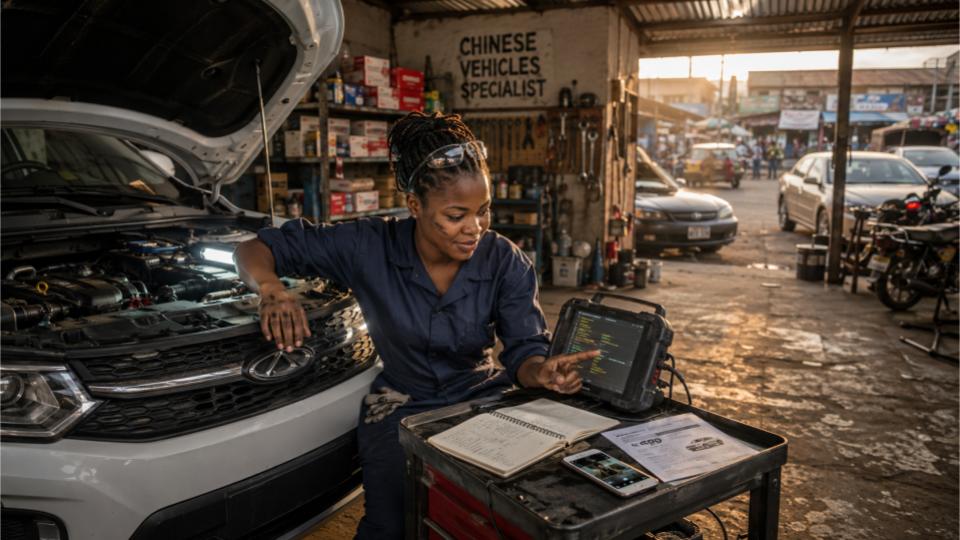
While Nigerians are busy complaining about Chinese vehicles, a quiet group of mechanics, engineers, and entrepreneurs are building serious income from the exact same cars everyone else is dismissing.
Chukwudi owns a mechanic workshop in the Nnewi axis of Anambra State. Three years ago, a customer drove in with a Chery Tiggo that had developed a strange electrical fault. Every mechanic on the strip turned the car away. Not because the problem was unfixable. Because nobody on the strip had bothered to learn the electrical architecture of Chinese vehicles. Chukwudi did not turn the car away. He had spent four months the previous year studying Chinese vehicle diagnostics using a combination of YouTube, a used laptop, and a OBD scanner he bought from Computer Village in Lagos for twenty-two thousand naira. He fixed the Tiggo in two days and charged forty-five thousand naira for the job. Word spread. Today, Chinese vehicle repairs account for nearly sixty percent of his monthly revenue. His workshop is the only one on the strip that does not turn away Chinese car owners. He has not had a slow month in two years.
There is a conversation happening in Nigerian social media, in Lagos traffic, and in mechanic workshops across the country that goes something like this: Chinese cars are cheap and unreliable. They break down too easily. Spare parts are impossible to find. You cannot trust them. This conversation is understandable. Some of it is even partially true, especially for the lower-end models that flooded the market in the early years before Chinese manufacturers began taking quality seriously. But the conversation misses something important. Something that is currently making money for the Nigerians who are paying attention.
The number of Chinese vehicles on Nigerian roads has grown dramatically over the past six years. The growth is not slowing down. Chinese cars are cheaper to acquire than their Japanese and European counterparts, and in an economy where purchasing power has been squeezed by naira depreciation and inflation, affordability wins. Brands like Chery, BYD, Haval, JAC, Innoson, Lifan, Geely, and BAIC have moved from being rare sights to common presences on Nigerian roads in Lagos, Abuja, Port Harcourt, Owerri, and beyond.
Every single one of those vehicles will need repairs at some point. Most of them will need repairs more than once. The pool of mechanics, technicians, and parts dealers who are properly equipped to service them is a fraction of the demand that exists. That gap, between the volume of Chinese vehicles needing service and the number of qualified people who can provide that service, is the goldmine this article is about.
ⓘ Important context before you continueThis article is not a claim that Chinese vehicles are superior to Japanese or European alternatives, nor is it investment or financial advice. It is a practical, honest examination of a real market gap in Nigeria’s automotive sector and the income opportunity it creates for Nigerians who develop specialised skills to serve it. Income figures mentioned are drawn from reported experiences and represent individual outcomes that will vary depending on location, skill level, effort, the specific niche chosen, and market conditions. Always conduct your own research before making any business or training investment decisions.
WHY THIS IS A GENUINE GOLDMINE AND NOT JUST HYPE
Let us be specific about what makes this opportunity real rather than theoretical, because Nigeria has no shortage of people telling other people about golden opportunities that turn out to be neither golden nor opportunities.
The first reason is simple supply and demand mathematics. The supply of mechanics who can work confidently on Chinese vehicles is very small. The demand from Chinese vehicle owners who need reliable service is growing every month. When supply is low and demand is high, the people who can fill the gap charge more, get repeat customers, and build waiting lists. Chukwudi is not the only mechanic in Nigeria experiencing this dynamic. It is playing out in different forms across every major city.
The second reason is specificity of knowledge. Chinese vehicles, particularly the newer models from 2020 onwards, have sophisticated electronic systems that require proper diagnostic tools and manufacturer-specific knowledge to service correctly. A mechanic who learned on Tokunbo Toyota Corollas and Honda Civics has a completely different knowledge base from what a Chery Tiggo or a BYD Dolphin requires. This creates a natural barrier to entry that protects the income of those who invest in learning it. It is much easier for a new mechanic to compete in the Toyota and Honda space, where knowledge is everywhere, than to compete in the Chinese vehicle diagnostic space, where genuine expertise is scarce.
The third reason is parts supply. This is actually an advantage in disguise, despite what most Nigerians assume. Because Chinese vehicle parts are not yet as widely distributed as Japanese parts, the traders and dealers who establish themselves in Chinese automotive parts early are building a business with low current competition and growing future demand. Several Nigerian traders who began importing Chinese vehicle parts two to three years ago are now running the most profitable auto parts operations in their cities, not because they are exceptionally talented traders but because they moved into a space before the crowd arrived.
The fourth reason is the trajectory of Chinese automotive quality. The early wave of Chinese vehicles that gave them a poor reputation in Nigeria were genuinely inferior products. That gap has been closing rapidly. The Chery Tiggo 7 Pro, the Haval Jolion, the BYD Atto 3, and several other current Chinese models are competitive with mid-range Japanese offerings on quality and features while still being significantly more affordable. As this reality becomes more widely understood, the volume of Chinese vehicles on Nigerian roads will increase further. The mechanics and technicians who are building their expertise now are positioning themselves ahead of a curve that is still building.
✔ The specific gap nobody is talking aboutElectric and hybrid Chinese vehicles are beginning to enter the Nigerian market in small numbers. BYD, which is now the world’s largest electric vehicle manufacturer, has been exploring the Nigerian market alongside several other Chinese EV brands. The mechanics who understand electric vehicle diagnosis, battery management systems, and EV-specific safety protocols in Nigeria currently number in the dozens. When EV adoption increases, as it inevitably will as charging infrastructure develops and purchase prices fall, those few dozen will become extraordinarily valuable. Learning EV fundamentals alongside conventional Chinese vehicle repair right now is the long-term version of the same opportunity.
FOUR NIGERIANS WHO STOPPED COMPLAINING AND STARTED EARNING
Chukwudi’s story opened this article and it is worth examining in more detail because the specific decisions he made contain a clear pattern. He did not enrol in an expensive formal training programme. He did not travel abroad to learn. He bought a quality OBD2 scanner compatible with Chinese vehicles, paid for internet data, and spent four months watching every Chinese vehicle diagnostics tutorial he could find, taking notes in a physical notebook, and practising on cars that workshop customers brought in with his supervisor’s permission before he branched out on his own.
The key decision was the OBD scanner. Many Nigerian mechanics avoid this purchase because it feels expensive at the point of buying. A decent scanner capable of reading Chinese vehicle fault codes runs between forty-five thousand and one hundred and twenty thousand naira depending on the brand and capability. Chukwudi calculated that a single diagnostic job that his competitors could not do would recover the scanner cost within two to three jobs. He was right. The scanner paid for itself within the first month.
Today his workshop employs three additional technicians, all of whom he has trained in Chinese vehicle diagnostics himself. He has turned away larger workshop space twice because the current location is sufficient for the volume of work he can comfortably manage at his current team size.
Aisha was running a small general auto parts stall in the Kano spare parts market when she noticed a pattern that her male colleagues had dismissed as a problem: Chinese car owners kept coming into the market and leaving empty-handed because the parts they needed were not in stock anywhere. Her colleagues saw the difficulty of sourcing Chinese parts as a reason to avoid the niche. Aisha saw it as a reason to own it.
She began researching Chinese automotive parts importation, made contact with a freight forwarding agent who was already handling small general imports from China, and placed a modest first order of commonly needed parts for the three Chinese vehicle models she had seen most frequently in the market: Chery, JAC, and Haval. The order took six weeks to arrive. Three of the seven parts she ordered sold within two days of displaying them. The other four sold within the following two weeks.
Three years later, Aisha’s stall has expanded to three adjacent spaces in the market. She has a small catalogue of over two hundred Chinese vehicle part numbers that she can source on order. She has become the person that other mechanics in Kano call when they need a Chinese vehicle part they cannot find locally, and she charges accordingly for the service. Her most profitable months are the ones when a Chinese vehicle model becomes popular in the city and the first wave of repairs begins hitting workshops, because she is the only supplier who has the parts in stock.
Emeka’s entry into Chinese vehicle diagnostics came from a different angle. He had been working as an electrical technician for an electronics repair shop in Lagos Island when a friend suggested he look at automotive diagnostics as a way to earn more. He spent six months learning automotive electrical systems through online resources and a short practical attachment at a mechanic workshop in Trade Fair Complex. He focused specifically on Chinese vehicles from the beginning, reasoning that the competition was lower and the curiosity factor of being one of the few people who could diagnose them would work in his favour.
Rather than opening a fixed workshop, which would have required capital he did not have, Emeka built a mobile service model. He invested in a quality diagnostic scanner, a basic set of electrical tools, and a simple online presence through WhatsApp Business and Instagram. When a Chinese car owner on Lagos Island has a diagnostic or electrical issue, Emeka comes to them. He charges a fixed call-out fee plus the diagnostic or repair fee.
The mobile model has two advantages that a fixed workshop does not. The first is the dramatically lower overhead cost. The second is the radius of service he can cover. He works across Lagos Island, Victoria Island, and Ikoyi, areas with higher concentrations of newer Chinese vehicles among residents who value the convenience of a technician who comes to them. His monthly income has been consistently above three hundred thousand naira for the past fourteen months.
Fatima’s path is the most unexpected of the four and possibly the most instructive. She had worked in automotive training for five years, teaching conventional vehicle mechanics at a vocational training centre in Abuja, when she realised that her curriculum had nothing specific to say about Chinese vehicles despite the fact that her students were increasingly encountering them in the jobs they took after graduation.
She spent eight months developing a twelve-week curriculum specifically on Chinese vehicle maintenance and diagnostics, drawing on manufacturer documentation, online resources, and a partnership with a Chinese vehicle dealer in Abuja who allowed her students to use vehicles for practical sessions in exchange for discounted rates on minor servicing. She began running the programme as weekend cohorts from a rented space near the main auto market in Abuja.
Demand for the training has been consistent. She runs two cohorts of twelve students per quarter. Each student pays seventy five thousand naira for the twelve-week course. The programme now generates over one million naira per quarter in training revenue alone, not counting the consulting work she has begun taking from workshops that want their existing staff trained in Chinese vehicle systems. She has been approached by two state government vocational training programmes about partnering to include her curriculum in their offerings.
THE CHINESE BRANDS ON NIGERIAN ROADS AND WHAT EACH ONE NEEDS
Understanding which Chinese brands are actually present in significant numbers in Nigeria is important because it tells you where to focus your learning and your inventory. The brands below are not a complete list of every Chinese vehicle that has ever entered Nigeria. They are the ones currently present in meaningful enough numbers to generate consistent repair demand.
One of the longest-established Chinese brands in Nigeria, with the Tiggo SUV range being the most common model. Chery vehicles are known for their turbocharged engines and sophisticated infotainment systems. Electrical faults and turbocharger-related issues are the most common service needs. Parts supply has improved significantly in recent years.
JAC has both passenger vehicle and commercial vehicle presence in Nigeria, including pickup trucks and light commercial vehicles that are used in business and agriculture. The commercial vehicle segment creates a specific and consistent repair demand, because business owners cannot afford downtime and will pay promptly for fast, reliable service.
Great Wall Motors, operating under the Haval brand in Nigeria, produces some of the most mechanically sophisticated Chinese SUVs available. The Haval Jolion and H6 have a growing owner base among middle-class Nigerians in Lagos and Abuja. These vehicles have advanced driver assistance systems that require specialist calibration knowledge to service correctly.
BYD is the future-facing opportunity in this entire space. As the world’s leading electric vehicle manufacturer, BYD’s increasing Nigerian presence represents the early stage of an EV market that will need technicians who understand battery management systems, electric drivetrains, and charging infrastructure. Learning BYD systems now is positioning for a market that is not yet here but is coming.
WHAT THE INCOME ACTUALLY LOOKS LIKE
Income in the Chinese vehicle service space varies significantly depending on the specific niche, the city, the quality of the technician’s skills, and how well they market their services. The table below gives directional ranges based on reported outcomes from Nigerian technicians and traders in this space. These are not guaranteed earnings. They are realistic benchmarks based on what Nigerians who have committed to this niche are currently achieving.
△ A note on the income rangesThe ranges in the table above are directional estimates based on reported outcomes from Nigerian professionals in this space. Actual income depends heavily on the quality of your skill, your reputation in your local market, the specific city and neighbourhood you serve, your ability to communicate your value to potential clients, and the effort you consistently put into building and maintaining client relationships. The advanced figures represent what is achievable by someone who has spent two to three years building genuine expertise and a strong local reputation. They are not starting point figures.
The Nigerians complaining about Chinese cars and the Nigerians making money from Chinese cars are looking at the same vehicle. One sees a problem. The other sees a CLIENT.
HOW TO ACTUALLY LEARN CHINESE VEHICLE REPAIR IN NIGERIA
The most common question Nigerian mechanics and aspiring technicians ask when they learn about this opportunity is: where do I train? The honest answer is that the formal training infrastructure is still being built in Nigeria, which is both a challenge and an opportunity. The challenge is that you cannot simply enrol at a well-established institution that teaches Chinese vehicle systems in the same way you might enrol to learn conventional mechanics. The opportunity is that the knowledge gap means the person who figures out how to learn it becomes the person who teaches it, and teaching it is one of the most profitable positions in the whole ecosystem.
-
Online Learning Combined With Hands-On Practice
The most accessible starting point. YouTube has a growing library of Chinese vehicle diagnostic and repair tutorials, both in English and with English subtitles. Channels from Chinese mechanics, international automotive technicians, and a growing number of Nigerian mechanics who have documented their own learning process are all useful resources. The key is that online learning must be combined with hands-on practice on real vehicles. Find a mechanic workshop that services Chinese vehicles and offer to work there informally for two to three months to practice what you are learning digitally. Most workshop owners will accept this arrangement if you are genuinely useful and not disruptive.
-
Authorised Dealership Attachment
Several Chinese vehicle brands operating in Nigeria have authorised dealerships that maintain service centres. Approaching these dealerships for a formal or informal attachment is one of the most direct ways to access manufacturer-specific training and documentation. The quality of training available through dealership attachments varies by brand and by the specific dealership, but the exposure to real vehicles under manufacturer protocols is invaluable. Brands like Chery, Haval, and JAC all have authorised Nigerian dealerships with service departments. A letter of introduction explaining your background and your specific learning goals is the best way to approach them.
-
Invest in a Quality Diagnostic Scanner Early
A diagnostic scanner that is compatible with Chinese vehicle OBD systems is not just a tool. It is a learning device. When you connect a scanner to a vehicle and read the fault codes, you are learning the vehicle’s electrical architecture through direct experience rather than through theory. Scanners that support Chinese vehicle protocols include the Launch X431 range, the Autel MaxiSys range, and several other professional-grade units available from automotive equipment suppliers in Lagos, Kano, and Abuja. Budget between sixty thousand and one hundred and fifty thousand naira for a capable unit. The investment is recovered quickly on diagnostic jobs that competitors without the scanner cannot take.
-
Structured Training Programmes From Emerging Specialists
Fatima’s story in this article is one example of how structured training in Chinese vehicle systems is beginning to develop in Nigeria. Several other training providers in Lagos, Abuja, and Port Harcourt are offering short courses and bootcamps in Chinese vehicle diagnostics. The quality varies, so ask to speak to previous graduates before enrolling, ask to see the curriculum in detail, and confirm that the training includes substantial hands-on time with actual vehicles rather than being primarily theoretical. Word of mouth within the mechanic community is the most reliable guide to which training providers are worth the investment.
-
Specialise in One Brand First, Then Expand
The mistake many beginners make is trying to learn everything about all Chinese vehicles at once. This produces shallow knowledge across a wide area rather than deep knowledge in a specific area. Choose the Chinese brand that is most common in your specific city or neighbourhood and become genuinely expert in that brand first. Know its common fault patterns, know its part numbers, know its diagnostic codes, know its service intervals. Once you have that depth on one brand, expanding to a second brand is significantly faster because the foundational knowledge transfers. Chukwudi started with Chery specifically because it was the brand he saw most often in his area. His expertise in Chery opened the door to referrals for other Chinese brands.
YOUR PRACTICAL STARTING POINT THIS WEEK
The patterns across all four stories in this article are consistent enough to be distilled into a practical starting framework. Every one of them started with a specific first action rather than a comprehensive plan. Chukwudi bought a scanner. Aisha placed a first order. Emeka built a WhatsApp Business profile. Fatima wrote a curriculum. The first action was small enough to be taken immediately and specific enough to produce something real. Here is your equivalent.
YOUR FIRST 30 DAYS: ACTION PLAN
ⓘ Before you invest significant money: do your local research firstEvery Nigerian city has a different mix of Chinese vehicles on its roads. The opportunity described in this article is real, but its specific shape in your city depends on which brands are present in what numbers, which workshops are already serving them, and which parts are most commonly needed. Spend time talking to Chinese vehicle owners and mechanics in your specific area before making any significant financial investment. The pattern of opportunity is consistent across Nigeria. The specific details of where the gaps are differ from city to city and will determine which niche makes most sense for your situation.
THE CARS ARE ALREADY ON THE ROAD. THE QUESTION IS WHETHER YOU ARE READY TO SERVICE THEM.
Chukwudi is not waiting for Nigerian roads to fill with Chinese vehicles. They already have. Aisha is not waiting for demand for Chinese parts to develop. It already has. Emeka is not waiting for Lagos Island residents to start driving Chinese cars. They already do. Fatima is not waiting for mechanics to want training in Chinese vehicle systems. They already do.
The goldmine in Chinese cars is not a future opportunity. It is a present one that is being missed by most Nigerians because the cultural narrative around Chinese vehicles is still dominated by the early-years complaints rather than the current-years reality. Every week that passes, more Chinese vehicles drive onto Nigerian roads. Every week that passes, the gap between the demand for qualified service and the supply of qualified technicians either stays the same or grows. The Nigerians who move now are the ones who will own this space when the mainstream finally catches up.
Stop looking at Chinese cars as someone else’s problem. Start looking at them as your next client.
Frequently Asked Questions (FAQs)
Why are Chinese cars becoming popular in Nigeria?
Chinese cars are becoming more common in Nigeria because they are generally more affordable than Japanese and European vehicles while offering modern features, attractive designs, and improved technology. As inflation and naira depreciation reduce purchasing power, many Nigerians are choosing more affordable vehicle options.
Is there really money in repairing Chinese vehicles in Nigeria?
Yes. The number of Chinese vehicles on Nigerian roads is increasing faster than the number of mechanics who can properly repair them. This gap creates a strong business opportunity for technicians, diagnostics specialists, parts dealers, and trainers who develop expertise in Chinese vehicles.
Which Chinese car brands are most common in Nigeria?
Some of the most visible Chinese brands in Nigeria include:
- Chery
- BYD
- Haval (GWM)
- JAC Motors
- Geely
- BAIC
- Lifan
- Innoson
These brands are becoming increasingly common in cities like Lagos, Abuja, Port Harcourt, Kano, and Owerri.
Do Chinese cars break down more often than Japanese cars?
Older Chinese vehicle models had reliability issues, which contributed to their poor reputation in Nigeria. However, many newer models have improved significantly in quality, technology, and durability. Like all vehicles, proper maintenance and access to qualified technicians are important.
How can someone learn Chinese vehicle repair in Nigeria?
There are several ways to start learning:
- Watching online tutorials on YouTube
- Working with workshops that service Chinese vehicles
- Training with authorised dealerships
- Buying and learning to use diagnostic scanners
- Joining practical automotive bootcamps and vocational programmes
Hands-on experience is especially important.
What tools are needed to start Chinese vehicle diagnostics?
One of the most important tools is a quality OBD diagnostic scanner compatible with Chinese vehicles. Mechanics also need:
- Basic electrical repair tools
- A laptop or tablet
- Internet access for software updates and research
- Manufacturer-specific diagnostic knowledge
Can someone make money selling Chinese car parts in Nigeria?
Yes. Chinese vehicle parts are still less available than Japanese parts in many Nigerian markets. Traders who can reliably source and stock these parts often face less competition and growing demand from workshops and vehicle owners.
What is the future of Chinese electric vehicles (EVs) in Nigeria?
Chinese EV brands like BYD are gradually entering the Nigerian market. While adoption is still early, experts expect EV demand to grow over time as charging infrastructure improves. Technicians who learn EV systems now may have a major advantage in the future.
How much can a Chinese vehicle specialist earn in Nigeria?
Income varies depending on skill level, location, and niche. According to examples in the article:
- Entry-level technicians may earn between ₦80K and ₦150K monthly
- Established specialists can earn ₦300K to ₦800K+ monthly
- Parts dealers and trainers may earn even more depending on demand and reputation
These are not guaranteed figures and depend on experience and market conditions.
What is the biggest advantage of entering this niche early?
The biggest advantage is low competition. Many Nigerian mechanics still avoid Chinese vehicles because they lack the knowledge or tools to service them. Early learners can build strong reputations, loyal customers, and long-term income before the market becomes crowded.

1 Comment
Humm, wow wow