

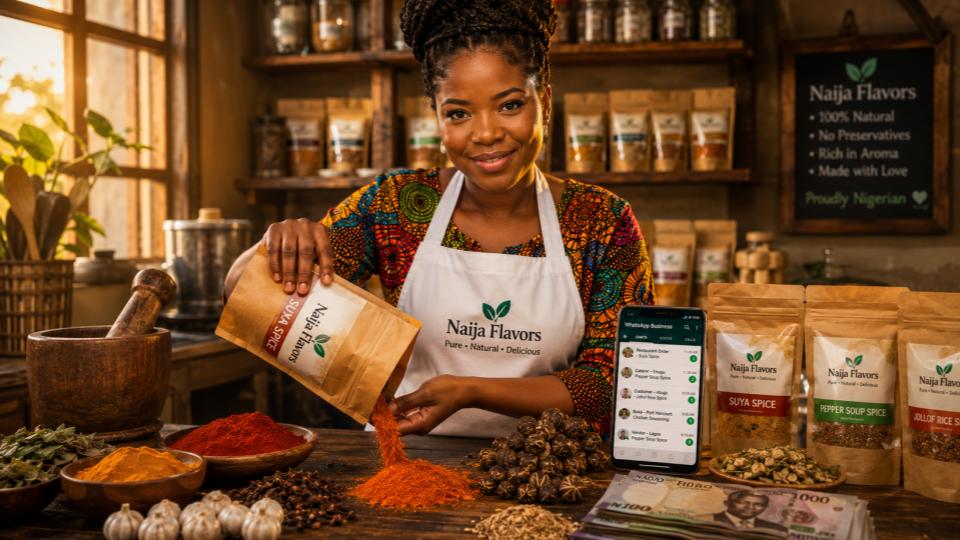
This is the most complete guide to starting and growing a cooking spice business in Nigeria available in 2026. You will find detailed information on the most profitable spices, how much capital you actually need at each stage, how to brand and package products that sell, how NAFDAC registration works and when you need it, how to sell online, how much you can realistically earn, and how to build a spice business that lasts. Whether you are starting with twenty thousand naira from home or planning a larger commercial operation, this guide has the specific information you need.
Why This Business Is Hiding in Plain Sight
There is a woman in Surulere, Lagos, who started grinding and packaging pepper soup spice from her kitchen in 2021. She had seven thousand naira, a home blender, some small nylon bags, and a printed paper label she designed herself. She sold her first batches through WhatsApp status to contacts who knew her cooking was good. By 2023 she was supplying four restaurants and a caterer. By early 2026 her monthly revenue crossed three hundred thousand naira. She has two part time staff now and a commercial blender. She has never taken a business loan.
That story is not exceptional. Versions of it are playing out across Lagos, Abuja, Aba, Kano, Enugu, and dozens of other Nigerian cities, and most people walking past the opportunity never see it because it looks too simple. Spices. Something people have bought in markets for centuries. Something your grandmother sold by the handful wrapped in old newspaper. How could that possibly be a serious business in 2026?
The answer is that the business has changed, even if the product has not. The infrastructure for reaching customers is different. The packaging possibilities are different. The branding potential is different. And the scale of the market, powered by a population of over 220 million people, a massive food vendor culture, and an exploding online food content ecosystem, is larger and more accessible than it has ever been.
The cooking spice business in Nigeria is genuinely one of the best opportunities for someone starting with limited capital right now. That is not a motivational claim. It is a business argument supported by the specific economics of consumable goods sold into a market with daily, non negotiable demand. Let this guide prove it to you with numbers and specifics rather than just enthusiasm.
The True Size of Nigeria’s Spice Market in 2026
Most people who think about the spice business imagine a woman selling small packets at a market stall. That image is real but it captures only the smallest fraction of the actual market. To understand the real size of the opportunity, you need to think about every single place in Nigeria where food is prepared professionally or commercially.
Start with restaurants. Lagos alone has an estimated thirty thousand registered and informal restaurants, from fine dining in Victoria Island to roadside bukas in Mushin. Every single one of them buys spices and seasoning regularly, typically weekly or biweekly, and in volumes that dwarf what any household buys. A medium sized buka in Lagos goes through roughly ten to twenty thousand naira worth of spices per month. A larger restaurant can spend fifty thousand naira monthly on seasoning alone.
Now add the catering industry. Nigerian weddings, burials, birthdays, and owambes are among the most food intensive social events in the world. A single medium sized wedding in Lagos can feed five hundred people, requiring commercial quantities of spices for jollof rice, chicken, goat meat, puff puff, fried rice, and dozens of other dishes. Nigeria hosts millions of such events annually.
Then add the street food economy. Suya sellers, akara sellers, bole and fish vendors, pepper soup joints, mama put operators, and small chops businesses all purchase spices consistently. The street food economy in Nigeria feeds tens of millions of people daily and operates on thin margins where the quality of seasoning directly determines customer loyalty and repeat business.
Finally, consider households. With rising food prices pushing more Nigerians to cook at home rather than eat out, domestic spice consumption has grown significantly since 2023. Home cooks who want restaurant quality flavor in their jollof rice and pepper soup are increasingly willing to pay for premium blended spice mixes rather than buying raw ingredients separately.
“The spice market in Nigeria is not small and fragmented. It is enormous and surprisingly underserved at the premium branded end. Most of what Nigerians buy is generic, unbranded, and inconsistent in quality. That gap is where a smart small business owner can build genuine competitive advantage.”
The Most Profitable Spices to Sell in Nigeria
Understanding which spices to focus on is one of the most important decisions you will make when starting this business. Not all spices have the same margin, the same demand consistency, or the same competitive landscape. Here is a detailed breakdown of the categories with the strongest commercial case for a Nigerian entrepreneur in 2026.
Suya Spice (Yaji)
One of the most consistently high demand spices in Nigeria. Every suya seller needs it. Home cooks buy it for grilling and marinades. The recipe varies by region, which creates space for local product identity and brand differentiation.
Very High Demand
Pepper Soup Spice
A uniquely Nigerian blend combining uda, ehuru, uziza, and other local spices. Almost impossible to replicate correctly without the right formula. Restaurants and home cooks who find a reliable blend become loyal customers for years.
Very High Demand
Jollof Spice Blend
A relatively new product category that has grown with social media food culture. A well formulated jollof spice mix that consistently delivers rich, smoky flavor commands premium pricing and generates intense customer loyalty.
High Demand, Growing Fast
Garlic and Ginger Powder
Daily use staples that nearly every Nigerian kitchen buys consistently. The convenience factor over fresh garlic and ginger is strong. Margin on properly dried and packaged garlic and ginger powder is excellent given the low processing cost.
Steady Daily Demand
Curry and Thyme
The most universal Nigerian kitchen spices. Demand is constant and predictable across all income brackets. Margin is thinner than blended spices but volume makes up for it. Strong entry point for beginners due to easy sourcing.
Consistent Volume Seller
Chicken and Meat Seasoning
The branded homemade equivalent of Maggi or Knorr, but positioned as natural, preservative free, and more flavorful. This is the highest value opportunity in the entire category because the margin between raw materials and a branded product is enormous.
Premium Pricing Opportunity
Traditional Local Spices
Dawadawa, uziza, ehuru, uda, ogiri, and other indigenous spices are used heavily in traditional Nigerian cooking and are increasingly popular among diaspora buyers. Less competition, strong cultural identity, and export potential make this an underexplored opportunity.
Export Potential
Shawarma and Barbecue Spice
The growth of fast food and street food culture in Nigerian cities has created strong demand for these blends. Every shawarma joint and BBQ stand needs consistent seasoning. A reliable supplier relationship with these businesses creates recurring wholesale income.
Growing Urban Market
Who Your Customers Actually Are and What They Need
One of the most important shifts in thinking for anyone starting a spice business is moving away from imagining a single type of customer and recognizing that the market has several distinct segments with different needs, different buying patterns, and different price sensitivities. Serving even one of these segments well is enough to build a sustainable business. Serving two or three creates something genuinely scalable.
Household Buyers
This is the most numerous customer segment but not necessarily the most profitable per transaction. Household buyers purchase in small quantities, often weekly, and are sensitive to price. They become your best marketing asset when they love your product because word of mouth in Nigerian communities, particularly among women who share cooking tips, is extraordinarily powerful. A household customer who becomes an evangelist for your brand will bring you more customers than any advertisement. The key to winning this segment is consistency of flavor, attractive packaging that fits in a kitchen cupboard, and a price point that makes your branded product feel like a reasonable premium over the generic market alternative.
Restaurant and Buka Operators
These are your highest value repeat customers. A restaurant that sources spices from you monthly becomes a reliable income stream that requires almost no ongoing sales effort once the relationship is established. The critical factor for winning restaurant clients is not price. It is consistency. A chef who builds their signature jollof or pepper soup around your spice blend is investing their reputation in your product. If your blend changes because you switched a supplier or adjusted your formula, their customers notice and they lose business. The restaurant owner who learns this about you once will find another supplier immediately and never return. Winning restaurant clients is about being absolutely consistent and reliably available, not about being the cheapest option.
Caterers and Event Food Businesses
Nigerian caterers operate in large volume bursts around events. They may buy almost nothing from you for three weeks and then place an order for twenty packs of suya spice and fifteen bags of pepper soup blend in a single purchase. The relationship requires patience and availability. Caterers who trust your quality will call you reliably before every major event, and a single caterer working one wedding per weekend is a meaningful wholesale client for a small spice business.
Online Buyers and Diaspora Customers
This is the fastest growing segment and the one with the highest willingness to pay premium prices. Nigerians in the United Kingdom, United States, Canada, and Europe who want authentic pepper soup spice or genuine suya yaji cannot easily find quality versions locally. They are accustomed to paying London or New York prices for everything. A fifty gram pack of genuine Nigerian pepper soup spice that you sell for eight hundred naira domestically can realistically sell for the equivalent of three to four thousand naira when exported, not because you are overcharging but because the customer values authenticity and availability above price.
Startup Capital: An Honest and Detailed Breakdown
One of the most common pieces of discouraging advice given to aspiring food business owners in Nigeria is that you need a lot of money before you can start properly. That is not true for the spice business, and the numbers below will show you exactly why. What matters is understanding which stage of investment corresponds to which level of business operation, and being honest about what each stage can and cannot achieve.
₦20K – ₦50K Home Starter
Practical Advice on CapitalThe most common mistake new spice business owners make is spending too much of their startup capital on packaging and branding before they have validated that people actually love their product. Test your formulas first. Give samples to ten people and collect honest feedback. Adjust until the flavor is genuinely excellent. Only then invest in professional packaging. Beautiful packaging on a mediocre product will generate one purchase. Excellent flavor in basic packaging will generate ten repeat purchases. Get the product right before you get the presentation right.
Five Ways to Generate Income from Spices
The spice business is not a single income model. It is a category that contains at least five distinct revenue streams, each with different capital requirements, different customer relationships, and different growth ceilings. Understanding all five lets you make intentional decisions about which combination suits your resources and ambitions.
Direct Retail to End Consumers
Selling directly to households and individuals is the starting point for most spice businesses and remains a core revenue stream even as businesses grow. The margin on direct retail is the highest of all channels because there are no intermediaries taking a percentage. A spice blend that costs you two hundred naira to produce and package can retail directly for eight hundred naira. That four hundred percent markup disappears quickly when you start selling through middlemen. The limitation of direct retail is the time and energy required to maintain the customer relationships and fulfillment process. At high volumes it becomes operationally demanding without staff support.
Wholesale Supply to Food Businesses
Selling in bulk to restaurants, bukas, caterers, and event food businesses sacrifices margin for volume and consistency. A restaurant buying twenty packs per month at a discounted price is less profitable per unit than selling those packs individually, but the predictability of the income and the low sales effort required after the initial relationship is established make wholesale a crucial stabilizing revenue stream. Aim to build a wholesale client base that covers your fixed monthly costs, then use your retail and online sales for growth income on top of that foundation.
Branded Packaged Products for Retail Shelves
This is the highest potential revenue model but also the most demanding in terms of investment, compliance, and relationship building. Getting your spice brand onto supermarket shelves in Shoprite, Spar, or even smaller chain stores requires NAFDAC registration, consistent product quality across large batches, competitive pricing that still leaves margin after the retailer’s cut, and often a listing fee or promotional spend to get shelf space. The payoff is access to thousands of customers you could never reach individually. The path there is gradual and requires building a track record at smaller retail points first before approaching major chains.
Online Sales Through Digital Channels
The online market for Nigerian spices is genuinely underexplored and growing faster than any other channel. Selling through WhatsApp Business, Instagram, TikTok, and Jiji requires almost no infrastructure investment beyond a phone and good photos or videos. The key is creating content that demonstrates the value of your product rather than simply advertising it. A thirty second video showing the aroma, texture, and cooking result of your pepper soup spice blend will generate more orders than a week of generic promotional posts. Online sales also open the door to nationwide delivery and the diaspora market, both of which are covered in detail later in this guide.
Training and Knowledge Products
This is the income stream most spice business owners never consider. If you develop genuine expertise in spice blending, sourcing, branding, and selling, that knowledge has value to others who want to start similar businesses. Running workshops, creating online courses, or offering consultancy for aspiring spice entrepreneurs is a real income stream that leverages the expertise you build through your own business journey. Several Nigerian food entrepreneurs have built secondary income streams worth hundreds of thousands of naira monthly purely from teaching others what they know. The credibility comes from operating a real business, not from claiming expertise without evidence.
How to Start Your Spice Business: A Genuine Step by Step Guide
1. Spend Two Weeks Doing Nothing but Research
Before buying a single gram of spice, spend serious time understanding the market you are entering. Visit spice sellers at Mile 12, Oyingbo, Wuse Market, or your local equivalent. Buy from five different sellers of the same spice and compare quality, packaging, and pricing. Eat at restaurants and pay attention to their seasoning. Ask food business owners what spice problems they face with current suppliers. Talk to home cooks about what they wish spice products did better. This research phase is not optional preliminary work. It is the foundation that will save you from expensive mistakes and help you identify the specific gap your business can fill that nobody else is filling well.
2. Develop and Test Your Formula Until It Is Genuinely Outstanding
The core of a spice business is not the packaging or the marketing. It is the flavor. Your formula is your competitive moat. A pepper soup spice that makes the best pepper soup anyone who tastes it has ever eaten will market itself through the testimonials of everyone who uses it. A mediocre formula with excellent packaging generates one time sales followed by customer disappointment. Take time to develop your recipes properly. Study traditional formulas, experiment with ratios, and taste your products against the best versions available in the market. Get feedback from at least twenty people with different palates before you settle on a formula. Document every ingredient and proportion carefully so your product is consistent from batch to batch.
3. Build a Brand Identity That Communicates Value
Your brand is not just your logo. It is the complete impression your product creates before someone tastes it. A strong brand name, a consistent color scheme, clean typography, and clear messaging about what makes your spice different all work together to communicate that your product is worth its price. Many Nigerian small food businesses skip this step and wonder why customers always negotiate on price. Premium packaging and consistent branding reduce price negotiation because the customer’s perception of value is established before they even open the product. You do not need to spend a fortune on this. A thoughtfully designed label printed professionally costs far less than most people assume and makes a dramatic difference to how your product is perceived.
4. Source Consistently from Reliable Suppliers
The quality of your finished spice product is entirely dependent on the quality of your raw materials. Finding a reliable supplier who provides consistent quality across multiple orders is one of the most important and underappreciated aspects of running a spice business. Many small business owners source from whoever has the cheapest price on any given day. This creates inconsistency in their product that customers detect, often without being able to articulate why one batch tasted different from another. Build relationships with two or three suppliers whose quality you have verified and pay slightly more for consistency rather than optimizing purely for the lowest price. Your reputation depends on every batch being as good as the last one.
5. Start Selling Before You Feel Ready
There is a common trap in new business preparation where the search for perfect conditions prevents any actual selling from happening. Your packaging is not perfect yet. Your website is not built. Your NAFDAC registration is pending. Meanwhile no revenue is coming in and your confidence is gradually draining. Start selling with whatever you have as soon as your product quality is genuinely good. Your first fifty customers will teach you more about your business than six months of additional preparation. Real market feedback improves your product, your packaging, and your marketing faster than any amount of planning in isolation.
6. Build Systems for Consistency as You Grow
The most common point of failure for small Nigerian spice businesses that achieve initial success is the transition from a single person operation to a small team. When the founder is doing everything personally, quality is naturally consistent because the same hands and the same attention go into every batch. When other people start helping with production, that personal quality control disappears unless you have documented your formulas, your processes, your sourcing standards, and your packaging procedures in writing. Build these systems early, even before you need them, so that growth does not destroy the quality that created your customer base.
Packaging and Branding That Actually Sells
In a market where identical or near identical spices are sold by dozens of vendors, packaging is the primary differentiator at the point of purchase. This is not about vanity. It is about the psychology of value perception and the practical reality that a customer who cannot taste your product before buying will form their purchase decision based entirely on what they can see.
The packaging formats that work best for Nigerian spice businesses in 2026 fall into a few categories. Small standing pouches with clear front windows that let the customer see the color and texture of the spice inside are the most effective retail format. They stack neatly, they look professional, they are resealable for convenience, and the clear window creates an appetite appeal that opaque packaging cannot. Glass jars with branded lids command the highest price points but require more investment and create fragility and weight challenges for online orders. Flat seal pouches are the most cost effective option for volume production and work well for customers who prioritize price over premium presentation.
Labels deserve particular attention. A label that looks like it was designed properly, with a clean font, a consistent color palette, clear product description, weight, ingredients list, and contact information, communicates competence and trustworthiness to a buyer who has never encountered your brand. A label that looks rushed or amateurish undermines the quality of even an excellent product. The cost of professional label design in Nigeria ranges from five thousand to twenty thousand naira for a designer who knows what they are doing. That is money that pays for itself in the first week of sales through higher conversion rates and reduced price negotiation.
Where to Buy Spices in Nigeria: A City by City Guide
Mile 12 Market for the largest variety and most competitive bulk pricing. Oyingbo Market for local spices and traditional ingredients. Mushin Market for high volume wholesale. Balogun Market for imported seasonings and packaging materials.
Singer Market and Kantin Kwari are the dominant wholesale markets. Kano has some of the best pricing in Nigeria for northern spices including ground uda, cloves, and ginger, making it an important sourcing point even for businesses based in the south.
Wuse Market and Garki Market are the primary options. Prices tend to be higher than Lagos or Kano but quality is generally reliable for common kitchen spices. The high income consumer base in Abuja justifies premium pricing that other cities may not support.
Ochanja Market is one of the largest trading markets in West Africa and offers exceptional variety and pricing for southeastern spices. For businesses in Anambra, Imo, Enugu, or Abia, Onitsha sourcing significantly reduces raw material cost compared to sourcing locally.
Mile 1 and Mile 3 Markets are the primary sourcing locations. Especially strong for fresh pepper varieties and south south traditional spices including ofor and ogiri. Good for businesses targeting the Rivers State and surrounding market.
Bodija Market is one of the most important food commodity markets in southwestern Nigeria. Strong for dried pepper, locust beans, and Yoruba traditional seasoning ingredients. Pricing is competitive and quality is generally reliable for businesses in Oyo and neighboring states.
Sourcing Strategy For businesses that can manage the logistics, sourcing directly from origin states rather than metropolitan market middlemen reduces cost significantly. Ginger sourced directly from Kaduna or Nassarawa, where it is grown, costs a fraction of what the same ginger costs at Mile 12 in Lagos after multiple middlemen have taken their margins. Building supplier relationships in origin areas requires more initial effort but creates a sustainable cost advantage that becomes more valuable as your volume grows.
Marketing Strategies That Generate Real Sales
The Nigerian spice market does not suffer from a lack of supply. It suffers from a lack of marketing. Most spice sellers rely on proximity and habit rather than active promotion. A customer buys from whoever is closest and most familiar. Breaking into that pattern requires giving potential customers a reason to seek you out specifically rather than defaulting to whoever is nearest.
Food Content as Your Primary Marketing Engine
The most powerful marketing strategy for a spice business in Nigeria in 2026 is creating food content that demonstrates your product’s value in action. A video of jollof rice being cooked with your blend, showing the color developing, the aroma being described, and the final dish being tasted with genuine reaction, does something no text advertisement can do. It creates a sensory connection between your product and the desire for delicious food. You do not need a professional camera or studio setup. A phone with decent camera quality, good natural light, and genuine enthusiasm for the cooking process is enough. The authenticity of home cooking content often outperforms polished production in Nigerian social media contexts.
WhatsApp as a Sales Channel
WhatsApp remains the most important sales channel for small Nigerian food businesses, and most business owners significantly underuse it. Posting on your status daily with recipes, cooking tips, customer reviews, and product availability keeps your brand visible to your entire contact network at zero cost. A WhatsApp Business account with a catalog of your products, clear pricing, and automated greeting messages creates a professional impression that builds buyer confidence. Building a broadcast list of existing customers for occasional promotions and restocking announcements generates repeat purchases from people who already love your product.
Restaurant and Food Business Direct Outreach
Every restaurant owner in your city is a potential wholesale client. Approaching them directly with samples rather than a sales pitch is the most effective method. Bring enough of your blend for a chef to test in an actual meal. Do not describe your product. Let them taste the result. A chef who prepares your pepper soup spice blend and discovers that their kitchen crew immediately compliments the flavor is already three quarters of the way to being your customer. The conversation about price and volume is much easier after a demonstration than before one.
Selling Spices Online in 2026: Platforms and Strategies That Work
Online spice sales in Nigeria have moved well beyond experimental into genuinely mainstream for brands that invest in their digital presence. The platforms and approaches that are generating real revenue in 2026 each work somewhat differently and reward different types of content and engagement.
TikTok has become the most powerful discovery platform for Nigerian food brands. A single video showing the preparation of your suya spice blend, combined with the reaction of someone tasting suya made with it, can reach hundreds of thousands of Nigerians overnight if it captures authentic food enthusiasm. TikTok’s algorithm rewards content that generates genuine engagement rather than follower count, which means a brand new account with compelling food content can outperform an established account with generic promotional posts. The key is showing rather than selling. Give value in the form of recipes, tips, and behind the scenes production content and let the quality of your product sell itself through demonstration.
Instagram remains the strongest platform for building a curated brand identity that justifies premium pricing. High quality food photography, consistent aesthetic, and story based content about your brand’s origin and values create the kind of emotional connection that makes customers choose you over a cheaper alternative. Instagram shopping features allow product tagging directly in posts, reducing the friction between content discovery and purchase.
Jiji and Facebook Marketplace work well for reaching buyers who are actively searching rather than discovering. These are intent based platforms where someone who searches for pepper soup spice in Lagos is already ready to buy. A well photographed listing with clear pricing, customer reviews, and responsive communication converts at high rates because the work of creating demand has already been done by the buyer’s own search behavior.
NAFDAC Registration Explained: When You Need It and How to Get It
Everything You Need to Know About NAFDAC for Spice Businesses
The National Agency for Food and Drug Administration and Control requires registration for packaged food products sold to the public in Nigeria. For a spice business, this means that once you are selling branded, labeled, packaged spice products rather than loose unpackaged spices, NAFDAC registration becomes relevant and eventually necessary for serious commercial operation.
The practical reality for most small spice businesses starting out is that NAFDAC registration is not the first step. It is the step you take when your business has proven itself at a scale that justifies the investment and when you want to access retail channels like supermarkets that require it. Many successful Nigerian spice brands operated through direct sales, WhatsApp, and local markets for one to two years before formalizing their NAFDAC registration.
What NAFDAC registration requires for food products: A physical production facility that can be inspected, whether a dedicated production kitchen or a commercial facility. Documentation of your product formula, ingredients, and production process. Laboratory testing of your product for safety parameters including microbial counts and heavy metals. Application forms submitted through the NAFDAC SON portal with the relevant fees, which range from approximately fifteen thousand naira to one hundred thousand naira depending on product category and production scale.
How long it takes: The NAFDAC registration process for a straightforward packaged food product typically takes three to six months from complete application submission to certificate issuance. Incomplete applications extend this timeline significantly. Working with a NAFDAC consultant who specializes in food product registration saves time and reduces rejection risk for businesses going through the process for the first time.
What registration gets you: A NAFDAC registration number that appears on your product label, access to major supermarkets and formal retail chains that require it, the ability to export legally, significantly increased consumer confidence, and protection from counterfeiters who cannot legally reproduce your registered product.
Export Opportunities for Nigerian Spices
This is the part of the spice business story that most Nigerian entrepreneurs have not fully explored, and it represents one of the most significant opportunities in the entire sector for 2026 and beyond.
The Nigerian diaspora in the United Kingdom, United States, Canada, Italy, and several other countries numbers in the millions. These are people who grew up eating pepper soup, suya, and jollof rice and who cannot easily replicate authentic versions of those dishes in their adopted countries because the specific spice blends are unavailable or expensive in African shops there. A genuine, high quality, properly packaged Nigerian spice blend is not a commodity product in London or Houston. It is a taste of home for a customer who will pay a significant premium for the real thing.
International e-commerce platforms including Amazon, Etsy, and eBay list Nigerian spice products that sell at prices that would seem extraordinary in a Nigerian market context. A pepper soup spice blend that sells for eight hundred naira in Owerri regularly sells for equivalent prices of three thousand to five thousand naira on international platforms, after accounting for packaging and shipping. The margin mathematics of export are fundamentally different from domestic retail in a way that rewards brands that can meet international food safety and labeling requirements.
Important Note on Export
Exporting packaged food products from Nigeria to most developed countries requires meeting the food safety and labeling standards of the destination country, not just Nigerian standards. For the United Kingdom, this means UK Food Standards Agency compliance. For the United States, it means FDA labeling requirements. These requirements include specific information that must appear on labels, packaging materials that meet import standards, and in some cases pre notification to import authorities. A NAFDAC registered product is a strong foundation but not a guarantee of international regulatory compliance. Research the specific requirements of your target export market before investing in export packaging and inventory.
Challenges and How Serious Businesses Overcome Them
Every business has problems. The spice business has specific ones that appear consistently enough to be worth discussing in detail so you can prepare for them rather than being surprised by them.
Adulteration and Quality Fraud in the Supply Chain
Adulteration of spices is a genuine and persistent problem in Nigerian markets. Ground pepper blended with flour to increase weight. Curry powder cut with cheaper yellow colorants. Garlic powder that is mostly cornstarch. These fraudulent products exist because the incentive to cut quality for higher margin is strong and detection by the average buyer is difficult. The solution is building supplier relationships with people you have verified through testing over time rather than always seeking the lowest price from whoever is offering it today. Test new batches from even established suppliers periodically. Inconsistency in your supplier’s product eventually becomes inconsistency in yours, and your customers will notice before you do.
Packaging Material Cost Volatility
The cost of packaging materials in Nigeria is significantly affected by exchange rate fluctuations because most packaging materials, including the films used for pouches, the inks used for labels, and the machinery used to seal products, have import components. Sharp naira depreciation events like those of 2023 and 2024 caused packaging costs to spike overnight. Building a stock buffer of packaging materials during stable periods and including a review clause in your pricing so that packaging cost increases can be passed to wholesale clients with reasonable notice protects your margin against this volatility.
Customer Price Resistance
Many Nigerian buyers default to price negotiation with small businesses in a way they would never attempt with a branded Maggi product at Shoprite. This is not personal. It is a learned behavior in markets where price is always negotiable. The solution is branding that creates a fixed price perception. A product with a professional label, a proper price printed on the packaging, and a consistent presence across multiple sales channels trains customers to treat it as a fixed price product rather than a negotiation starting point. The moment you discount heavily to close a sale, you establish a reference price in that customer’s mind that makes future full price sales harder. Hold your price and let quality justify it.
How Much Can You Realistically Earn?
Income projections for any business depend on too many variables to reduce to a single number, but understanding the realistic range at different stages of business development helps you set appropriate expectations and measure your progress against meaningful benchmarks.
| Business Stage | Monthly Revenue Range | Key Revenue Driver | Primary Channel |
|---|---|---|---|
| Home starter, first 3 months | ₦15,000 – ₦60,000 | Personal network, WhatsApp | Direct retail |
| Established home brand, 6 to 12 months | ₦80,000 – ₦200,000 | Loyal repeat customers, referrals | WhatsApp, Instagram |
| Growing brand with restaurant clients | ₦200,000 – ₦500,000 | Wholesale accounts | Direct B2B plus online |
| NAFDAC registered, supermarket presence | ₦500,000 – ₦1,500,000 | Distribution volume | Retail shelves, wholesale |
| Established brand with export sales | ₦1,000,000 – ₦5,000,000+ | Premium pricing, diaspora market | International e-commerce |
The spice business rewards consistency in a way that very few small businesses do. Every customer who finishes your product and comes back is evidence that your formula works. Every repeat purchase is a vote of confidence. Build on that foundation slowly and it becomes something genuinely significant.
The Future of the Spice Market in Nigeria
The trajectory of Nigeria’s spice market over the next five to seven years points clearly in one direction: formalization, premiumization, and expansion. The informal bulk spice market at Mile 12 and similar locations is not disappearing, but it is being supplemented by a growing branded consumer spice market that did not exist at meaningful scale fifteen years ago and that is still in relatively early development compared to where it is heading.
Several trends are accelerating this development. The explosion of food content culture on Nigerian social media has created an entire generation of home cooks who invest in their cooking and are willing to pay for quality ingredients that improve their results. The growth of the Nigerian restaurant industry, particularly in second tier cities that are developing middle class consumer bases, is expanding the professional buyer market for quality spices. The increasing ease of cross border e-commerce is opening the diaspora market to Nigerian brands that previously had no way to reach it. And the rising cost of imported branded seasonings like Maggi and Knorr, which are affected by the same foreign exchange pressures as everything else in Nigeria, is creating space for domestic premium alternatives at price points that were previously uncompetitive.
The spice brands that invest now in genuine product quality, consistent branding, and NAFDAC compliance are building the infrastructure to capture a significant share of a market that will be several times its current size by 2030. The businesses that wait until the opportunity is obvious to everyone will be entering a competitive market rather than a wide open one.
The Real Opportunity Here
The cooking spice business in Nigeria is not a secret that only a few privileged people can access. The ingredients are available in every major market in the country. The skills required to blend excellent spice formulas can be developed with practice and feedback. The marketing channels are free or extremely affordable. The customers are literally everywhere.
What separates the businesses that grow from the ones that stay small is not access to capital or connections. It is the willingness to take product quality seriously, to invest in presentation, to market consistently, and to treat customer relationships as the foundation of a long term business rather than individual transactions.
People in Nigeria eat every day. They cook from scratch at far higher rates than almost any comparable country. They attach deep emotional significance to the flavor of their food. That combination creates a demand that does not shrink during economic difficulty, does not get disrupted by technology, and does not require any external validation to be real. The goldmine is not hidden because it is difficult to find. It is hidden because it looks too simple to take seriously. Take it seriously.

1 Comment
This is massive
Excellent